
Werewolf Women of the 1950s to 1970s
Welcome back to my sub-series, Werewolf Women at the Movies.
READ Part 1 here – 1910s-1940s
READ Part 2 here – 1950s-1970s
READ Part 3 here – 1980s-1990s
READ Part 4 here – 2000s
READ Part 5 here – 2010s-2026
After the War, we saw a shift in the roles of women and a concerted effort to get them out of the workforce and back in the home, for a variety of reasons. We also saw shifts and counter-shifts in gender ideologies, censorship, and lots of cultural changes. It was a wild time!
Women don’t appear as werewolves very often in these two decades in Western cinema, and when they do, they are either being manipulated into a false belief that they are a werewolf, or they are part of the parasitic and predatory rich upper classes, who prey upon those below them.
There was a significant increase in werewolf films in these 3 decades! Here are the stats:
| All Werewolf Films 1950-1979 | Woman is the Werewolf/Believes she is a werewolf? | Directed by Women | Written by Women |
| 82 | 13 | 1 | 1 |
Running totals:
Total werewolf films 1910-1979*: 102
Total werewolf films directed by a woman: 01
Total werewolf films written/co-written by women: 03
Total with a woman werewolf: 16
*Total that I’ve found… not necessarily comprehensive!
Films written/directed by women so far:
- The Werewolf (1913) dir. Henry MacRae, adapted for screen by Ruth Ann Baldwin from the short story The Werewolves (1898) by Henry Beaugrand.
- The Undying Monster (1942) dir. John Brahm, co-written by Lillie Hayward and Michael Jacoby
- Libahunt/Werewolf (1969) dir. Leida Laius, co-written by Leida Laius and Lembit Remmelgas, based on the 1912 play of the same name by August Kitzberg.

Our next werewolf lady appears in the late 1950s. The Daughter of Dr Jekyll (1957), a black and white horror film thematically related to Stephenson’s novella, made Dr Jekyll’s alter-ego a werewolf, and suggested that this was inheritable. However, very much like She-Wolf of London, Janet’s situation may not be what it seems, and she may not be the killer perpetrating such savage attacks.
While this one wasn’t written or directed by a woman, it was co-produced by a woman – Ilse Lahn – whose co-producer was the scriptwriter, Jack Pollexfen. There were a few women co-producing werewolf films, in fact!
So far, since 1913, we have x2 real werewolves, one Native American, one Romani, and x2 psychologically manipulated white women who only believe they are werewolves. In each case, it turns out the ‘werewolf’ is someone else. In the first case (She-Wolf of London/Curse of the Allenbys) there’s no such thing, and the killer is a human elderly lady. In the second case, The Daughter of Dr Jekyll, there is a real werewolf, but it’s a man.
It has been several decades now, and still a white woman could never. And when she thinks she might, she always contemplates suicide as a form of ennobling self-sacrifice to protect the world at large. We are two for two so far.
There follows the rise of Hammer Horror and Universal Monsters, and a whole boatload of werewolves, all male. Some are turned into werewolves by women who curse them, but these aren’t “werewolf women”, so I don’t think they count.
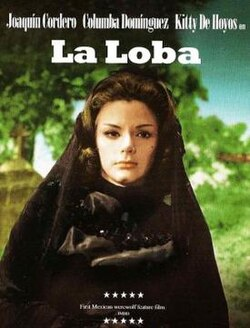
We have to wait for Mexican cinema to get with the woman werewolf programme before we see another one on screen: Clarissa Fernandez, played by Kitty de Hoyos in Mexican horror La Loba, The She-Wolf (1965).

Clarissa is a rich, attractive Mexican girl by day who is also a murderous werewolf by night, and falls for a doctor whom she sees for a cure. It turns out that the doctor, Dr Alejandro Bernstein, is also a werewolf, and they go on a love-filled killing spree together only to be killed by – wait for it – a specially trained, werewolf-killing dog. Beautiful.

We then get Libahunt/Werewolf (1969), directed by Estonian director Leida Laius, who co-wrote the script with Lembit Remmelgas. This is an adaptation of the 1912 play by August Kitzberg.
The play and film are both set in rural Estonia in the early 1800s, where three children are growing up together on a farm. The farmers’ son, Margus, and two orphan girls, Mari, who was adopted first, and Tiina, adopted later, after her mother was executed for witchcraft.
Tiina is the hot-blooded one, and Mari is the ‘good’ child. Margus falls for Tiina, but Mari is in love with him and has the approval of his parents. Jealous of Margus’s love for Tiina, Mari accuses her sister of being a werewolf. Tiina escapes the farm into the forest, and there’s some shamanistic elements, but by the end it’s clear that Mari might be telling the truth… with tragic consequences.
The play is not about werewolves as monsters – it’s a love triangle and a tragedy, with isolation and loss at its core. Estonian Gothic, if you like. This is the first time we get a werewolf film that is both directed and co-written by a woman!
Women Werewolves of the 1970s
Women get attacked by male werewolves a lot in the interim, and it’s often used as a symbol of man’s rapacious greed and sexual aggression. It’s also a good excuse to have women on screen with their clothes ripped to shreds, tits out, make-up on, and screaming. However, in the era of exploitation and Women’s Lib, this is all about to change.
Can a woman be a monster? Of course she can. She can be whatever she wants! It’s the 1970s, bitches! (Are there horrific and tragic consequences? Obviously! You can’t let them get away with it, you know!)
An American Grindhouse exploitation flick that blended the outlaw biker gang genre with the traditional horror film is the brilliantly named Werewolves on Wheels (1971). If you want to get deep with it (why not), it played with tensions surrounding subcultures, the nature of “freedom” and the rejection of Christocentric norms. Or it was a violent Grindhouse flick with a low budget that wanted to turn a bunch of bikers into werewolves. Whatever.

It’s about an outlaw biker gang who fall foul of some satanic monks worshipping the devil in the Arizona desert (as you do). The cult transform the lead biker’s girlfriend Helen, who infects her boyfriend. Helen is introduced as the doomed Bad Girl, fascinated by death – including her own. In the first few minutes, after we establish the gang are volatile, violent and all-round good chaps, she asks a tarot reader to read her cards and tell her how she dies: she is told she will die “in the tower, struck by lightning”.
The alpha couple then kill off their own gang until they are stopped and the gang return to the church for revenge on the cult – but stop when they see themselves in the cult procession. Of course you want to see it. Here’s the full film on YouTube (at the time of posting).

The Rats Are Coming! The Werewolves Are Here! (1972) dir. Andy Milligan features a whole family with a hairy secret, including the sister who tortures rats, so this one counts too.
One daughter, Diane, escaped the werewolf curse and went off to medical school, and has now returned with a husband in tow. Now she is back, she is needed to help their father work out why the curse skipped her. Mainly, however, it’s a fucked-up family drama set in England in the early 1900s, and features live animal torture.

Finally, we end the 1970s offerings of women werewolves with the Italian sexploitation sleazefest of a film, featuring lycanthropy as a psychological condition, La Lupa mannara/Werewolf Woman (1976).
TW for CSA and rape (repeated), suicide, and psychiatric committal. As this plot is fairly extreme, I’ve put it in an inline spoiler, so you can read it at your own discretion.
Plot of La Lupa Mannara/Werewolf Woman (1976)
The protagonist, Daniella Neseri (played by Annik Borel), a survivor of childhood rape, has nightmares about a werewolf ancestor who appears to her in waking visions. Under the delusion that she is a werewolf, she seduces and murders men by tearing their throats out with her teeth, including her own sister’s boyfriend.
She is committed to an asylum where she attacks and kills a (female) nymphomaniac who tries to seduce her, and escapes. She meets a compassionate stuntman with whom she falls in love, and this temporarily ‘cures’ her. However, the couple are attacked by a group of men and he is killed while she is raped. Daniella resumes her murderous rampage in revenge. She is eventually captured in the woods where she is found, nearly feral and dancing behind a wall of flame, by the authorities. She is re-committed while her father kills himself.
These films are both absolutely wild in their own ways, but we’ve got one fucked up morality tale about Bad Girls on Bikes, and one sexploitation psychodrama about rape trauma. I don’t know if I’m off piste here, but it feels like women get to be the victims of werewolves even when they are one, in different ways to the ways in which men are victims of the werewolf curse.
Deathmoon (1978) has a werewolf woman on the poster, but not in the actual film (?), but I was drawn in by that poster art. It’s a white American guy, cursed by an indigenous Hawaiian woman. The woman herself is not a werewolf as far as I know? I haven’t seen this one, though. Let me know if there is a werewolf woman so I can count her in!
So far, we’re on 16 women, and not all of them turned out to be actual werewolves! Don’t despair, though. Things pick up in the 1980s onwards. Make sure to follow this blog/subscribe to updates so you don’t miss a post!

Leave a Reply