
Introduction
I did my series on Werewolf Films by Decade, and got intrigued by how many werewolves were she-wolves, and how many werewolf films have been directed by women, or written by women.
For this, I thought I’d go back in time to the films featured in my posts and find out when she-wolves started to appear, and how they were represented when they did. I don’t know much about this at all, so this is just going to be a list rather than an essay.
Reading List
If you’d like to read more on this cultural phenomenon, try the volume of collected essays She-Wolf: A Cultural History of Female Werewolves ed. Hannah Priest.
You can also read:
- Beware the Full Moon: Female Werewolves and ‘that time of the month’ by Jazmina Cininas
- “Hairy Thuggish Women”: Female Werewolves, Gender, and the Hoped-for Monster by E. Clark (link is to a PDF download of the article)
- What Do You Think She’s Gonna Do With a Set of Real Claws?: Gender, Race, and Sexuality in Onscreen Portrayals of Women Werewolves, Ashleigh K. Williams, MA thesis from CUNY
- Chapter 8 of Monsters of Film, Fiction, and Fable: The Cultural Links Between Human and Inhuman (2018) – “CHAPTER EIGHT: THAT TIME OF THE MONTH: THE FEMALE WEREWOLF IN CINEMA” by C. O’Leary-Davidson
- Text that requires subscription access: Cininas, Jazmina. “One Wolf Girl Battles against All Mankind: The New Breed of Female Werewolf as Eco-Warrior in Contemporary Film and Fiction.” 2010. Philosophy Activism Nature, no. 7, PAN Partners, 2010, pp. 10–22, https://search.informit.org/doi/10.3316/informit.648465647341897.
This is not a comprehensive reading list either – it’s just a few ideas to get you started down your rabbit hole of choice.
Here we go with the films I found! I’ll reproduce some of my previous posts here, and we’ll see where we get to.
Werewolf Women 1910-1949
From what I can find (and I may have missed some!) there were about 20 werewolf films made from 1913-1949, including ones that used lycanthropy as a psychological condition rather than a physical one.
Here are the stats:
| All Werewolf Films 1910-1949 | Woman is a Werewolf/Believes she’s a a werewolf? | Directed/co-directed by Women | Written/co-written by Women |
| 20 | 3 | 0 | 2 |
Written/co-written by women:
- The Werewolf (1913) dir. Henry MacRae, adapted for screen by Ruth Ann Baldwin.
- The Undying Monster (1942) dir. John Brahm, co-written by Lillie Hayward and Michael Jacoby
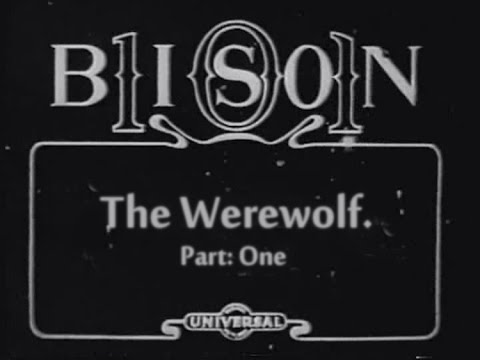
The very first motion picture to feature werewolves was The Werewolf (1913), and it had female werewolves. It was also adapted for the screen by a female scriptwriter. A strong start straight out of the gate! Unfortunately, the film itself is … problematic.
The Werewolf was also the world’s first werewolf film, directed by innovative Canadian silent cinema pioneer, Henry MacRae. It was scripted by Ruth Ann Baldwin, another pioneering screenwriter and director of the 1910s, and based on the short story The Werewolves (1898) by Henry Beaugrand. It is now a ‘lost’ film, thought to have been destroyed in a fire at Universal Studios in 1924.

The plot positions Native Americans as werewolves, something picked up in modern American werewolf fiction too, where blood quantum laws echo fictional preoccupations with purity of werewolf heritage. This is something addressed in one of the essays in Wolves, Werewolves and the Gothic (open access reviews here, here and here).
In this case, the plot relies on the Othering of the Native American characters and positioning them as adversaries of the White settlers driven by vengeance and dark magic.
The official synopsis of the film (which had a running time of 18 minutes) is as follows in case the link doesn’t work or isn’t accessible:
[expect dated/offensive language and dehumanising phrasing, and the plot features murderous white male entitlement and exoticisation/fetishisation of indiginous women.]
The play opens in pioneer days. Kee-On-Ee, an Indian maiden is married to Ezra Vance, a trail blazer. When her child is five years old, Kee-On-Ee is driven back to her tribe by Ezra’s brother, who scorns all squaws. Ezra is killed by an old enemy and Kee-On-Ee, thinking his failure to return to her to be indifference, brings up her child, Watuma, to hate all white men. When the child is grown, Clifford and a party of prospectors appear. Kee-On-Ee, now a hag, sees her way to be revenged. She sends her daughter to Clifford’s camp and he is driven nigh mad by her beauty. Clifford finds her in the arms of a young Indian. She taunts him. Enraged beyond control, Clifford shoots the [man] – [original is “buck”]. He flees to the mission. Watuma leads the enraged Indians against the Friars. When one of them raises a cross, Watuma slowly dissolves into a slinking wolf.
A hundred years later, Clifford, now reincarnated in the form of Jack Ford, a miner, receives a visit from his sweetheart, Margaret. Hunting with her he comes upon a wolf which he is unable to shoot. The wolf dissolves into the woman of old, and there appears before his puzzled eyes the scene where he slew the Brave. The “Wolf-woman” would caress him, but he throws her off. She returns again as the wolf and kills his sweetheart. Clifford’s punishment for the deed of past life is made complete at the death of the one he loved.
Official synopsis of The Werewolf (1913)
Kee-On-Ee and her daughter Watuma were both played by White actresses: Marie Walcamp (younger Kee-On-Ee) and Lule Warrington (older Kee-On-Ee) and Phyllis Gordon (Watuma). Ezra Vance was played by Clarence Burton.
With the advent of two World Wars and plenty of evidence of man’s savagery, not to mention the publication of some popular werewolf fiction, we had to wait until the 1940s for our next werewolf woman to make an appearance as far as I can tell.
The Cry of the Werewolf (1944) echoes The Werewolf (1913), but in this case the at-will transformation is enacted by a Romani princess who kills to protect the secret location of her ancestress’s tomb. Here, Native American ‘magic’ is swapped for Romani magic, as in The Wolf Man where Lawrence Talbot contracts lycanthropy from Bela, played by Bela Lugosi. So there is still an element of “it wouldn’t happen to a white woman”, but it does happen frequently to white men.
1946 saw the noir crime horror, She-Wolf of London, hit the screens, another offering from Universal Studios. Its UK title was the more Gothic and less sensational The Curse of the Allenbys. Phyllis Allenby believes she is a werewolf and has succumbed to ‘the curse of the Allenbys’, and is responsible for a series of frenzied attacks. However, it turns out that she is being manipulated into insanity by her conniving Aunt Martha for her own ends.
This film capitalises on the werewolf’s savagery – all victims of the ‘Wolf-Woman’ are found with their throats torn out – and positions the feminine as monstrous. However, it could also be interpreted as a cynical or realistic post-War recognition that women, as well as men, are capable of viciousness and animalistic savagery. This is reinforced by the reveal that the ‘werewolf’ is nothing but psychological trickery, and the murders were committed by a human being who knew what she was doing.
Here ends the Werewolf Women of the 1910s-1940s. Not many for a 40 year period, but we’re not hitting our stride yet. The werewolf really gets going in the popular imagination from the 1950s onwards. What I find really interesting about this series is that women never really get into werewolves on screen in terms of directing or writing the films… Obviously, there are many more as the number of films increase with each decade, but it seems to be a consistent trend that it’s not a topic you’ll find a lot of women writing about or making films about.
Women are, however, casting and producing werewolf films a lot, starting in these early decades and going forward. So they’re behind the scenes, but not usually behind the script or in the director’s chair. I’ll leave you to ponder why that is (I have no answers!), and take you through the films & the stats in the next few posts!
Leave a Reply