
Werewolf Women of the 2000s
Welcome back to the Werewolf Women sub-series. You can catch up with previous posts below.
READ: Part 1 – 1910s-1940s
READ: Part 2 – 1950s-1970s
READ: Part 3 – 1980s-1990s
There was a small explosion of werewolf women in this decade, so I’m going to group the films by theme. Some clear trends emerged: the films that used the werewolf to explore a range of teenage experiences from the perspective of a girl, rather than a boy; the softcore porn adult films, which tried to be both Creature Feature/Horror and erotica; and the straight-up Horror/Thriller attempts at making the werewolf a monster to be fought and defeated (but also, she’s a woman).
Also a disclaimer: I’m not aware of any trans women writers/directors credited under a male name on the lists I’ve looked at. If this applies to any writers/directors, please let me know so I can add them to the list. Conversely, I’m not aware of any directors/writers credited under a female name who have transitioned; if so, I can remove them. Also, as this post is very binary, I’m not aware of writers/directors who identify as non-binary, so if that’s the case, I can remove them from this list.
The stats are not looking much better, but we are seeing a slight uptick in women writing their own werewolf stories. Here they are:
| Werewolf Films 2000-2009 | Woman is a Werewolf/Believes she is a werewolf | Directed/Co-Directed by a Woman | Written/Co-Written by a Woman |
| 87* | 14 | 3 | 7 |
Running Totals:
Total number of werewolf films* 1910-1999: 285
Total werewolf films directed by a woman: 06
Total werewolf films written/co-written by women: 19
Total with a woman werewolf: 43
*That I can find, not necessarily comprehensive!
Films written/directed by women so far, which includes films with a background werewolf character, and films where the original story was written by a woman, even if it was adapted for the screen by a man:
- The Werewolf (1913) dir. Henry MacRae, adapted for screen by Ruth Ann Baldwin from the short story The Werewolves (1898) by Henry Beaugrand.
- The Undying Monster (1942) dir. John Brahm, co-written by Lillie Hayward and Michael Jacoby
- Libahunt/Werewolf (1969) dir. Leida Laius, co-written by Leida Laius and Lembit Remmelgas, based on the 1912 play of the same name by August Kitzberg.
- The Monster Club (1981) dir. Roy Ward Baker, co-written by Valerie Abraham and Edward Abraham, adapted from the stories of R. Chetwynd-Hayes. This is an anthology film with a werewolf featured.
- The Company of Wolves (1984) dir. Neil Jordan, adapted by Neil Jordan from the stories of Angela Carter (credited as a writer) and Charles Perrault. I’m including this as it’s an adaptation of a woman’s original fiction.
- The Dungeonmaster (1984) dirs. Rosemarie Turko, Peter Manoogian, David Allen, Steven Ford, Charles Band, John Carl Buechler, Ted Nicolaou, co-written by Rosemarie Turko, Jeffrey Byron, Peter Manoogian, Allen J. Actor, Charles Band, David Allen, John Carl Buechler, and Ted Nicolaou. This features a werewolf, but, like The Monster Club, is not a “werewolf film”. Nevertheless, Rosemarie Turko co-directed and co-wrote on this film, so it’s included.
- Leviatán/Monster Dog (1986) dir. Claudio Fragasso, co-written by Rossella Drudi and Claudio Fragasso.
- Red Riding Hood (1987) dir. Adam Brooks, written by Carole Lucia Satrina. This is the first time since 1913 that a woman has a single writer credit for a werewolf film/a film with a werewolf in it.
- The Nightmare Before Christmas (1993) dir. Henry Selick, co-written by Caroline Thompson and Michael McDowell, based on the original story by Tim Burton. A background character is a werewolf.
- Wilderness (1996) dir. Ben Bolt, co-written by Bernadette Davis, Andrew Davies, and Denis Danvers.
- Shopping for Fangs (1997) dirs. Justin Lin, Quentin Lee, co-written by Daniela Alvarado and both directors.
- The Curse (1999) directed and written by Jacqueline Garry. This is the first werewolf film I’ve found which was written solely by the female director. It’s the third time ever that a woman has a single writer credit for a werewolf movie.
- Ginger Snaps (2000) dir. John Fawcett, written by Karen Walton.
- Wolf Girl (2001) dir. Thom Fitzgerald, written by Lori Lansens.
- Ginger Snaps 2: Unleashed (2004) dir. Brett Sullivan, written by Megan Martin.
- Ginger Snaps Back: The Beginning (2004) dir. Grant Harvey, co-written by Christina Ray and Stephen Massicotte.
- Blood and Chocolate (2007) dir. Katja von Garnier, and adapted from the YA novel by Annette Curtis Klause. Adaptation by Ehren Kruger and Christopher Landon. This is included in the writing score as well, as it’s an adaptation of a book written by a woman.
- Twilight (2008) dir. Catherine Hardwicke, written by Melissa Rosenberg, based on the YA novel by Stephenie Meyer. So far the only film to be based on a book by a woman, directed by a woman, and adapted for screen by a woman (single credit).
- The Twilight Saga: New Moon (2009) dir. Chris Weitz, written by Melissa Rosenberg, based on the YA novel by Stephenie Meyer.
- War Wolves (2009) dir. Michael Worth, assistant directors Stephenie Galvan and Edward Beckford. I am counting assistant directors as co-directors for the purposes of the stats.
It’s worth noting that women are producing and casting loads of these films, so they are definitely having an impact on werewolf cinema, but they aren’t helming the films so much! It’s also worth noting that for some of these films, the information is incomplete.
As there are so many for this decade, I’m going to keep this post to the 2000s on their own and split out the 2010s (and what there is of the 2020s) into another post. The 2000s was not a decade that will be remembered for its taste, I suspect, so if you aren’t into crude humour or softcore porn, I guess a few of these won’t be for you. On the other hand, it also produced some iconic cult films! A mixed bag.
I’ve subdivided our werewolf women into categories this time, as we start seeing a lot more films playing with the different lanes of werewolf fiction.
Teen Wolf

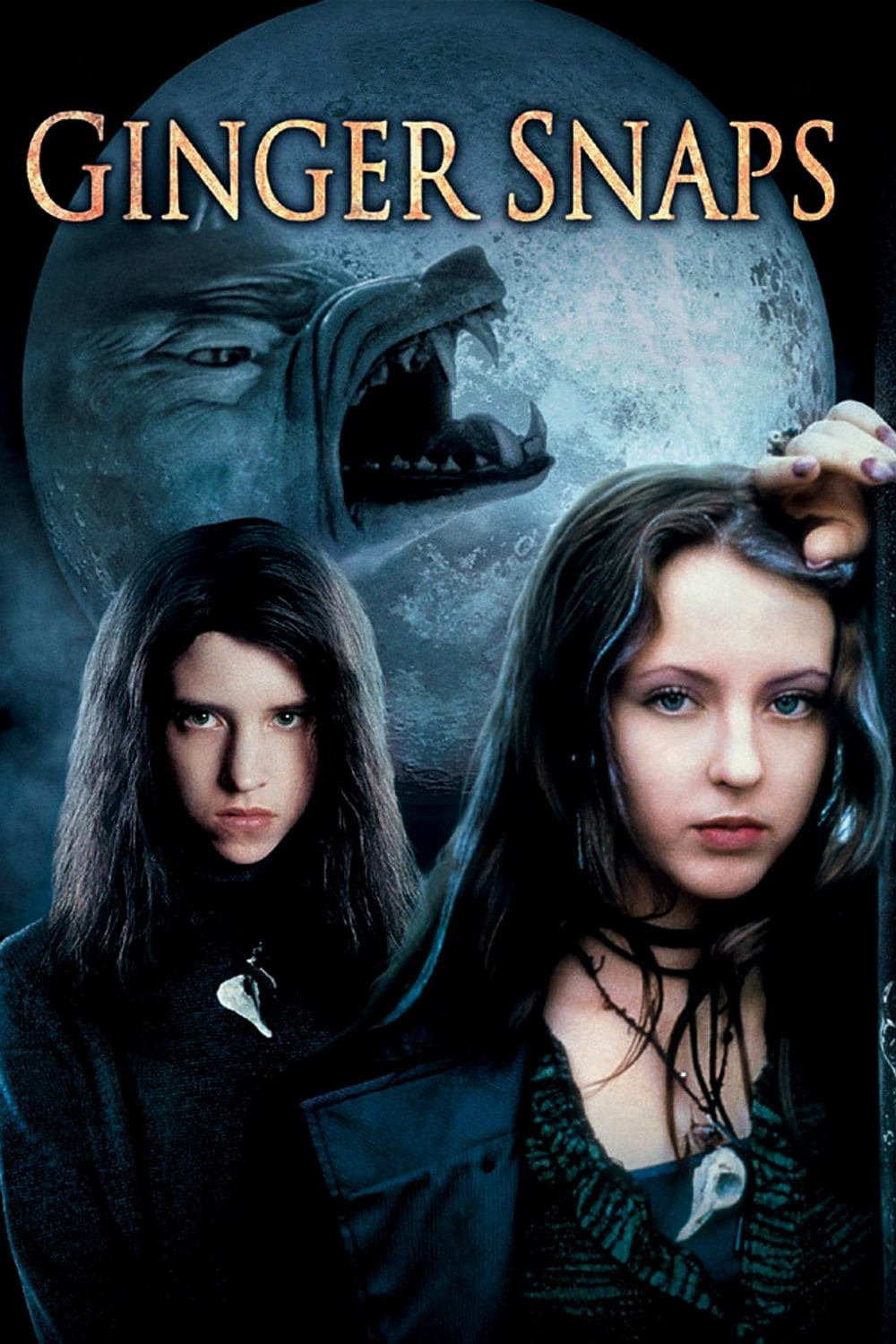
One of the most famous female werewolf films, Ginger Snaps (2000) is next, and like Garry’s The Curse, it connects werewolfism to the menstrual cycle, and in this case, to puberty and teenage hormonal changes. While it was directed by a man (John Fawcett), the story was co-conceived by Fawcett and Karen Walton, who wrote the script (single credit). I know a lot of people who love this film because it helped them grapple with their own transformations around this time, especially undiagnosed neurodivergent and/or queer people. I also know a few people who hate it for the same reasons others love it.
Following the success of Ginger Snaps, we got the sequel, Ginger Snaps 2: Unleashed (2004), written by Megan Martin. Brigitte has escaped the confines of Bailey Downs but she’s not alone. Another werewolf is tailing her closely and her sister’s spectre haunts her. An overdose of Monkshood – the poison that is keeping her transformation at bay – leads to her being incarcerated in a rehabilitation clinic for drug addicts where her only friend is an eccentric young girl by the name of Ghost. Not only is her transformation aligned to her own puberty and development, but also in therapy at the clinic her therapist explicitly connects Brigitte’s description of her condition to queerness, and her inability to come to terms with being a lesbian.
In the same year, we got the third film in the trilogy, Ginger Snaps Back: The Beginning (2004), in which Brigette and Ginger are themselves but if they lived in 19thC Canada instead, transposing the premise of the first film into a different time period and context. The sisters find themselves besieged by werewolves in a Trader’s Fort, and when Ginger is bitten, they can only rely on one another. This was co-written by Christina Ray with Stephen Massicotte. I would be interested to see this – I’m curious about whether different aspects of maturity and femininity are highlighted by the shift in setting, but it seems the plot is story-light and more action focused.
This trilogy was not the only werewolf coming-of-age tale to be written or adapted for screen by a woman.
Wolf Girl (2001) was written by Canadian novelist and screenwriter, Lori Lansens. This is the story of Tara Talbot (the surname a nod to the Talbot family in The Wolf Man), a teenage girl with hypertrichosis. She lives her life in Harley Dune’s Travelling Freak Show (with Tim Curry playing Harley Dune), on display as the ‘Terrifying Wolf Girl’, but underneath she is just a teenage girl who longs to be normal. She meets someone who can help her lose her extra body hair, but as she loses it, she becomes increasingly feral.
There is, however, some homophobia towards the lesbian bully, which I’m saddened but unsurprised by, and the other bully is revealed to have a micropenis, which is played for laughs. Queerness and genitalia differences aren’t ‘gotchas’, but that’s where things were often positioned in the early 00’s, and that’s what you get here.
Horror anthology Blood of the Werewolf (2001) gives us not one, but two werewolf girls. I’m putting it here as I’m not sure where it goes otherwise. Both segments centre on relationships and the consequences of lycanthropy.
In one of the three segments, a man goes back to his hometown to profess his love for a girl he knew there, but she is still under her grandmother’s control and hides a secret. If she loses her virginity, she’ll turn into a wolf. She also walks upright as a wolf, still wearing a dress, and does a bit of murder.
In segment two of three, there’s a lesbian couple, where one is a shapeshifter (with a wolf form) and the other wants to be turned. However, the transformation is not what she envisions, and she doesn’t quite get what she wants…
Blood and Chocolate (2007) is another werewolf romance where a teen girl falls in love with a man and has to choose between him and keeping her family secret. Hugh Dancy is the love interest, Aidan, and Agnes Bruckner plays Vivian, the secret werewolf who lives with her aunt in a chocolate shop. This plays on pack dynamics and the Alpha couple concept, and is loosely based on a Young Adult novel by English-American author, Annette Curtis Klause. Ehren Kruger and Christopher Landon adapted it for the screen. It was directed by the German filmmaker Katja von Garnier, which makes it another rare werewolf movie to be directed by a woman, and an even rarer one based on a book by a female novelist.
Softcore Erotica/Sexy Times with Women Werewolves
After the sexploitation films of the 1970s and the m/f softcore ’90s film The Strangers, we get back into softcore porn with indie low budget films like An Erotic Werewolf in London (2006), and Werewolf in a Women’s Prison (2006), both of which are F/F, directed and written by men, and balance the girl-on-girl action with actual werewolf action.
I’ve got to say here, I’ve only found a couple of gay werewolf films, but, possibly because of the male gaze/popularity of lesbian porn for straight men who like werewolf films, there are a lot of sapphic werewolves around. This is not a comment on quality, but just noting that the ratio of sapphic werewolves to gay werewolves remains overwhelmingly high.
For some m/f sex, if that’s what you’re into, try Animals (2008), where there’s a sort of a plot involving wolf transformations, and a possessive triangle between Nora, our she-wolf of the film, and two men, Jarrett, whom she bites, and Vic, who comes back to claim her. Jarrett realises he’s actually in love with Jane, and that’s the love that can save him. While there are a lot of sex scenes, I don’t think the way they’re shot is necessarily very good. It’s more about showing prolonged scenes of heterosexual sexuality in a way that ties to the themes of the film, but feel free to watch it and decide if it’s porn, Art, or Arty Porn, or just a load of sex scenes in a werewolf movie.
Women Werewolves in Horror
Moving on from sexy she-wolves banging, and teenagers struggling with identity and duality, we have Dog Soldiers (2002), where the werewolf women are, refreshingly, not all about their times of the month. This is more of a family situation, where the werewolves are a family living in the Scottish Highlands, who hunt together when the moon is full. It’s a good time overall, and it’s not trying to say anything, except that soldiers get royally shafted, I guess. I really like the shift here from sexy to crafty, back to The Howling style of community, but without the sex and with more action.
Wes Craven took the helm of Cursed (2005), starring Christina Ricci as Ellie, who gets mauled by a werewolf along with her brother Jake (Joshua Jackson). This takes the werewolf to the urban jungle of Los Angeles, and focuses on the siblings as they succumb to the curse, and learn how to end it – by killing the one who started it. It’s a horror film first and foremost, with Ellie’s changes taking place in tandem with her brother’s.
This horror edge continued with Skinwalkers (2006), where this appropriated Native American myth was altered to include wolf blood to bind the curse. Appropriation and the conflating of skinwalkers with werewolves is not its only problem. Yes, some are women, but I’m not really sure that does anything interesting.
Finally, we get indie film War Wolves (2009), which includes women in the ‘Werewolf Super-Soldier’ subgenre. They are, of course, evil. Our plucky protagonist must stop these aberrations, even though he himself has been infected with the werewolf virus. He and his special ops force are the good guys. I’m not sure about this messaging at all, but it did have a woman on the team as an Assistant Director; Stephenie Galvan. Otherwise, it was directed and written by Michael Worth, who also starred in it as Jake Gabriel, our hero.
So that’s the 2000s – a mixed bag of a decade, but with some clear trends emerging for the female werewolf!
Leave a Reply