
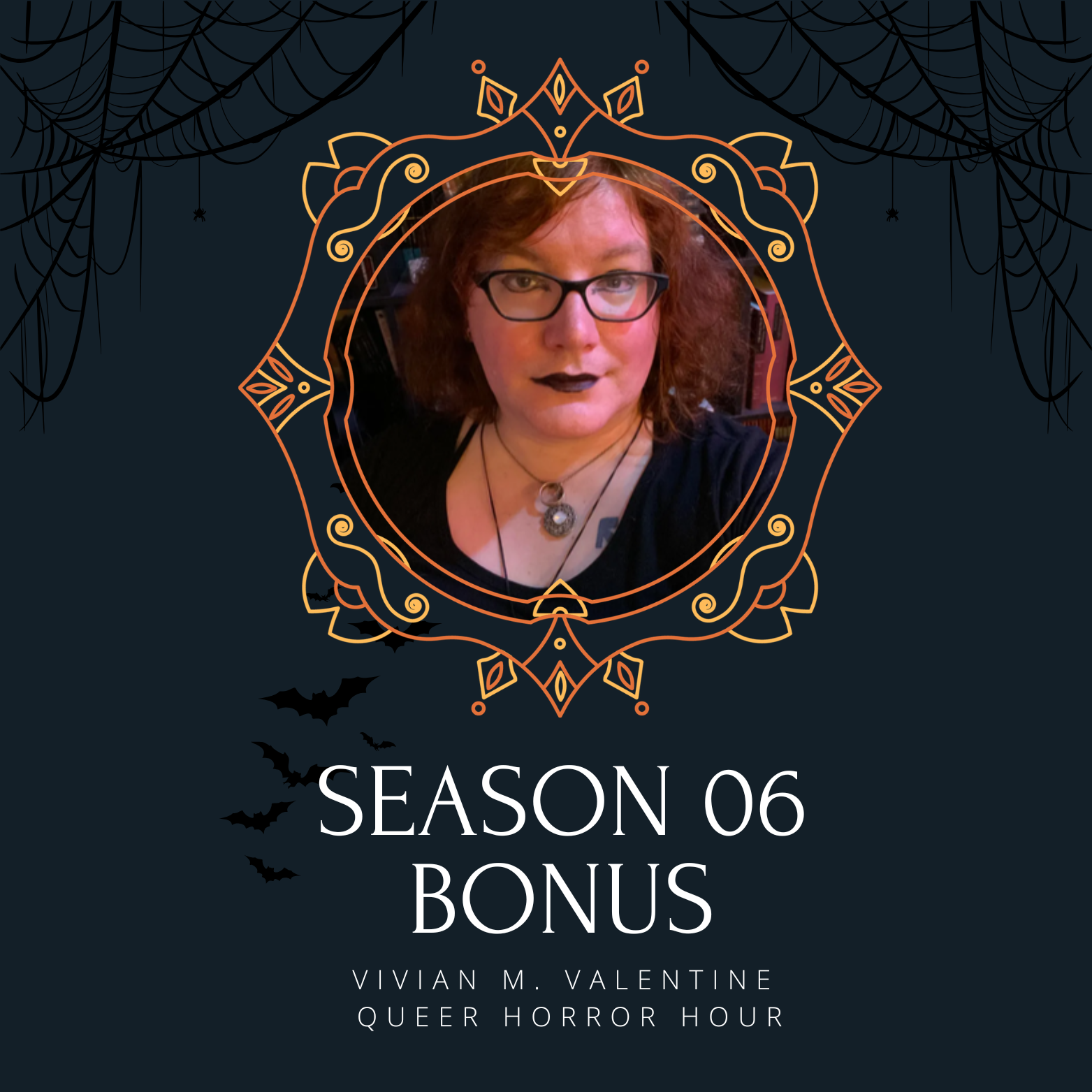

Vivian Moira Valentine (she/her) is a rad trans lady who loves monsters. She is the author of the Amelia Temple series and the Ravenkirk series, and her short fiction has appeared in a number of publications.
Book Links: mybook.to/AmeliaTemple
Author Spotlight: Vivian M. Valentine (2024)
BlueSky: @itsviviactually.bsky.social
Introduction
CMR: Hello and welcome back to Eldritch Girl and a very special bonus episode. I have with me Vivian Valentine, author of such works as the Amelia Temple series and the Ravenkirk series as well. Vivian, would you like to introduce yourself to us?
VMV: Of course. Hello, everyone. I’m Vivian Moira Valentine, your third favorite transsexual horror author. And I am just excited to be here.
CMR: We are here for the 100 Horror Movies in 90 Days Challenge, but we will be talking about your work as well. So let’s start with what have you been watching for the challenge?

Psycho (1960) dir. Alfred Hitchcock – 100 Movies In 92 Days Chat
VMV: So I feel incredibly basic for saying this, but I just… finally for the first time watched Psycho this morning.
CMR: Oh, that’s a good one!
VMV: And I regret to report it is in fact one of the films of all time. You know, it’s one of those movies any classic like that, it feels a little intimidating, because you want to be like… there’s a point you’re like, “Oh come on, it can’t possibly be that good”, right? Because for those of us who basically grown up from the ‘80s and beyond, we’re living in a post-Hitchcock film environment. Same as anybody who grew up in that period is like you know post Spielberg.
On the one hand none of it is super innovative from our perspective, right, because now we’ve seen a hundred reactions to what this movie does for the first time or at least for the first time that a popular audience saw it. But no, it is actually just an amazing film.
It’s funny because it’s one of those, like if you’re a horror nerd, right, who has grown up ‘70s and beyond, (I was born in 1980), you already know the plot of Psycho. The basic [plot], same way as if you were born after the ‘30s, you know the basic plot of the Universal Pictures’ Frankenstein and Dracula before you ever saw them. I imagine any horror nerds born from 2000 on already know Scream. You’re gonna read something, or see something, that’s gonna hit all the points ahead of time. There’s no spoilers going in. You know the twists. And even knowing that, just going in, it’s like, oh wow, this is incredible.
I kind of do wish I could go back in time and like be there in the theaters in 1960 and watch this not realizing that Vivian Leigh is a false protagonist, right, or the twist with Norman and his mother. But even knowing that, it’s like – wow. Watching all this unfold, and watching the way it’s put together, is so cool. It’s one of the reasons I wanted to watch it beyond just that… you know, “let’s watch a classic”.
It’s on hiatus now, but my wife and I have been doing a podcast on horror movies. Don’t go upstairs. The idea is we’re looking at film franchises. So the first season is Halloween. We’ve watched all 13 Halloween movies, one after the other. And we’re going through and watching the way it evolved over the years. So, I kind of wanted to go back and like, let’s look at what’s sort of the prototypical slasher, right? There were movies between Psycho and Halloween that also built the form, but really this is the one that kind of definitely inspires Halloween obviously, because he got Vivien Leigh’s daughter to be the main character of Halloween, and then reusing name Loomis, and stuff like that, and then here kind of codifies the tropes of this genre from the beginning, and everything else is a reaction to that.
It’s really neat to go back and watch.
CMR: I think that’s really cool as well, because also the script writer was Robert Bloch for Psycho. [Correction: Robert Bloch wrote the original story; the screenwriter was Joseph Stefano.]
And like that really ties in because Robert Bloch was such a well-known writer of weird tales, short stories, other novels. He wrote a lot of kind of that sort of thriller and the, yeah, sort of weird twists were kind of his thing. He seemed to really enjoy that. So, yeah. I really like Psycho as a film. But I also really like Psycho 2. I don’t know if you know of Psycho 2? Have you seen it?
VMV: I’m vaguely familiar with the franchise from that point. Yeah. I haven’t seen any of them yet. Except for actually, I did this backwards. This year we watched Bates Motel, the TV series.
CMR: Oh, yeah. The prequel?
VMV: It’s kind of it’s kind of a prequel, kind of a remake. It’s very weird, because it’s set in 2014, but yeah, it was kind of cool now having seen that, going back like oh wow, the TV series really was a love letter to this film, because they took so many elements from it.
CMR: I really loved the very sympathetic protagonist that Norman Bates kind of is in Psycho, even.
VMV: Yeah.
CMR: And I thought that was really nice because then in Psycho 2 you have him as a really sympathetic protagonist and in fact very much the victim of people who don’t want him released and don’t want him coming back into the neighborhood and trying to trigger his mental illness to get him taken away from the community. So you see him villainized, and the idea of rehabilitation and is that possible, and you know, what sort of things can lead to… you know, all that sort of thing. I don’t think that was ahead of its time, because I think that’s part of conversations that were happening at the time you know but it’s just really interesting.
VMV: I don’t know how familiar you are with what’s going on here [the USA], But it’s one of our big cases, but there’s a major case now in the news of a woman who is, well, this went to a mistrial of familicide. And the defence was, well, she was experiencing postpartum psychosis.
And so a lot of the question is, what is the appropriate response to this? Because like, okay, if she’s suffering a severe mental illness, then obviously we have to approach that with a degree of compassion. And also this was horrible. And it’s very clear that even today we don’t know, collectively as a society really, how to respond.
There’s a lot of contempt and disbelief for people who have suffered severe illnesses that lead to, and I want to make it clear, very rare cases.
Because it is… The unfortunate side effect of this movie and I don’t want to say it caused this reaction because it’s something that exists within the society (the stigma of these severe mental illnesses). Because like even the language we use to discuss it: “psycho”, “a psycho”, someone who’s psychotic. It’s like the overwhelming majority of people who experience psychosis are not violent.
CMR: No.
VMV: They don’t commit the [crimes], and instead they get stigmatized and they are frequently abused or just mistreated and clearly misunderstood. You’re familiar with the Locked Tomb series? So I won’t spoil too much, but in the second one, Harrow the Ninth, the main character, our viewpoint character, is experiencing psychosis. And the author, Tamsyn Muir herself, I mean, I apologize if I mangled her name pronunciation there, but she, herself experiences psychosis. She drew from her own experience to describe what Harrow was experiencing and got a lot of negative backlash from some readers. There’s this lack of compassion for what the fictional character experienced and that’s what the author has experienced. It’s like, what’s wrong with you?
CMR: Yeah. Yeah, I think it’s also touching on a thread from Johannes T. Evans on BlueSky about collective revenge against people who, in the context that he was writing in about collective revenge against… parents who are experiencing mental illness and can’t look after their children, and instead of being given the support, there’s this thirst for revenge against them for being “unfit”, as opposed to compassion for them for being ill. You know, and that kind of the nuanced conversation there. I thought that was a very interesting thread, and it kind of it just came to mind then.
VMV: I think that that sort of community backlash of revenge against people with mental illness for things that they do when they’re not particularly in their right mind is something that is a serious thing, but also I think films like Psycho inadvertently stoked that stereotype as well for people who saw the film. And then instead of taking away the subtleties of the film or of the characters, they saw – and perhaps people who didn’t even see the film at all, but they just knew, “Oh it’s a crazy man. He dresses up as his mum. And he kills people. That’s what they do.”
That’s even something addressed in the denouement. Because after we’ve had the big reveal of Norman’s mother and everything, we cut to we finally see Norman as Norma now we get to the you know the police department where he’s in custody and they bring in the psychiatrist to basically explain the plot to everyone and there’s no point where the sheriff is like are you laying the groundwork for an insanity defence? And it’s like okay, you know what the reaction is going to be, it’s like you’re trying to forestall it, I feel, and it’s not quite working. I did like with the psychiatrist; “I’m not laying the groundwork for anything. I’m just telling you what’s happening.”
CMR: Yeah, I find it really interesting how influential this film has been in so many different ways as well. And I think it’s one of those films that you feel like you’ve seen, like you said, you know the plot and you’ve probably seen a lot of clips, reaction, gifs, all that kind of stuff. And so… you know when you sit down to watch it for the first time, you can often have different kind of impressions of it before you’ve even gone into it.
So is there anything that specifically surprised you about the film when you watched it from beginning to end?
VMV: The biggest thing since my direct familiarity with the story came from the Bates Motel TV show is like I said, just seeing how many elements they carried or they were touching back on little things like, you know, making a big deal about, in the beginning, Norman’s taxidermy hobby, which is obviously just there to set up the reveal with his mother.
But one thing I thought was really kind of neat was there’s an ongoing plot thread through the first, at least the first couple of seasons that there’s a new highway exit being built. And that’s going to threaten the business that they just started, right? Because it opens with them having purchased the Bates Motel. And that’s directly from the movie where now 10 years later, he’s like, oh yeah, they moved the highway and now business is slow. And that’s kind of neat.
A lot of other things is just, you know, seeing the cinematography, right? Like there’s these incredible shots. And it’s like, here’s almost the best we’re doing with what technology we have. And it’s still so inventive. The bit where the private detective who’s the second kill is just falling backwards down the stairs and the camera is following him. I thought that was really impressive. And of course, there’s just a little bit of, you know, this was this is well after color film. It’s a little bit black and white. And part of that is, of course, because famously the blood is chocolate syrup because nothing else has the right consistency.
CMR: Yes the chocolate sauce fills the shower, yeah, it’s such a good scene.
VMV: It really is. Again, when you go in and you know the plot, it really is clever how well it the second act is hiding the big twist from you like you think okay we’ve got a false protagonist, and now we know, and now it’s Norman cleaning up after his crazy mother and it’s like nope, that’s not quite what’s happening… I would love to have someone see it without even knowing it’s a horror movie because you think it’s just gonna be a typical thriller about a woman who steals some money and the money is really so incidental to the plot.
CMR: Yes!
VMV: It motivates characters, but beyond that it’s just like, this is why the movie happens, this is why this is started, and after that, you kind of don’t care.
CMR: No, I think that’s it. Because it’s not really remembered that it starts off as the aftermath of a heist, or not heist, but she’s basically robbed her place of work hasn’t she? Yeah that’s why she’s running from…
VMV: Yeah, a real estate agent. A guy comes in buying a house in cash and she’s just come from a tryst with her boyfriend, which as an aside it’s funny how scandalous this is in 1960, because he’s not even married. They had to make Sam Loomis a married man in the TV show to suddenly make it scandalous, because you’re like well … you’re not married and he’s not married, what’s the problem? Oh right – 1960, that’s the problem. That’s why you’re sneaking around.
CMR: Yeah. And there’s loads of things like that, I think, that are very much like little time capsules in that film of ‘60s mores and norms. And I think that’s just so it’s so fun to watch those sorts of classic horror [films] because you really get into those sorts of conversations that were happening of, you know, “loose women” and women’s lib, and, like, the beginnings of women going out on their own and still being, you know, in a city even, because she’s not like she lives in the country.
VMV: No, she’s from Phoenix.
CMR: Right. Fascinating.
VMV: Speaking of the way the things you watch kind of break your brain, thanks to the What We Do in the Shadows TV series, I cannot see… the name Arizona and not immediately have Jackie Daytona break into my….. Now I want to see that crossover. Jackie Daytona is showing up and like they don’t care because they’re vampires but Guillermo has already realized this guy’s a murderer – “this guy’s a murderer!” “So what? So are we, stupid Gizmo!” that was a horrible Nadja and I apologize to everyone including the fictional country she’s from
CMR: Oh, Nadja. Yeah, I thought that would be amazing, though. Anyway, Arizon-iiaaa [said like Matt Berry playing Jackie Daytona/ Laszlo Cravensworth] aside…
VMV: This went to a weird place really quickly.
CMR: It did, yeah. But it was written by Robert Bloch, so it just invites weirdness, I think. But also, there’s so many different… retellings of Psycho already out there or people redoing it without realizing that they’re doing it, or doing it deliberately, you know, the little homage nods and things that I think one more won’t make a difference, just go for it I reckon.
VMV: Just how many times have you seen the shower scene, or a parody of the shower scene?
CMR: Yes, yeah.
VMV: Actually another … the soundtrack to Psycho is definitely one of those, like that bit when she thinks the highway patrolman is following her down the highway and the music is getting more intense and then he pulls off and she calms down. That was really good. But what I didn’t realize, again, until I watched it today, is that famous violin sting. You get that twice.
CMR: Oh, yes!
VMV: In the shower, and then when Norman goes to kill her sister after she’s found.
CMR: Yeah.
VMV: The mirroring.
CMR: yes!
VMV: If you look at Halloween even, in the first one you hear that the riff the entire way through it, right? It’s always there. But one of the most famous musical stings probably of the 20th century – they use it twice and it works so well.
CMR: Yeah, and it’s almost synonymous with the film, I think if you heard it you would know where it was from. I don’t know if I can play it on the podcast, but I think just, just go and find it guys.
VMV: You know what I mean? Find any TV show or cartoon of the past 50, 60 years. I’m sure they’ll have done a parody in one episode or another. It’s just so famous.
CMR: And like, I think maybe did Scream borrow it, or did a parody version of Scream borrow it?
VMV: I’m positive. If there’s not a scene in one of the Scary Movies I’ll eat my hat. I’m trying to think that because I rewatched Scream for the first time in years a few months ago. I don’t remember any direct references to it. Not the way it references slashers from the ‘80s.
CMR: Yeah no I’m trying to think and I don’t remember them doing that either. Yeah. It’s interesting though, isn’t it? Because I think, because a lot of slashers from the ‘80s referenced Psycho in some way as well, I think. Because everything kind of grew out of that. Because it’s one of the seminal proto-slashers. Even though not many people get killed. Like, there aren’t many.
VMV: There are two on-screen kills. Two on-screen kills. And strictly speaking, there’s not even a final girl.
CMR: No.
VMV: Because Marion’s sister, she gets saved by Loomis. Right? She doesn’t really even fight Norman. so yeah.
CMR: That’s still very much the damsel in distress trope isn’t it? Still very much like, there is a hero, the hero is coming to save you, everything’s going to be fine, and Loomis takes that position.
VMV: It reminds me in a lot of ways of Halloween 3. People are like, oh, it’s a secret gem. No, it’s not. You’re wrong. You’re lying to yourselves. It’s actually terrible. The main villain is fantastic at chewing scenery, and I love watching him, but it’s an awful movie. However, the neat thing of it, right, is the inciting incident in that one. The inciting incident in Halloween 3 is this one guy, he was a salesman or something, but he has found out about the plot with the masks, which involves…both computer circuitry and Stonehenge. Because why not?
CMR: Is this the one where they… It’s all about where they pronounce… It’s kind of Samhain [pron. Sow-in], but they pronounce it Sam-hain, don’t they? Throughout.
VMV: All the way through as well, now that I think about it. Yeah, there’s a whole plot about druids and crap, and it’s ridiculous. But the inciting incident is this guy gets killed at the start because he’s found out about the villain’s plot. And so… his daughter comes in to investigate. And she ends up like hooking up with the doctor who treated him. And somehow this doctor becomes the main character. It’s like, this movie should be about her. I don’t care about Temu Tom Selleck. And it’s the kind of same thing with Psycho.
It’s like, really, this should be about the Crane sister. But instead, Marion’s boyfriend is going to come in and kind of take over at the end.
CMR: Oh, God. It’s very much a contrast to the very sort of the weak heroes, the weak and weebly heroes of Gothic horror, I think. You can’t really have that, where they sort of turn up and immediately get stabbed or imprisoned or just like fall off a cliff or something. Like, sorry, love, you’re on your own. And Psycho is very much in that kind of more ‘60s American masculinity. kind of moment.
VMV: It’s weird because Loomis isn’t even like … he’s completely unaware that anything has happened to his secret girlfriend and like it picks up a week later after she’s dead he’s like, “I don’t know, I just see her like once every couple months when I come into town for business, what do you mean she’s dead and/or she’s missing and stole forty thousand dollars?? I don’t know anything about this the situation, I can’t keep track.”
CMR: “Shit, man, sorry sheriff”
VMV: “There’s also one in San Francisco and another in L .A.”
CMR: Exactly, yeah. And you can start to see why. Yeah, I mean, yeah, like, it’s a weird one, isn’t it? I do quite like that they reused Loomis’ name in Halloween.
VMV: I thought it would have to be [a call back to Psycho] because it’s such an unusual name, but at the same time, the characters really aren’t very similar.
CMR: No, not at all. I think it was like, if it’s anything, it’s just a little nod, isn’t it? To, oh, here is a really famous horror film.
VMV: We are making a film that we want, you know, people to remember. A little nod for the sickos. I do that all the time in my own. I think by the time, like every couple of chapters in Ravenkirk, there’s something that’s like, I need a name… So let me use one of my queer horror friends. Yeah, that works.
Horror Influences on Vivian M. Valentine’s Work

CMR: So I was going to say, what horror media has influenced your work? Because obviously you love horror films. We’ve been talking about a very classic film. Obviously you watch a lot for your podcast also. So do you find films coming into your work and that sort of thing, and other horror media? And if so, what media do you find most influential?
VMV: I would say the biggest, because I honestly don’t watch a whole lot of horror films because my wife is not as big of a horror fan as I am. I’ve been kind of like gradually over the course of 26 years bringing her into the fold, but she doesn’t. So when we were watching the Halloween movies, right, she’s like covering her face every time there’s a kill. I’m just looking like, how’d you do that? Yeah. Fascinating. The thick blood sprays… it’s amazing, where’s the hose? There’s something wrong with me, I don’t know.
CMR: That’s just an appreciation for craft though! That’s what that is!
VMV: I tell you what, when you watch these movies that predate CGI the way we have it now, you really do get an appreciation for the physical effects. I know now, that’s kind of like, the film snob, (especially for genre stuff), is always like, oh you should do a puppet, you should do a practical effect… You should just be an adult and go film it down in the quarry, and the thing is we’re right, number one, but you know like, I watched The Frighteners last week and that was like ’95, ’96, so we’re starting to really see now, you know, CGI, VFX. I’m like, you know what? It never had to be better than this.
CMR: No.
VMR: No, the bits where the ghost is poking through the wall don’t look very realistic. I don’t care. It was good enough.
CMR: Yeah.
VMV: All the ghosts were filmed on a green screen and they’re just being composited and I’m fine with that, actually.
CMR: I mean, we’ve come a long way from the ‘40s effects of filming a rippling mirror that’s actually water so that you can… you know, and then just tilting it, and putting Vaseline on the screen for the blurring, and like all of that kind of stuff, and do it literally smoke and mirrors, with so much stuff.
VMV: There’s something more clever about that honestly, yeah, and just and I don’t mean… Let me back up, let me back up, because I don’t want to demean another artist, I don’t want to knock the works of VFX artists, especially in an industry now that is like so reliant on them and also so exploitative, yes? Right, like when you look at a lot of the Disney stuff and you see how much oh they’re just like VFX-ing half the movie because it turns out actual production crew have a union and computer effects people don’t. So instead of props, we’re just going to have them hold a block of wood and composite and a gun afterward. So, I don’t want to act like I’m not… It’s really impressive what they do. It is fantastic. And honestly, the really great movies we’re seeing these days are like, they’re still using digital effects to improve the movie. It’s just not taking over the movie the way it does I think in that kind of late 2000s, 2010s, period. I don’t know there is to me there’s just something with more… I love the miniatures, and I love puppetry, and the practical effects, to me it just gives it more weight even though it doesn’t look as good or as real quote unquote, as good, or as realistic, as a really fantastic CGI, yeah. So I i would say a lot of that.
There was this brief, brief, brief trend of horror and horror-adjacent television in the mid to late 90s. Everyone trying to capture, you know, the X-Files wave.
So one of my favorite shows of the era was American Gothic. I almost forgot now. In fact, there’s a completely separate TV series that came out in, I think, the 2010s, [called] American Gothic. No connection whatsoever. I loved it [the original series in the 1990s]. It aired on CBS for, I think, at most two seasons. And that might be giving it more. And no one clearly believed in it because it was preempted constantly. But like that, yeah, to me that, I would say what I’m always going for is something that you could see in a mid-90s syndicated genre show. They didn’t really have a budget and they’re doing their best. And it still looks… so cool and atmospheric. I just really dig that.
CMR: Was that sort of your horror girly gothic awakening?
VMV: I always say honestly my very very real horror awakening would have been about first grade if there was this uh set of books, The Crestwood House Monster books or i think they were familiar the kids of that era, the orange monster books, because they’re the little thin hard covers with orange spines and trade dress and stuff and what they were, they were mostly dedicated to the Universal Pictures films, like you had one for each movie and a few extras like King Kong and Godzilla and just mad science in general. And they were like, um, each of them summarized the first movie. So you had one from Frankenstein, one from Dracula, one from Wolfman, etc.
And then subsequent chapters go into like, okay, here’s the rest of the series in less detail.
And then here are the inspirations for this, digging into like Bram Stoker’s research for the book Dracula.
And then like, and here are subsequent takes after, like here’s him going into Hammer Horror and I Was a Teenage Werewolf and stuff like that.
And my library had all like the whole set just about. So I would check them out every few months and read them all cover to cover again and again and again. And that really was my first love of monsters. And I think because at that young age kind of introduced me to not only to horror and to these classic horror stories, but also the idea was, okay, this is a version of Frankenstein. And there were a bunch before that and there were a bunch after. And that kind of got me into this mindset of, okay, there’s no Frankenstein story. There’s a bunch of them. There’s been a bunch of different takes on it, and there will be more in the future. And that’s super cool. There’s no, like, Boris Karloff did a fantastic job, but he was only in, I think, two of the Universal Pictures ones. And there were three other actors. And then there were the stage plays before, and then there were all the adaptations afterward.
CMR: Christopher Lee and Peter Cushing, I think, did one as well, didn’t they?
VMV: The Hammer version, yeah. So, yeah, that kind of was just how I approach it. It’s like, okay, these are story elements that have been combined and retold. readapted so many times over the generations and that just kind of like bubbled and percolated in my head until I started writing myself.
CMR: What was your favourite Gothic trope or favourite horror trope and have you used it in your work yet? That’s a hard one, sorry.
VMV: I love haunted houses. Or the place where there’s something wrong with it. And it’s not quite natural. There’s something inherently weird and you don’t know why. Like a feeling like the house itself is watching you. I love that. And yeah, I’ve used that. I was going to use it. I don’t think I used it in Amelia Temple. I was at first. The chapter where the girls visit the brownstone, originally it was going to be haunted by something. I ended up not using that idea, I went a different direction, but I used that in Shadows of Ravenkirk. The Ruthven’s home, Mooncroft Manor, has a guardian, that kind of is the house, is its body almost. I love The Crows because literally The Crows is a living house. I love that trope, it’s so fantastic.
CMR: Oh thank you. Yeah I also love it. I quite like this, so I would say that name Riven, but do you pronounce it Ruth-ven, because it’s American, I guess?
VMV: This is one of those where you’ve only ever seen it written, so I pronounce it Ruth-ven, but again, that’s just because that’s how I first saw it.
CMR: That’s how it’s spelled. Yeah, that’s exactly how it’s spelled. And that’s how you would think it’s pronounced. So, yeah, no, I’m just wondering if that was an American. I mean, we could say that that is the American version of that name, the American pronunciation versus the British.
VMV: Well, maybe, because I don’t know if this is ever actually going to come up in the books, but certainly the Ruthven family is claiming descent from the exiled Scottish clan and that may or may not be true, yeah.
CMR: Yeah, and I think because they would have pronounced it Riven if that was true so yeah I think that would be quite an interesting thing, that’s an interesting thing to play with.
VMV: I guess I like with names, I’ve said it so many times now I couldn’t I couldn’t pronounce it correctly ever.
CMR: No I wasn’t correcting you I was just curious.
VMV: I love that because of our descent from the UK is how many, especially here in the East Coast where I live, how many places there are that are just renamed English or British, but we mangled the pronunciation because we don’t know any better.
CMR: Well, no, I mean, it’s also because that could have been a pronunciation when somebody came over and named it, and that’s no longer the pronunciation back home, because language diverges and things change and that sort of thing yeah no no, sorry I was just – I really liked the Riven family – Ruthven family, sorry, I have to now remember to pronounce it the other way because if that’s what the author says, that’s canon, so yeah. I really like the Ruthven family and I really enjoyed the second one which is now out right?
VMV: It is now, it has been out as of this recording, it’s been out for a week.
CMR: Oh, amazing. Yes, I got an ARC of that. I loved it. So yes, I think people should definitely pick that up and read it.
VMV: They [the Ruthvens] just took over Book Two, as they do, without my intent. It’s just like, and it was funny, I’m like, okay, Nicodemus needs allies, so he’s going to call in the family. And I was like, well, now I have two dozen awful rich people.
CMR: Oh god it reminds me a little bit of season four of Slasher the TV show which is Flesh and Blood. Is that season four or five? I can’t remember… have you seen that show?
VMV: No! I’m gonna look into it now.
Queer Horror Media Discussion
CMR: Okay, do not watch it with your wife, I feel like she would not cope, but it’s very gory, it’s got a really good cast, and they tend to be in each season, so they’ll play different characters very much like American Horror Story has the same actors playing different people it’s also nice because some of the cast are quite queer openly queer so you’ve got that kind of… yeah you’ve got a bit of representation in it. It’s not about identity it’s not like people aren’t being killed because they’re gay or because they’re non-binary – everybody dies – but it’s like you know you just happen to have this representation within each series and I quite liked that.
VMV: That’s the nice thing when you’re doing queer horror is if you just like pack the book or pack the movie or whatever it is with a whole bunch of different queer people no one’s mad at you.
And also they yeah this gay person everyone’s gay everyone’s gay it’s fine it’s fine Also, the murderer is gay. Calm down. This trans person is horrible and this one’s nice. So you’re fine. Get off me.
CMR: But that’s the thing. I think you need space for queer people to be normal people and like messy people. People are not just like really nice and good representation. And I feel like that’s not, that doesn’t work in horror. And horror is a space for us to be as messy and like, yeah, to play in that.
VMV: Yeah it’s fascinating you know like going back to the Psycho of it all as a trans person it is not the easiest movie to watch.
CMR: No. Yeah it has a bit of Silence of the Lambs to it.
VMV: What’s fascinating with both Psycho and Silence of the Lambs; there’s a point where they kind of want to stop and say, now, granted that in 1960 the only language they use is transvestite, and there’s a point where that comes up in the denouement and the psychiatrist is like, no, no, no. Norman Bates isn’t a transvestite. He’s got two personalities and one of them is female. It’s different. And it’s like, what are you doing here? Are you trying, is this an attempt to, like, be respectful? Or… And Silas is like… Same thing with like, they almost try to go out of their way to say, no, no, no. Buffalo Bill’s not a tranny. We’re not doing that. And it’s like, I have so many complicated feelings and I’m going into my own personal shit. I can swear on this podcast, can’t I?
CMR: Oh, yeah.
VMV: Okay. I just wanted to make sure. I love that’s a question that everybody asks on every podcast that you have. Wait, hang on. Can I swear? Because I just did. I enjoy the movie, Silence of the Lambs. I enjoy the TV show Hannibal and stuff like that. But at the same time, it’s one of those things that kept me from coming out for a long time. Because that scene is a lot more detailed in the book. And it’s buying into this period of time where there was a very strong narrative about what a quote -unquote “true transsexual” was. Right? That was completely designed by cisgender psychologists and gatekeepers, right, and so they’re like they’re trying to say, no Buffalo Bill is just this complete, Jame Gumb is this completely separate thing here’s what a true transsexualism is looking like. Well I guess Thomas Harris did his research and none of that looks like me. I didn’t do any of this stuff, so i guess whatever I’m feeling must not be … yeah and I didn’t come out until my mid-30s.
CMR: Yeah. Yeah. I think I quite liked the show Clarice.
VMV: I saw that episode. Yeah, where they actually have Jen Richards come up and say… Yeah. Have that on -screen discussion.
CMR: Yeah, I really liked that. I really liked it. It was a trans actress as well. playing a trans woman in the film, in the show.
VMV: Let one of us talk to general audiences about the impact of this. Exactly.
CMR: Yeah. I thought that was really well done.
VMV: I know. I remember having that conversation. I think about half of my Bates Motel watch, I was just like, well, this is weird. Okay. Let me back up. I live posted on BlueSky about half of my Bates Motel watch, and there was some conversation between me and some other friends people like, okay so is Norman….. are we claiming Norman Bates? I don’t know.
Like in Psycho, you know Anthony Perkins was highly, heavily closeted, I think pretty much most of his life, right, I don’t remember if he ever actually came out, but definitely Psycho even though they’re presenting him as someone with an interest in women, that obviously due to his mother’s abuse he doesn’t have a healthy outlet for it, but you look at him it’s like … this dude’s gay.
Like oh yeah, this guy is, yeah, this is not a cisgender heterosexual man in some way, right?
Conversely, Bates Motel, the TV series, is almost aggressively unqueer. Right. They’re trying really hard. Freddie Highmore’s Norman Bates may be weird and squirrely and sensitive, but this is a straight boy. I’m like, but is he? There’s like one scene in the middle, early in the second season where like a guy is hitting on him and he’s just like very uncomfortable with it. And yet, and this was kind of my ongoing issue with the series. I’m like, from honestly the first episode, it’s just like, Norman Bates should not have hoes. And yet you keep giving him hoes. How does this, this guy should not have a romantic, how is he in a Betty Veronica situation for like part of season one? It’s weird.
And the funny thing is, and I did not realize this at the time, it came out the same year as Hannibal.
CMR: Oh, wow.
VMV: Which is the gayest show that does not have explicitly gay characters. Right? So you’ve got one prequel based off a prequel TV series inspired by a classic horror show about how much The main character wants to fuck and eat his rival. And you’ve got the other one where you’re just like, we’re just going to avoid this conversation entirely. Nope, this boy’s straight. Honest.
CMR: This happened with The Hitcher. So The Hitcher, the original film, is Rutger Hauer at his best in the ‘80s being a hitchhiker who kills everyone that picks him up in the car, and it’s a don’t pick up strange men because they’ll kill you type film, except that a young lad on his first road trip and his mother has told him don’t pick up strange men and then he sees this attractive older man on the side of the road in the rain and what does he do? He picks up the guy. And then you have these real close-ups on the face and his lips and the rain dripping off his lips and then his hand on his thigh and like just this very intimate thing of this guy sat next to him in the car and it’s an AIDS allegory isn’t it? And they’re explicitly referred to, like you know, a joking way, the cop says “oh yeah take your girlfriend” you know like that sort of thing um and it’s basically about how now anyone who comes into contact with this young man is going to die and anyone he has a relationship with including the only female love interest that they introduced, she’s doomed, because the Hitcher is chasing them because he wants his murder boyfriend back, basically. And yeah, so not to like ruin the whole film for everyone, but it has been out since like 1980 something, but…
VMV: You’ve had your chance, folks.
CMR: Yeah, you’ve had your chance. You’ve had your chance, folks. But no, no, I really recommend that one. I think it’s really interesting. But what they did in the remake, they remade it with Sean Bean as the Hitcher. should have been brilliant and Sean Bean’s up pretty much anything so like he would have done he would i reckon he would have he would have queered that up. Like if you’d asked him to. But they gave him a script that was so aggressively heterosexual that there’s something really fundamentally missing from the film, and it’s like they made the film thinking it was a cat and mouse thriller, yeah, and it is, but it doesn’t work as well. There isn’t this subtext going on. It’s the chemistry that makes it fun to watch.
VMV: Either you fundamentally misunderstood the original, or you are so terrified of the controversy, you’re going to run away. Right.
CMR: And like, Sean Bean would have done that.
VMV: Yeah, that’s why I love queer horror. Because like you said, it’s a messy genre. It’s a problematic genre. It is a genre that has, in many ways, presented us in a villainous light for that purpose again for that yeah look at the monsters they’re gonna get you! And then we can come back in, like okay let’s play with that.
Werewolf Chat
CMR: Yeah. I mean, the whole thing about a monster is that they are a warning and a sign to society of something, and it’s usually always something quite negative, but what happens when you are othered and you are made a monster? And if the only thing that you see yourself in are monsters and villains, then inevitably there’s going to be that reclamation of those monsters and villains as part of… you reclaiming and understanding your own identity, I think.
VMV: There’s a reason so many trans women and queer people in general are so into werewolves and vampires and everything. It’s like, okay, yeah.
CMR: Yeah. I think werewolves are especially interesting because they have this, I guess, they’re very isolated. They’re very lonely. It’s this very kind of singular existence but also like the duality and like the it’s fascinating…yeah.
VMV: There’s so little good quote -unquote werewolf media you know like we know what the vampire is we know what it represents and we can there’s like a hundred things you can point to and say this is the vampire this is what we’re playing with almost every werewolf story is different from the others.
CMR: And so many are men as well. There’s very few like – so I’ve been doing a sub -series on my blog about she -wolves in cinema so there are very few werewolves for the ladies – I’m sure you probably noticed this, that a lot of the werewolf films that we have are, oh no this man is so brooding and misunderstood. You know. And like, oh he has this terrible curse, and this horrible secret, and inevitably goes out and kills women, so it’s almost like that kind of merging with the serial killer.
VMV: There’s a lot of films like that, the metaphor is it’s male violence, yeah.
CMR: And in the modern day like so in it’s it’s been really explicit in the last few werewolf films that have come out. Robert Eggers’ film has not come out yet so I won’t comment on that because I don’t know what that’s about, but Kit Harington was in Beast Within which is explicitly about domestic violence and control and male control, and there’s a bit at the end and I was like ah yeah I see what you’ve done, and it’s seen through the eyes of his little daughter who’s doesn’t understand what is going on, but he is terrorizing his family, and she’s part of that.
Then there was Wolf Man where the dad is bitten and turns into a wolf very slowly as they’re locked in the cabin and then the daughter and the mum have to escape and that was recently like in the 2020s and there have been a few others as well where it’s very explicitly this kind of allegory for domestic violence, male violence and specifically gendered violence against women and usually their wives and daughters form that, and that seems to be what the trends are leaning into, I suppose now is like…
VMV: I’m not not interested in that.
CMR: No, I think there’s more interesting stuff to say. And like when you get the female werewolves, like so Ginger Snaps is obviously 2000, like the main one that everyone thinks about and is the kind of like, oh, girl hits puberty, girl becomes werewolf. And I’m like, I can relate to that. Yeah. There’s so much more than the bio-essentialist kind of werewolf, I suppose.
VMV: Yeah, there’s an issue of Swamp Thing, of all things. The middle of Alan Moore’s run, there’s this period where he’s like, it’s like a road trip. A road trip arc where Swampy is going from place to place in America and encountering different… there’s a vampire arc, there’s a haunted house, there’s a couple of others. And one of them explicitly is a werewolf story okay but here it’s a male writer, so there’s it’s… I’m not goingto say it almost does not become bitches be crazy, but that’s kind of what it is, where it’s female rage but specifically against male oppression, where it’s like there’s a menstruation metaphor but it’s more about more about this is how you treat us as if it’s disgusting and this is my reaction to that, okay? That I thought was very very good. That’s 85 and 86 yeah i’m not gonna say it’s perfect but definitely I think we’re looking into it definitely is a thread to follow.
CMR: Yeah I’m trying to think, like I’ve watched quite a bit. So The Curse 1999 is one where again it’s a menstruation metaphor and she thinks that she’s having massive like PMDD or something and then she ends up like everyone she dates dies around the full moon she just keeps eating them, and that was I think the first werewolf film that was about a female werewolf that was directed and written by a woman [without a man as co-credit], so I thought that was quite an interesting one. I haven’t seen it’s quite I think it’s more like a low budget one that didn’t get a lot of attention and certainly not as much as Ginger Snaps obviously, but there’s just so much in it.
There was one as well that was very psychological. It’s a triangle between a woman and her therapist and her boyfriend and she’s a werewolf and she’s living this very isolated lonely life and she’s talking to her therapist about it and she wants to have a romantic connection with this person that she’s met and she’s like, but how do I do that because of what I’m going through? How can I let him into this world? You know, it’s that sort of thing, and it’s a very slow, sad kind of, I think psychological … then there’s sex and you know and I think the therapist fancies her or like yeah so there’s this whole sort of um, sexy sad werewolf woman thing going on, and I think like there’s a lot more that I think to explore as well. Not just the werewolf as a savage creature, but the werewolf as a lonely creature, and how do you make connections, you know.
I always come back to the fact that being a werewolf is quite unnatural in a wolf state as well as a human state because a wolf needs community, it’s part of a pack, right, and the destruction that they wreak is not a wolf thing to do it’s a human thing to do.
VMV: That’s the interesting thing, because there’s so much media I think has been going from like the 90s on that kind of wants to focus on the idea of the community of werewolves and what does that look like.
CMR: Yes, True Blood, I think, comes to mind for that. I love that. And loads of other… I think Twilight, obviously. And you’ve got the Omegaverse as well.
VMV: Omegaverse is its own incredible… To me, I always go back to, as I think anyone who follows me on BlueSky knows, I’m a huge World of Darkness fan. So I really love… Werewolf the Apocalypse is problematic in many ways that revolve around it being written primarily by a white suburbanite leftish liberal audience in the ‘90s. So like there’s a lot of attempts to be respectful of human diversity, let’s bring in, let’s try to address say, the history of genocide in the U .S., by bringing in indigenous people, it’s bringing people from other cultures and other races in ways that they mean well and frequently devolve into stereotypes, which I just want to address that out front, right? Like it’s, there’s a lot to fix about that game if you want to play it today. But the part that I think is so relevant is we’re truly focusing on is the werewolf is about rage, yeah, the point where that’s you know a power stat in the game but or the idea… Okay, so what is what is the metaphor here?
It’s an incredibly Gen X game because all about like waking up one day in college and realizing oh wait my parents and my grandparents’ generation have just fucked up everything. And they’re going to fuck off and leave me holding the bag. You know, I’ve got to fix the environment and our history of colonialism and our history of racism. And what if it’s too late? And then you turn into a nine-foot killing machine about it. That’s brilliant, I suppose, yeah. It’s a fascinating… Because there’s a point where it’s like, okay… the joke is that it’s about being a furry eco-terrorist because the main thrust is that you know the cosmic force of entropy has gone nuts in no small part due to human activity and now it’s trying to destroy everything and that’s why the environment is collapsing in a way and it’s like yeah there’s this massive conglomerate that’s like run by the devil specifically to destroy the environment and sell demon-possessed products to people.
And in 1993, you’re like, this is a little over the top. And then in 2026, you’re like, oh, actually, no. No, it’s not. Actually, every massive corporation literally is Pentax. Okay, good on you guys. Ethan Scamp, my apologies. I was not familiar with your game. Yeah, so this is like… And all of this is naturally enraging to us. And that rage can be useful. And it can also go too far and create greater problems. And it’s kind of like the point is that all of the werewolf nation has is its anger and need to destroy, and that’s not enough.
Shadows Over Ravenkirk – Monster Mash
CMR: Speaking of feminine rage and… werewolves and she-wolves, you have one in Ravenkirk too. Did that come from your love of those games or did you just think, oh I need a werewolf, or like where did where did she come from and why did you decide that she would be a werewolf?
VMV: So a lot of it is and again you know, Ravenkirk is a It’s a monster mash. It is, I’d say definitely, yeah, that whole, the WAD is a big influence because the idea there’s a different game for every monster type and they all live in the same world and interact, but they don’t interact very well. And other things, you know, from… silly things like monster squad or that one Rick Moranis cartoon where he’s a teacher of a monster high in 1993 or whenever, it was um to the Monster High dolls now, like, we love matching these creatures up.
That’s what I wanted Ravenkirk to be. There’s so much stuff there that kind of defies easy categorization. So when I was creating it, and I knew, okay, we’ve got the Ruthven family and they’re very vampire coded or vampire adjacent, and that has kind of become, in the modern day, we definitely create that idea okay werewolves and vampires are natural enemies, because why not? um which is funny because when you look at you know the folklore that inspired them a lot of times there’s not an easy delineation between a vampire and a werewolf, and then when it comes down to it a lot of what we think of maybe ancient lore is some that The Wolf Man invented.
CMR: Yeah, because often a werewolf in life would be a vampire in death they’re literally the same person.
VMV: And then you know, vampires can turn into all kinds of animals. We’ve kind of come to that slight codification like okay so the Ruthvins are vampire-coded so we need an opposing clan of werewolves so what do what do they look like within this town, what’s their role? So immediately became like, okay well, what’s the Ruthvins are, uh they’re the modern aristocracy, they’re the Richie Riches, they’re the ones who run the town. Okay, so naturally, the opposition is, they’re more working class. Okay, but they’re not in control of the docks, because they already have some people who are handling that. Okay, so it’s a town, urban, versus rural thing. The Ruthvens control the town, the Talbots are the big people out in the ranches and the farms. And I wanted to, you know, it comes down to, honestly, they’re not that much different because if you control a good chunk of farmland, you must have some money behind you.
CMR: I also love the Talbot name as a nod to The Wolf Man. I was like, oh, Talbot!
VMV: And it’s right there in the beginning if you know your monsters.
CMR: Yeah, I do like that because I love all the Easter eggs in your books.
VMV: I can’t resist it.
CMR: Please read her books, everyone. Read Vivian’s books.
VMV: But yeah, and so I wanted that. That was kind of an easy, an easy thing, right. So what I wanted to, again, so much of what we think of as werewolf lore comes from 21st century or 20th century movies. So it’s like, okay, I don’t want to do the moon thing. Okay. We’ve done the moon thing with werewolves to death. There’s something, okay. What if they are kind of, more nature influenced, okay? Their patron is this kind of forest god. The werewolves are about rage, so it’s not necessarily … this isn’t you know, eco hippie green witch nature, this is nature red in tooth and claw, this is survival of the fittest, but again it’s not a wolf pack in harmony with this environment as part of an ecosystem where it’s maintaining a balance as food levels rise and fall. No, this is still human beings who are controlling nature, who are working the land for their benefit. So it’s not completely. Yeah. If that makes all make sense. I don’t know. Yeah.
I will suggest the Talbots are kind of the least fully baked of the various factions.
CMR: But we haven’t, yeah, we haven’t really seen much of them yet.
VMV: And you still won’t. Hannah gets a little more page time in the next couple books, and I’m going to develop them further, but right now it’s just like, sorry, these other groups have taken over the narrative and we’ve got to look into them.
CMR: I think this is just a really good series. I think it’s one that you could do spin -off novellas of from various points of view. Run this forever.
VMV: I’ve got a definite narrative that’s going to be about 10 -ish volumes, but I’m probably going to be playing Ravenkirk forever.
CMR: Great. Good. That’s what we want.
Wrap Up
CMR: I think we’re just about out of time. But to wrap up, can you let us know about anything that you’ve got coming out, anything that you would like people to check out that is out now of yours? And, yeah, maybe also tell us what your next horror film that you’re planning on watching will be or something on your watch list.
VMV: Yeah, so. Obviously, my backlist at this point is pretty long. I’ve got my fifth book just came out. So I have three books in the Amelia Temple series, which people seem to like. I’ve got two parts and counting in Shadows Over Ravenkirk.
Book three, I don’t have a release date for it yet, but that should be coming within the next year. And I’m just about to send the book four to my publisher. So fingers crossed we see that soon. Beyond that, the next thing I’m going to try, I think unfortunately it’s live theaters, but I’m really looking forward to seeing Teenage Sex and Death at Camp Miasma.
CMR: Oh yeah, I’ve heard of this one. I’ve heard good things. Yeah. I don’t know what mine’s going to be yet, but we will see. But that is a good one. Yeah. That’s been lovely to have you. Thank you so much for coming on the show.
VMV: I know, we’ve been trying to make this work for like, what, a year now?
CMR: Yeah, yeah, yeah. We did it!
VMV: Every couple of months we’re like, and we need to do our episode. We need to do our episode. We did it!
CMR: Well, it’s been absolutely lovely to have you on the show and I will see everyone next time for more bonus episodes and more main episodes where I just go through the next 10 films that I have watched for the challenge. Bye for now.

Leave a Reply