
A Scare A Day Reading Challenge

Romancing the Gothic founder and organiser, Dr Sam Hirst, is back for another month of A Scare A Day. Dr Hirst curates a daily reading list, and the challenge is to read the story or poem for that day and post your thoughts on social media using the tag #AScareADay (not #ScareADay – don’t forget the ‘A’ at the start like I always do!)
Last year, I posted a creative response to each story or poem featured in the challenge, and turned them into Season 05 of Eldritch Girl, where I talked about the stories and poems, and read my fiction/non-fiction piece inspired by the daily read.
This year, I’m pairing the challenge with #100HorrorMoviesIn92Days so I’m going to be suggesting a film pairing to go with the story/poem, the way I do for my book reviews over on Divination Hollow.
The challenge list is posted on RomancingTheGothic.com, and below. To thank Sam for this service, you can leave them a tip on Ko-Fi!
The “A Scare A Day” Daily Reading List 2026
October 1st – Joanna Baillie – Night Tales of Other Times – 1790 – Read it here
October 2nd – Nikolai Karamzin – The Island of Bornholm – 1794 – Read it here
October 3rd – Anne Bannerman – The Black Knight of the Water – 1802 – Read it here
October 4th – William Harrison Ainsworth – The Spectre Bride – 1821 – Read it here
October 5th – Charles Pigault-Lebrun – ‘The Unholy Compact Abjured’ – 1825 – Read it here
October 6th – Mary Elizabeth Braddon – ‘The Cold Embrace’ (1860) – Read it here
October 7th – Amelia Edwards – ‘In the Confessional’ (1871) – Read it here
October 8th – Elizabeth Stuart Phelps – ‘Since I Died’ (1873) – Read it here
October 9th – Mary Elizabeth Coleridge – ‘The Witch’ (1893) – Read it here
October 10th – Arthur Machen – ‘The Novel of the White Powder’ (1895) – Read it here
October 11th – Gertrude Atherton – ‘The Striding Place’ (1896) – Read it here
October 12th – Elia W. Peattie – ‘From the Loom of the Dead’ (1898) – Read it here
October 13th – Mrs Wilson Woodrow – ‘Secret Chambers’ (1909) – Read it here
October 14th – W W Jacobs – The Well (1911) – Read it here
October 15th – Violet Hunt – ‘The Prayer’ (1911) – Read it here
October 16th – Rabindranath Tagore – ‘The Lost Jewels’ or Monihara (1917) – Read it here
October 17th – Ellen Glasgow – ‘The Past’ (1920) – Read it here
October 18th – Mikhail Bulgakov – ‘The Red Crown’ (1922) – Read it here
October 19th – John Masefield – ‘The Haunted’ (1923) – Read it here
October 20th – Elsa Morante – The Secret game (1941) – Read it here
October 21st – Dorothy Quick – ‘After an Air Raid’ (1943) – Read it here
October 22nd – Mayra Montero – ‘Corinne, Amiable Girl’ (1991) – Read it here
October 23rd – Ahmed Khaled Tawfik – ‘The Wall’ – Read it here
October 24th – Mariana Enríquez – ‘The Little Angel’s Exhumation’ (2014) – Read it here
October 25th – A. C. Wise – ‘The Stories We Tell About Ghosts’ (2017) – Read it here
October 26th – Brandon O’Brien – ‘The Lagahoo Speaks For Itself’ (2017) – Read it here
October 27th – Darcie Little Badger – ‘Those Hitch-hiking Kids’ (2023) – Read it here
October 28th – Tyler Sookralli – ‘The Devil Wears Skin’ (2024) – Read it here
October 29th – Eleanna Castroianni – ‘They Return’ (2025) – Read it here
October 30th – Ash Vale – ‘consumed’ (2026) – Read it here
October 31st – Quincy Lee – ‘The Dark Follows Me’ (2026) – Read it here
A Scare A Day: Day 16
Day 16: “The Lost Jewels or Monihara” by Rabindranath Tagore (Pearson’s translation, 1917). Read it here.
This is a story about identity, materialism, and tragedy. I think it’s about the corrosive power of wealth-seeking, but also a deeply sad story about two people who fundamentally misunderstand one another and how to reach each other.
I think it’s also about the struggles and scars of Indian national identity, and what it means to be a ‘modern’ person in India at that time, whose modernity is it, and what are the pitfalls and penalties of living in this ‘modern’ world?
A Scare A Day: Plot Summary
A schoolmaster meets a stranger sitting by the river, and tells him the strange story of the haunted place the stranger is curious about.
A gentle man – a ‘modernised Bengali’, caught between two worlds that don’t have a place for him, marries a woman called Mani, and showers her with jewels, rather than children. These become statements of her identity, to the point that when he asks her for them to stave off a temporary financial crisis, she refuses, seeing this request as an existential threat, and runs away.
He raises the money some other way, and comes back successful – only to find his wife has disappeared with her jewellery box (unbeknownst to him, she has been murdered for them by an unscrupulous relative, Modhu, who was helping her run away to her father’s house). Devastated, he begins to experience ghostly encounters with Mani, and then sees a skeleton draped in jewellery descending into the river. He follows, and is drowned.
The stranger listens to this tale, then reveals he is the man in the tale, and the schoolmaster has been relating this story to a ghost.
A Scare A Day: Film Pairing

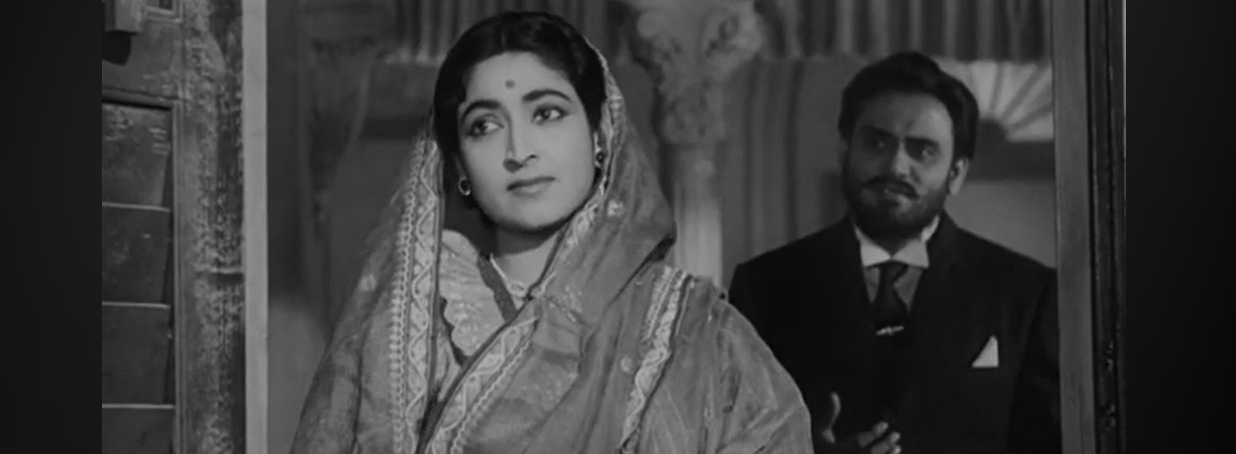
I would be remiss if I did not recommend the Bengali adaptation, মনিহার/The Lost Jewels (1961) dir. Satyajit Ray, written by Satyajit Ray and based on the original story by Rabindranath Tagore.
I like how sympathetic Mani is in this, especially where she’s refusing to go back to Kolkata for everyone to see she’s childless. She is obviously afraid of her brother, and is trapped in her situation. Her jewels become like her children; the only symbol of status or self-worth she possesses. You can see why any suggestion of giving them up is untenable to her. You can see her start to panic as she brings it up herself, and her desperation. It’s really sad. The schoolteacher blames the husband for not making Mani go with him to Kolkata, saying that he should have noticed this attachment to her jewels was addiction, or a sign of mental illness.
I discovered this one on YouTube with limited English subs (turn on closed captions, and in settings, select Bangla >> English. The result is pretty poor, but you don’t need to understand Bengali to get what’s going on. They are ok for basics, and if you’ve read the story, you’ll know where you are).
There is a more recent TV movie version, part of The Stories of Rabindranath Tagore series made in 2015.
A very different take on jewels/treasure becoming an identity, and a corrupting influence, is तुम्बाड/Tumbbad (2018) dir. Rahi Anil Barve, written by Mitesh Shah, Anand Gandhi, Rahi Anil Barve, and Adesh Prasad. Find out where to stream this title on JustWatch.




Leave a Reply