

Jorah Kai (he/him) is an author, journalist, musician, and existential detective.
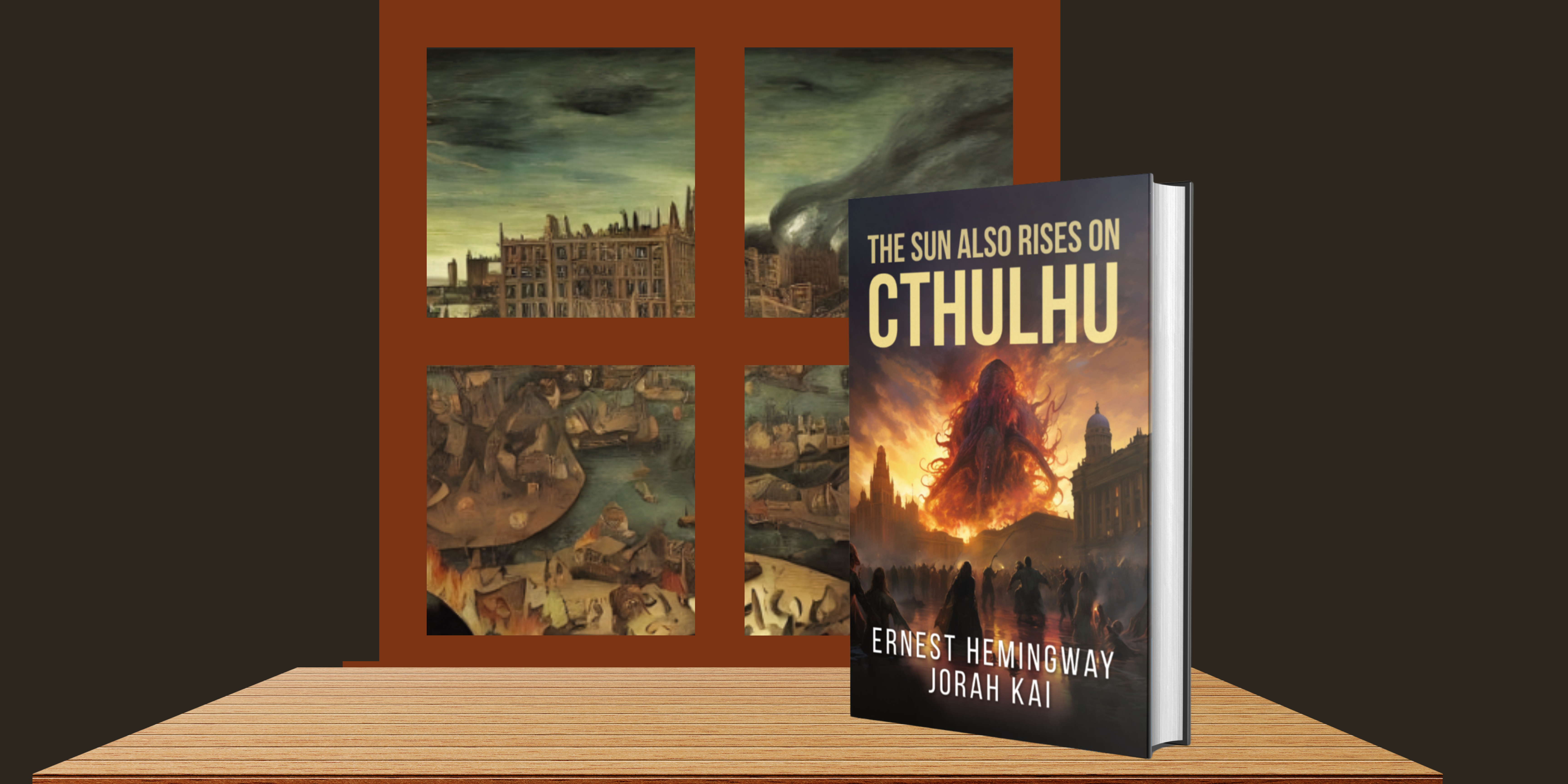
His latest book, The Sun Also Rises on Cthulhu, reimagines Hemingway’s classic with a Lovecraftian twist, fusing literary fiction with cosmic horror.
He is also the author of Amos the Amazing, a solarpunk fantasy that became an international bestseller.
When not writing, he’s pondering the abyss, teaching, or trying to make sense of the void.
Author Links:
Website: jorahkai.com
Instagram: @JorahKai
Threads: @JorahKai
Facebook: @JorahKaiAuthor
Bluesky: @jorahkai.bsky.social

Interior Illustrations by 王凯 and 王本 (Wang Kai and Wang Ben)
Mirko Fermani – Book Layout and Design
Welcome Jorah, let’s chat about your work, The Sun Also Rises On Cthulhu, which is a cosmic horror version of Ernest Hemingway’s 1926 classic, The Sun Also Rises. What’s your relationship with Hemingway’s book, first of all, and how did this develop into your novel?
Hemingway’s The Sun Also Rises is a novel I’ve admired for years—a brilliant, melancholic meditation on the Lost Generation, disillusionment, and human frailty.
I’ve been teaching Hemingway for a while now, especially The Old Man and the Sea, and there’s something about his raw, stripped-down style that just seeps into your bones when you spend enough time with it.
This project actually started as a creative writing exercise—not so different from what another famous student of Hemingway, Hunter S. Thompson, used to do. Thompson would type out entire Hemingway novels word for word, just to feel the power of his prose flow through him like an electric current. I wanted to do something similar—but in my own way. I started rewriting parts of The Sun Also Rises, playing with it, experimenting, seeing what happened when I pushed Hemingway’s existential crisis into cosmic horror territory. Somewhere along the way, the story took on a life of its own.
The idea of Pride and Prejudice and Zombies really inspired me back in college—the idea that you could take a classic, infuse it with something wildly different, and create a fusion that’s both familiar and utterly new. So that’s how The Sun Also Rises on Cthulhu was born. It’s a big, beautiful mess—a collision of literary fiction and cosmic horror, of Hemingway’s stoic realism and Lovecraft’s boundless dread.
Thematically, Hemingway and Lovecraft were contemporaries—both writing in the wake of WWI, both exploring existential despair and the limits of human understanding. So, why not take that raw emotional intensity and crank the horror to eleven?
At its heart, it’s the same story—the same wounded, wandering souls, still searching for meaning, still drinking and fighting and pretending not to care. But now, instead of just struggling against their own inner void, they’re pitted against an ancient, incomprehensible force that actually wants to consume them. And somehow? That felt right.

Mirko Fermani – Book Layout and Design
Jan Dornig – Cover Art
What were the main challenges in creating this fusion of your cosmic horror vision and Hemingway’s original prose?
The hardest part of working with Hemingway was the fact he’s been dead half a century.
Once we navigated past that, the rest was history….Merging Hemingway’s lean, direct prose with Lovecraft’s purple, gothic horror was like blending whiskey with absinthe—it had to be done carefully, with intent, and just the right amount of madness.
Hemingway’s style is famously spare, whereas cosmic horror thrives on the unknowable, the indescribable.
The trick was weaving that creeping dread into the spaces Hemingway left open.
His characters drink, flirt, fight bulls—meanwhile, the shadows stretch too long, the sea whispers of something ancient, and reality itself begins to warp.
Another challenge? Respecting Hemingway’s tone while making it my own. I didn’t want to simply mash them together—I wanted to create something that felt natural and inevitable, as if the horror had been lurking beneath the surface of the original all along.

How does this novel fit into your solarpunk ethos (and can you explain a little about solarpunk for those unfamiliar with the term)?
Solarpunk is about hope, resilience, and reimagining the future—a counterpoint to dystopian fiction. It envisions a world where technology, nature, and humanity coexist harmoniously, rather than spiraling into collapse.
So how does cosmic horror fit in? Well—what if the things in the dark don’t want us to evolve? What if something ancient has been orchestrating our self-destruction for millennia?
The Sun Also Rises on Cthulhu flirts with that idea—the possibility that our failures, our inability to rise above greed and war, aren’t entirely our own. And yet, despite the horror, there’s always a spark of resistance. That’s where the solarpunk ethos lingers—a belief that even in the face of cosmic insignificance, we can choose to fight for meaning.

How did you set about navigating the dynamics of the main characters and expanding on the themes – can you tell us about your writing process?
The characters in The Sun Also Rises are already wrestling with existential despair, broken relationships, and a world they no longer understand. In my version, they’re still the same lost souls—but now, the universe itself is hunting them.
My process started with deep immersion—I reread Hemingway, absorbed his rhythms, let the characters breathe. Then I started injecting horror organically—subtle at first. A wrongness in the air. A phrase that repeats like a curse. The way the ocean feels deeper than it should. I let the horror creep in slowly, until suddenly, they’re in too deep. Because that’s how cosmic horror works—you don’t realize you’re doomed until it’s far too late.
But beyond Hemingway’s Paris, I had another advantage—I lived it. I was a DJ and music producer for 25 years. I’ve played thousands of bars, stayed up to see the sun rise, had my heart ripped out of my chest, danced on, and been eaten for breakfast more times than I care to remember.
The nights blend into mornings, the drinks flow, the music pulses, and at some point, you start wondering if you’re still awake or if you’re already dreaming. So getting into the spirit of Hemingway’s Paris was as easy as cracking open a bottle of fine whiskey.
I knew the madness, the desperate highs and crushing lows, the neon-lit longing of people trying to forget something they can’t name. But the madness—**the void, the mirror—**that took real pain. That took sacrifice. Because you can’t just write cosmic horror—you have to feel it. You have to stare into the abyss until it stares back. Until you realize that maybe it always was. I did it for art. I hope it was worth it.

Book Design and Layout by Mirko Fermani
You’ve written a mix of cosmic horror, solarpunk, and nonfiction; how do you feel this latest book fits in with your work in terms of its themes, style and content, or do you feel that this is new territory for you?
It’s both a natural evolution and a bold leap into madness. Amos the Amazing is solar-fantasy, full of wonder and mythic adventure. The Sun Also Rises on Cthulhu is existential horror, full of dread and broken souls. And yet, they both wrestle with the same big questions:
What does it mean to be human?
How do we fight despair?
Where does free will end and fate begin?
This novel also ties into my larger “Mirrorverse” quadrilogy, which explores the tension between hope and horror, the seen and unseen, the known and unknowable. So, in a way, it’s a new experiment—but also another piece of a much larger puzzle.

What has been your favourite reader responses to your work so far – either your latest novel, or to your work in general?
I love hearing that my books stick with people—that the words linger, haunt them, make them question things.
One of my favorite responses was from a reader who said, “Reading The Sun Also Rises on Cthulhu felt like drowning in moonlight—beautiful, terrifying, and impossible to look away from.”
That’s exactly the feeling I wanted to create.
Another? A student who read Amos the Amazing and said it made them believe in magic again. That’s the dream, isn’t it?
I’m now teaching a new book – The Hunger Beyond – to 1000 students in my cyberpunk supercity of Chongqing, and a student came to me to tell me it was much too short and they want more of it. You’ve got to love that.
Ultimately, my goal isn’t just to entertain—it’s to leave an imprint. If my words echo in someone’s mind long after they’ve closed the book, then I’ve done what I set out to do.
Like This? Try These:

Sandra Bond’s reimagining of Jerome K. Jerome’s classic, Three Men in a Boat, turned Jules Verne-esque Sci-Fi, Three Men in Orbit.
Sci-Fi Comedy.
Sandra’s Author Spotlight will be featured on cmrosens.com on 18 July 2025.
sandra-bond.com/three-men-in-orbit – find out more.


Leave a Reply