
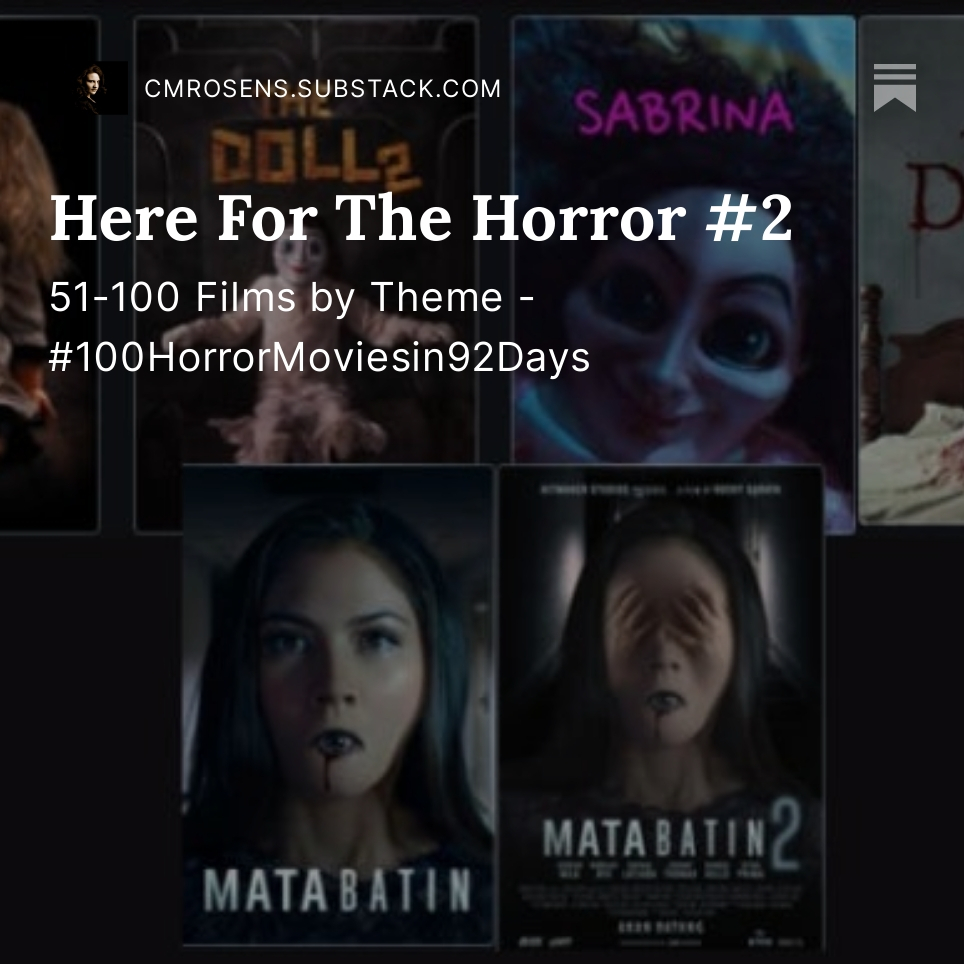
Part 2! The post on the first 50 films for my challenge can be read here, and this post covers films 51-100. To nobody’s surprise, there is… more family horror on this list! And more Welsh Horror! Wow. Who could have foreseen. I’ve made these themes deliberately broad so that it fits all the films in!
- Family Horror (Films 51-65)
- Welsh Horror (Films 66-68)
- Trauma/Existential Dread (Films 69-86)
- Supernatural/Possession (Films 87-100)
Family/Generational Horror
- POLTERGEIST II: THE OTHER SIDE (1986) dir. Brian Gibson – This carries on almost immediately from where Poltergeist left off, and this time, the spirit of a deceased cult leader is after the angelic little Carol Anne, the focus of activity in the first film. There are some interesting developments in the family dynamics and especially with exploring the father’s insecurities and how he overcomes them as the cult leader seeks to exploit them. There’s also the angelic child ideal and her position in the family relative to her siblings, and how children handle death (of their grandmother).

- THE DOLL (2016) dir. Rocky Soraya – Indonesian horror franchise. This is a choppy film and not the best one of the series. Some kids find a doll at their house which is clearly cursed, and call in Laras, an exorcist, to get rid of it. She then tells the story of the doll, and the secrets it uncovers in the original couple who end up with it.
- THE DOLL 2 (2017) dir. Rocky Soraya – A different doll this time, the ‘Sabrina’ doll, and a different family. This time, after the death of her daughter, a woman calls the girl’s spirit into her favourite doll, but the girl is now vengeful and determined to uncover all the family secrets that led to her death. We see the return of Laras the exorcist, and the impact of this case on her own family.
- SABRINA (2018) dir. Rocky Soraya – We see some overlap with characters from The Doll 2, but this time, the affected doll is a new version of ‘Sabrina’ and the child is the daughter of the single dad who designed her. The girl tries to summon her mother’s spirit to inhabit the doll, but gets… something else. Again – there is the uncovering of family secrets and the tensions that show there’s no such thing as a happy family.
- THE DOLL 3 (2022) dir. Rocky Soraya – When her troubled little brother kills himself after the death of their parents in an accident, a woman calls his spirit into his favourite doll, but with murderous results. Again, some terrible truths come out regarding the new life that she is trying to build for herself.
The Doll films are basically the same plot over and over, but with different dynamics, secrets and characters each time. Each film is as much about the doll/child via the doll exposing the cracks in the adults’ world, the lies that the adult relationships are built on, and wreaking some kind of punishment with relentless childish logic and unmitigated fury. These films all belong to the ‘Trauma’ theme section as well as the ‘Family’ section, but I’ve put them here as the central concern in each is the relationship between people trying to be a form of family to one another, and what happens when this goes wrong.
- MATA BATIN/The Third Eye (2017) dir. Rocky Soroya – A different franchise to the Doll films but the same premise. This one focuses on a relationship between two sisters, Alia and Abel, and the family of vengeful ghosts in their home who need release.
- MATA BATIN 2/The Third Eye 2 (2019) dir. Rocky Soroya – Alia now works at an orphanage, and there are more vengeful spirits plaguing the children. Again, this focuses on child-rage (another young girl), and the destructive nature of that rage, despite strong justification. It’s also about ties that bind family members across life and death.
The Third Eye films in substance are more of the same formula for Soroya, who also writes or co-writes the films. They explore different characters and character dynamics, but the core is always a micro-study of a family, the cracks that adults conceal, and the way these cracks are brought to light by the family’s children while dragging the same children into the darkness. This darkness is represented in MATA BATIN 2 as a hellscape (in an Indonesian context: not the Christian concept of ‘Hell’ and the afterlife, but recognisable to those with that religious background). it’s represented in the Doll films by the evil dolls, which are very much in this world, and causing havoc and destruction that the children could not do in life, acting out rage fantasies and revenge fantasies in brutal, bloody fashion, even on other children who have done nothing except draw the spirits’ jealousy for various child-logic reasons.
If you find this interesting, these films are worth a watch through this lens alone. There are other things going on in the films too, but this was the lens I was watching through and the themes I was focusing on in my watch through.
If you are interested in this kind of horror, then another recommendation for family trauma and grief navigation is HARUM MALAM / Blood Flower (2022), dir. Dain Said. It’s a Malaysian horror with possessed plants from Sumatra, more [Islamic] exorcisms, and the uncovering of dark secrets within a broken family.

- HATCHING (2022) dir. Hanna Bergholm – Keeping with the theme of child-rage, this film is a Finnish supernatural monster horror that’s also an allegory for tweenage self-discovery and transition from pliable, submissive, easily moulded child to a person with her own desires and goals. This is very much in the same vein as Ginger Snaps, the Canadian werewolf puberty allegory, except in this case the creature is represented as something external to Tinja, the main character, and something she has real trouble reconciling with. The struggle between these two sides of Trinja plays out within the context of the stifling family environment and toxic relationship with her mother, who simultaneously treats Trinja like a grown-up and confidante while at the same time trying to keep her repressed and submissive. Something has to give, and there is too much inside Trinja to be contained in one small body… so she hatches Alli.
- UMMA (2022) dir. Iris K. Shim – Korean-American horror that looks at diaspora experience and the uneasy shift from one culture to another, and is as much about that as it is about the generational trauma passed down from mother to daughter across three generations. There’s a lot of trauma in this film so it also belongs in the ‘Trauma’ theme section, but that is depicted as family-related, although the grandmother/mother’s trauma was from moving from Korea to the USA. There’s also the rift between the living mother and daughter in terms of cultural and linguistic absence; the new generation has not been taught Korean, and does not know any of the traditions or where they come from. Meanwhile the mother does – she straddles both worlds and tries to put the old one behind her. Rejecting her past means rejecting her culture and not passing it on, but that’s also depicted as doing her ‘American’ daughter a disservice.
- TETHERED (2022) dir. Daniel Robinette – I can’t really explain this one without spoilers… but the twist is fairly obvious I think. It’s a film about hereditary madness (as hinted at from the voiceover at the beginning). I think it’s trying to play with the Wolf Man/North American forest cryptid myths, but without a full transformation. But it is also a film about being tethered to the whims and will and wants of a parent, even after that parent is gone. This is a very literal element of the film, and can be read as a different look at cultural ties, and the restriction of following them. It was good up to the very end, and then I get why people don’t like that arc/ending.
When I posted this one on Bluesky, it was compared to CAVEAT (2020) dir. Damien McCarthy, just the tethering concept, but that film also fits thematically into this section as well so I am mentioning it here!! - CTHULHU (2007) dir. Dan Gildark – Much like Dagon, ignore the title, it’s actually another adaptation of The Shadow Over Innsmouth, with a bit of a twist on the hereditary concerns. In this version, a gay man goes home to his family after his mother’s death, only to find his father is leading a cult (of Cthluhu, the god of the fish-people, I guess, the worldbuilding is very mythos-based but not clearly spelled out). He requires his son have children to pass on the fish-person genes, and this leads to a scene of male rape while drugged. It merges apocalyptic happenings and near-future dystopian scenes with the coming of the fish-people, so it’s got a lot of creepy cult goings-on and elements of In The Mouth of Madness, all while the gay MC is trying to navigate his place in his family and escape their pervasive hold on his life, while being forced to participate and continue the line. He has to choose between his lover or his father, and which part of himself he is going to accept or attempt to destroy.
The director put a copy on YouTube to legally watch for free like an absolute legend, and here it is:
- EVIL DEAD RISE (2023) dir. Lee Cronin – This latest installment of the Evil Dead franchise focuses on a single mother, her kids and her pregnant sister, in an apartment building, in a set up reminiscent of Demons 2. As the family begin to turn one by one, the tensions build and things spiral. I’ve put this as family horror because that’s the focus of the story, and the dynamics between the central characters are the driving force of the film.
- ปริศนารูหลอน/THE WHOLE TRUTH (2021) dir. Wisit Sasanatieng – A Thai YA horror about the trauma of ableist ideals and addiction combining in a perfect storm of layered secrets and lies that need to be exposed before they repeat themselves.
- DAS PRIVILEG -Die Auserwählten / The Privilege (2022) dir. Felix Fuchssteiner and Katharina Schöde – a YA German sporror (spores/fungi) about adoption and experimentation, cults and the enforced/controlled passing down of generational … stuff. I found this really interesting from that adoption perspective, and the existential crisis of discovery that what you’re inheriting is not actually yours to be forced to carry around – and there’s other stuff rammed in on top. It adds that extra layer to it, I think.
- M3GAN (2022) dir. Gerard Johnstone – US American AI anxieties collide with middle class white US American culture around death and managing trauma badly, individualism to a dangerous extreme, and over-reliance on technology. An auntie who is not ready to be a mother takes on her orphaned niece and farms out all the emotional bonding to a robot doll called Megan, who takes over their lives. The girl’s grandparents have already offered to take on the child, and this would seem to be the best option for the girl, but the Auntie decides against it – presumably to combat her own loneliness, without thinking of what’s best for the child. The lack of ritual and structure around death in this family/film means that there is no space for it to be discussed openly or navigated, and this leads to Megan’s role as the child’s grief counsellor, replacing her Auntie, who doesn’t know how to navigate her own loss let alone the emotional impact it is having on the child.
This arc is – spoilers ahead – never resolved. The young girl has to defeat Megan on her own as the Auntie is pretty useless, and the girl is left to deal with her own trauma and save the adult in loco parentis in the process. This can be seen as a metaphor for the expectations of Gen Z – self-saving, expected to overcome their own trauma alone while saving everyone else around them, and to do so by finding a balance with technological progress and human potential. It can also be seen as a wider critique of how children are raised with only the parental figure’s wishes and needs foregrounded, not those of the child. In this case, the emotional needs not being met are around grief and loss, but that can be replaced with other things, too; anything a child isn’t given room to express to the adults in their life.
Welsh Horror
- DARK SIGNAL (2016) dir. Edward Evers-Swindell – I liked this one a lot. It’s got some very North Welsh flavour to it, and has a Polish single mother main character with a disabled mixed race son (Polish is the third most-spoken language in Wrexham after English and Welsh, and it was really good to see some of the diversity in North Walian communities reflected in the film). It’s also about the horrors of modern dating, and the struggles facing local Welsh media, and gives us a Welsh serial killer (the Wedlock Killer) who collects the wedding ring fingers of his victims as trophies. Plus: James Cosmo!
- GWAED AR Y SêR / Blood on the Stars (1974) dir. Wil Aaron – a cult classic and one of the first horror films in the Welsh language. It’s a horror comedy about a choir and their creepy choirmaster, who turns out to be controlled and bullied by the children, into committing terrible (and terribly funny) murders to ensure the choir win a local talent competition. There is an unsubtitled version on YouTube, but you arguably don’t need subtitles to get what’s going on, you just miss a lot of the jokes.
Wil Aaron also directed the classic O’r Ddaear Hen (1981) which is hailed as the first Welsh horror film (that’s not a horror comedy). It’s really hard to track down, and described as The Wicker Man on Anglesey. I think it’s very loosely based on a Welsh language novel, Y Gromlech ar y Haidd (1971) by Islwyn Ffowc Elis, discussed by Jane Aaron in her book, Welsh Gothic (UWP, 2013). I’ve done a post on that here.
68. VALLEY OF THE WITCH (2014) dir. Andrew Jones – I should have known going in that this would not be a good film, as Andrew Jones films are of a similar quality all around. He’s also responsible for the ‘Robert the Doll’ franchise, a knock-off version of the cult classic Puppet Master. Yes, this is set in a Welsh valley community, but it’s based on a faulty premise: no witches were ever burned in Wales, and only five people (four women and one man) were hanged as witches during the witch hunts of the 17th century. I’ve written a full post on this here with citations and links. [Burning was in Lowland Scotland and on the Continent, not in England or Wales, where the penalty was hanging.]
This film also presupposes and imposes an English attitude to witches and witchcraft that did not seem to exist in Wales at this time, and also has an uncomfortable but not explicit link to the real suicide cluster in Bridgend 2007-08. It’s hard not to draw that parallel with young men killing themselves in this film, in this case due to supernatural coercion. I made that connection instinctively, and I am pretty sure anyone affected by it, or who knows about it, would do so too.
This is a real shame, as there are so many ways this film could have used real Welsh folklore or Welsh witchcraft/ghost stories or Welsh supernatural elements, and instead we got a bit of an Anglicised mess.
Trauma/Existential Dread
This section is a miscellany of trauma, but most of it is rooted in the human fears around isolation, a lack of connection or an imposition of community (see: cults), political upheaval/war, climate change, and the aging process. Within this section, I’ve grouped the films by their trauma type.
Legacy
- THE HARBINGER (2022) dir. Andy Milton – US American film about the 2020 lockdown, where a demonic presence, the Harbinger, that erases people one by one after giving them sleep paralysis and night terrors. ‘I’m not ready to be forgotten’ is a powerful line, and the end line about returning from hospital to ‘gaps in the world’ is a hideously poignant one. It’s a film not just about processing COVID lockdowns and losses but also about young people being forced to face mortality before they’re ready, and the big questions of what they might leave behind to be remembered by.
- I AM THE PRETTY THING THAT LIVES IN THE HOUSE (2016) dir. Oz Perkins – I wasn’t sure where to place this film, but it covers a lot of ground. There’s the writer, aged and frail and lost in the past, who confuses her nurse for the ghost in the house. There’s the ghost, who has forgotten how to communicate, and is just an echo of herself. There is the nurse, good at her job, but living her life like an apparition rather than a person. The writer has her legacy, and the ghost, through the writer, has hers; but the published story has robbed the ghost of her voice, so that she couldn’t hold onto herself after it was told, and the nurse doesn’t have a way in life to tell her story at all.
- X (2022) dir. Ti West – This was devastatingly sad, and I loved it. I need a long break before watching PEARL, though. The crisis of growing old and beyond the ability to do the things you could when you were younger, the loss of youth, the loss of virility, the desire to return to something so far out of reach… all of that.
- ENYS MEN (2022) dir. Mark Jenkin – This is a Cornish horror with a lot of silence and existential crises piled into one film with a load of Cornish folklore elements. It’s about loss of community, identity, history, heritage, youth, love, and more. The main character asserts that she is not alone on the abandoned island, as to her, all of the memories and people sporadically surrounding her and re-enacting brief moments of their lives are real and present. I’ve put this under ‘Legacy’ trauma as this is all about the legacy of these abandoned places where Kernow was spoken, and the way these things live on in memory until there is nobody left: and what happens then? I don’t have the range to talk about the standing stone and the lichen growing in her scar, as I don’t know enough about the ways in which Cornish Gothic and Cornish folk horror use the landscape, but I saw parallels with Welsh Gothic themes here. Welsh Gothic and the landscape has a complicated relationship that is claustrophobic/entrapping and plays into the ‘Haunted by the Past’ trope, but it’s also something to cling to, to be sustained by, and something that can contribute to a sense of hiraeth – a deep aching homesickness for Wales, even for a Wales that never existed. I’m not sure exactly what ENYS MEN is doing with this, but I think it’s very similar. I’ll be reading more about this, as it really intrigued me.
Repression
- MARIONETTE (2020) dir. Elbert van Strien – There is so much trauma in this film, and when you know the ending, that makes the central story details all the more horrifying in hindsight, and even sadder than before. The philosophy and theology of fate is discussed, but ultimately it’s about the repression of trauma and what that does to the human mind (particularly the mind of a child).
- HAUTE TENSION/High Tension (2003) dir. Alexandre Aja – This could have been a good slasher with a sapphic relationship endgame and two final girls, and it became À la folie… pas du tout / He Loves Me, He Loves Me Not (2002) dir. Laetitia Colombani meets Identity (2006) dir. James Mangold. It’s also suspiciously similar for the first part to a Dean Koontz novel, Intensity (1995), which had a mini-series adaptation on the Fox network which ran in 1997. By ‘suspiciously similar’, read ‘virtually the same’. So the twist in this film – which makes no logical sense – may have been an effort to avoid a copyright lawsuit, as they really didn’t work through the issues the twist throws up. It also makes this a film that reviewers have interpreted both as lesbophobic (the locus of desire is itself monstrous and destructive) and a warning against repression (the repression of desire is the monstrous thing, not the desire itself). It can also be both at once.
Community Trauma
- 1BR (2019) dir. David Marmor – I don’t want to spoil this, but it’s an apartment complex horror/thriller that looks at the lack of community in modern US American urban life (specifically in Los Angeles, California), and ways in which the need for community can be exploited. It can also be seen as a critique of certain oppressive political regimes, but also is an a-religious critique of religious cults and their modus operandi.
- THE HERETICS (2017) dir. Chad Archibald – Canadian horror with a sapphic couple and the consequences for a survivor of a dark cult who tried to use her to bring their god into the world. I’m putting this in “Community Trauma” as cults are a community, and this is all about the characters dealing with their relationships with others, via support groups and their memories of the cult.
- THE WOODS (2006) dir. Lucky McKee – New England Gothic boarding school horror, set in 1965. This one has a lot of folk horror vibes, and is kind of The Craft (1996) dir. Andrew Fleming meets Down A Dark Hall (2018) dir. Rodrigo Cortés, with Ms Traverse giving big Aunt Zelda from Chilling Adventures of Sabrina vibes.
- Kladivo na čarodějnice/WITCHHAMMER (1970) dir. Otakar Vávra – Czech drama which contains an allegory against Communist show trials in Czechoslovakia, and bears a lot of similarities in content and critique to Witchfinder General (1968) dir. Michael Reeves, but with more criticism of the aristocracy’s involvement in the trials, and more focus on the torture methods. While Witchfinder General focused on Matthew Hopkins as sexual predator, in WITCHHAMMER the accused can be anyone and are mainly elderly women. The horror is how the trials progress, the deliberate insistence on accepting confessions made under torture despite reservations of other characters, and the arc of the witchfinder himself. He falls into decadence and drunkenness the more people he accuses and the higher he climbs through the fear he cultivates, until his final drunken speech, where he announces to the camera that he is above the law and no longer ‘an ordinary man’. This is a film about the methods used to turn communities against each other and destroy them, and methods of oppression, and complicity, and the abuses possible within socio-political and religious structures.
Socio-Political Upheaval/War Trauma
- THE INVOCATION OF ENVER SIMAKU (2019) dir. Marco Lledó Escartín – Spanish horror film set in Albania, in English, Albanian and Italian, shot in documentary style complete with narrator voiceover. This was a good watch for me, a moody, slowburn supernatural horror interweaving Albanian Orthodox mysticism and heresy with folklore against the 1997 riots. I’d definitely watch this again.
- A HAUNTING IN VENICE (2023) dir. Kenneth Branagh – if you’ve read the Agatha Christie novel this is based on, Hallowe’en Party, or seen the Mark Gatiss adaptation starring David Suchet and Zoe Wannamaker – no you didn’t. Forget all that. This is war trauma Poirot, who is a very different man to his previous incarnations, and Ariadne Oliver’s arc is also dramatically different. The film leans heavily into the supernatural and supernatural explained tropes of the Gothic, while also using jumpscare shots, It Was A Dark And Stormy Night pathetic fallacy, and using a cursed Venetian palazzo close to ruin to reflect the hollow and broken lives of those trapped inside it, all haunted, in their own way, by war and some form of personal failure.
- EL PÁRAMO/ The Wasteland (2021) dir. David Casademunt – Spanish horror in which a small family live in an isolated cabin in the titular wasteland, away from the war that ravages their country. They find, however, that the spectre of war and its trauma can touch them even there, when a wounded fighter arrives unconscious in a boat, and blows his brains out in their cabin. The monster from the wasteland begins to stalk them, and fractures their lives in different ways, forcing the sensitive young son to grow up fast as he faces it.
- NNEKA THE PRETTY SERPENT (2020) dir. Tosin Igho – Nigerian horror in which a traumatised young girl who witnessed the murder of her parents by ritualists grows up and gains powers, setting herself on a course of vengeance. She has to face the Queen of the Coast, who at first seems to be helping her develop her powers and encourages her quest for revenge – but Nneka falls for the son of one of her parents’ killers, and this weakens her allegiance to the Queen and the Queen’s agenda. As Nneka learns she might be able to dethrone the Queen, things get more complicated and far more dangerous.
Relationship Horror
- AFTERMATH (2021) dir. Peter Winther – This horror/thriller is about the attempted reconciliation of a married couple following the wife’s affair, but their fresh start in a new house where a murder-suicide took place is rife with problems. I enjoyed the twists, and I chose to put this as ‘relationship trauma’ rather than ‘family horror’ as I think that best describes the films in this section. Technically, some of the Doll franchise films could fall under this subcategory too, but I wanted to keep them all together!
- THE NIGHT HOUSE (2020) dir. David Bruckner – I liked this one, a fairly predictable twist but I liked the story. A grieving widow is haunted in their lakeside property by a presence that may or may not be her late husband. His dark secrets start coming to light, along with trauma from her own past.
- IN THE EARTH (2021) dir. Ben Wheatley – British sporror about man’s relationship to the environment, played out in a microcosm of domestic drama as a man goes to an island to check on his ex-girlfriend, who is studying fungal phenomena with her ex-husband. This is a kind of mad science meets Wicker Man ritualism, folk horror meets ecohorror, reminiscent of The Happening (2008) dir. M. Night Shyamalan, and They Remain (2018) dir. Philip Gelatt.
- IT FOLLOWS (2014) dir. David Robert Mitchell – a thinly veiled STI allegory, in which a deadly supernatural creature is passed down a chain of one-night stands, ready to kill those who don’t evade it and work its way back up the chain again. This one can go under supernatural themed films, but due to the allegory of the plot, as that’s really what stood out to me about it, I’ve put it here.

Supernatural/Possession
This section is also quite broad, so again, I’ve grouped the films under some subheadings to parse them out.
I Want To See Dead People
- DISCARNATE (2018) dir. Mario Sorrenti – This is the ‘using drugs to see dead people’ approach, which is fine. I really enjoyed the creature design and the concept.
- VERÓNICA (2017) dir. Paco Plaza – The fictionalisation of the real life case of Estefania Gutierrez Lazaro, who died in Madrid, 1992, after using a Ouija board. This is a fairly good possession film, with the added ‘based on a true story’ element to build an additional sense of tension and dread.
Monster Mash
- NOSFERATU THE VAMPYRE (1979) dir. Werner Herzog – The 1922 Nosferatu ran into copyright issues, so couldn’t use the name of the famous Count. This film had no such problems, and Count Orlok is, as intended, Count Dracula.
- I, FRANKENSTEIN (2014) dir. Stuart Beattie – This wanted to be Van Helsing (2004) dir. Stephen Sommers so badly, and it wasn’t. It was not quite as badly paced as Morbius (2022) dir. Daniel Espinosa, but it didn’t stick with me very well.
- FASCINATION (1979) dir. Jean Rollin – You can’t go wrong with Jean Rollin, can you? This one is genuinely great, mainly because the bisexual murderlady does indeed kill off both lovers (m/f) and then levels up to kiss the vampire queen. It’s also one you can play the Jean Rollin drinking game with pretty well. The rules are: every time someone fully exposes their tits with no fabric in the way, the last person to yell “TITS!!” at the screen has to drink. The absolute best film to play this with is The Shiver of the Vampires (1971) which is presumably the collective noun.
- THE UNCANNY (1977) dir. Denis Héroux – Peter Cushing plays a nervous writer with a dark secret to reveal to the world: cats are evil, and actually own humans, not the other way around. I mean. We all knew that, right? This is a fun anthology film and I really enjoyed the segments. You just know Vincent Price was jealous he didn’t get to be in the cat film.
- THE CURSE OF ROBERT THE DOLL (2016) dir. Andrew Jones
- ROBERT REBORN (2019) dir. Andrew Jones
I don’t know why I watched not one, but two, of the Robert the Doll films. I don’t know why there are five of them. I don’t know why Stalin is called ‘the Czar’ in Robert Reborn. Let’s just move on.
Somebody Think of the Children
- SKINAMARINK (2022) dir. Kyle Edward Ball – Canadian arthouse horror, no idea what I thought of it, to be honest. I get the claustrophobia and the long drawn out tensions, and the disorientating camera angles at child-height. I get the waking nightmare dissolving collective consciousness and concepts of ‘up’, ‘down’, etc, and the dragging out of time in a way that seems eternal to a child. I also didn’t really enjoy it. I don’t like children getting hurt anyway, and definitely not in that visceral kind of way. The 911 call was awful. So that one is one I’m glad I can say i’ve watched, and now I don’t have to watch it again.
- CHILD’S PLAY (1988) dir. Tom Holland – a classic for a reason, and it was nice that the kid was ok. I watched it after Skinamarink as a palette cleanser.
- KUNTILANAK (2018) dir. Rizal Mantovani – a fun kids’ horror with cute kid protagonists battling a cursed mirror. It does get dark so maybe not for younger kids, as there is a dead boy in it and they find his body later, but I enjoyed it as a horror comedy with intrepid children.
Highway to Hell
- BEYOND THE WOODS (2016) dir. Sean Breathnach – Irish horror that had a great concept but didn’t stick the landing. I actually enjoy films where groups of mates have naturalistic dialogue and sit around chatting shit to each other as if you’re eavesdropping on them, so I did enjoy this, and the dynamics of the friendship group. I also really liked the sinkhole concept, and the creature design was fine for a low budget horror.
- DELIVER US FROM EVIL (2014) dir. Scott Derrickson – US American Catholic possession horror, with a Jesuit priest who’s a bit of a dick and a cop who’s also a bit of a dick facing a demon being a colossal dick. The theology is as you’d expect from this sort of film. Essentially. I thought about putting this in the ‘war trauma’ subtheme, as the demon in this case came from Iraq and got back to the US by possessing some veterans and inducting them into its cult, and you could see the demon as a clunky PTSD allegory. However, I like the rule of three, and demon possession is the central plotline, so it goes here.
- NEFARIOUS (2023) dir. Cary Solomon, Chuck Konzelman – Not being too familiar with US American right wing personalities or religious culture, I don’t know who the writer/s are, but this was a fairly run-of-the-mill possession film where the demon spouts a lot of US Evangelical theology, and from what I can see of the reviews, it looks like the film was intended as a vehicle for this theology to be gotten out into the mainstream. This explains why it was much better expressed than you’d usually find in a possession film, which usually manages to convince me the writer/s have never met a Catholic or <insert alternative Christian tradition here> in their lives, and why the emphasis in this film was on the theological discussion rather than the special effects. If I was in the mood to study this film from a theological perspective I may have been more interested, but it was 2am, and I just didn’t care. I’d foolishly paid to rent it on Prime on impulse, not knowing a single thing about it, so I didn’t DNF. I just sat on my broken sofa until the [later] early hours of the morning, regretting my life choices.
For a US right-wing film, it managed to be persuasively anti-capital punishment, or at least descriptively anti-electric chair as an inhumane method of execution, which I wasn’t expecting. I’m not familiar with the inter-community debates and discourse around that, so the nuance was interesting to see.
It was also a really good example of how US Evangelical theology attempts to rewrite its recentness and claim it is an accurate interpretation of a much older tradition, when it’s neither. It was essentially The Screwtape Letters on Death Row, but I think C. S. Lewis had a more humane theology in many ways, and a stronger grasp of ethics. It did make me think again about S. Jonathon O’Donnell’s excellent book, Passing Orders: Demonology and Sovereignty in American Spiritual Warfare (Fordham University Press, 2020), and this filmic text is something that could be examined through the lens of O’Donnell’s work. Not by me, though, I don’t have the time or the inclination.
Theological interest aside, it was a bit of a dud to end on, so I watched CAVEAT (2020) and BLOOD FLOWER (2022) afterwards as bonus treats for myself, and I’ve recommended both further up.

Challenge complete. How are you doing?

Leave a Reply