
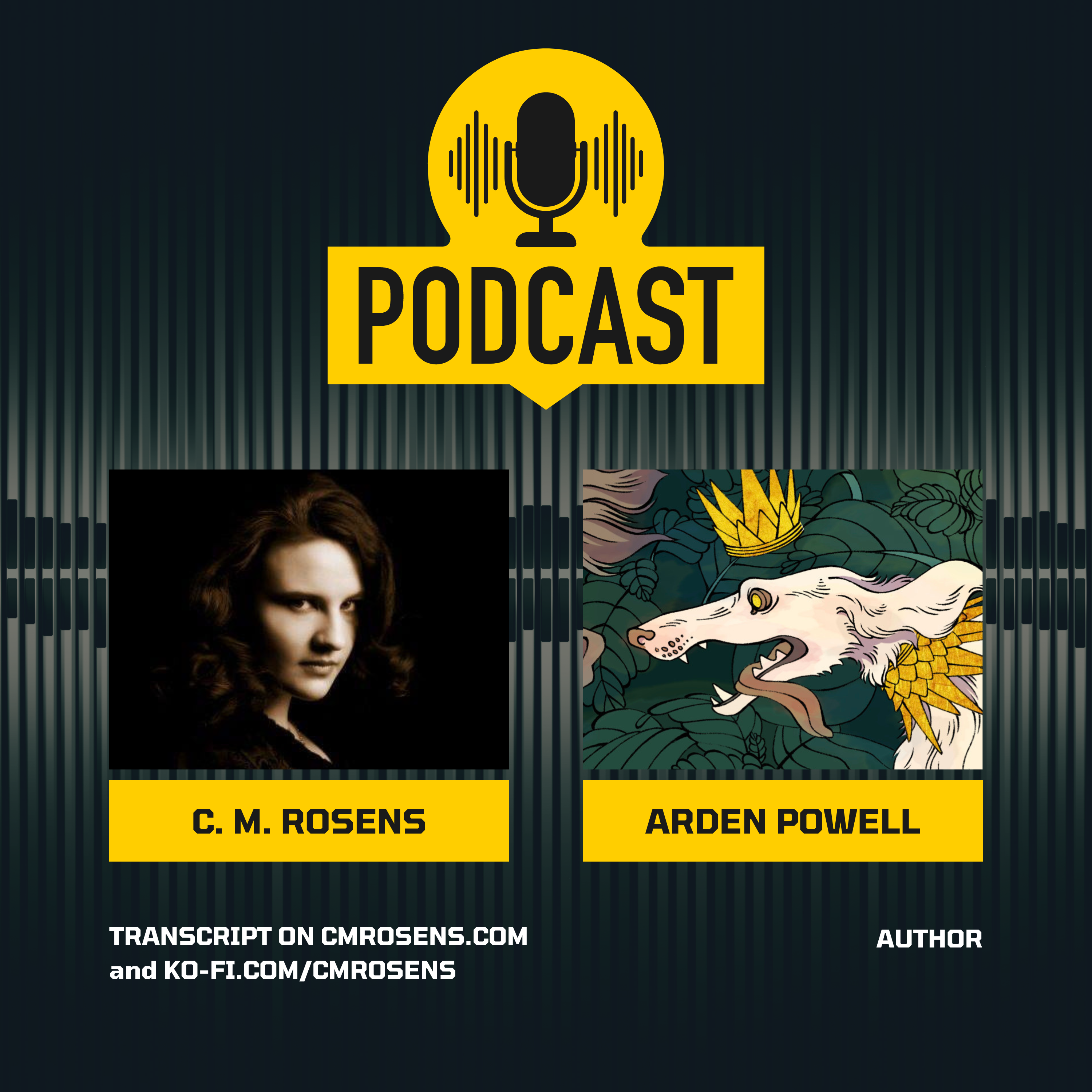

Arden Powell: Bio
Arden Powell is a speculative-fiction author and illustrator from the Canadian East Coast. They graduated from St. Francis Xavier University in 2013 with a Bachelor of Arts degree, Honouring in English Literature. As a hybrid author they self-publish as well as publish with indie presses, and have had work accepted by literary magazines including Baffling Magazine and Lightspeed. Their most recent release is Flos Magicae, an historical fantasy romance series. A nebulous entity, they live with a small terrier and an exorbitant number of houseplants, and have conversations with both. They write across a range of fantasy sub-genres and everything they write is queer.
Introduction
CMR: Hello, and welcome back to Eldritch Girl. And for this author interview bonus, I’ve got Arden Powell with me. It’s lovely to have you. Would you like to introduce yourself.
AP: Yes, hi, hello! Thank you for having me. I am a Canadian speculative fiction writer and a hybrid author with a focus on fantasy, romance, and horror. My first novel came out from a small press in 2018, and then in 2020 I started self-publishing with Faerie Hounds and The Bayou being my first two releases.
CMR: And The Bayou just got done by the Midnight Society! [@MidnightPals on Twitter, in the month this interview was recorded (2022)].
[Laughter]
AP: Yes, I saw that I was thrilled, just getting dragged through the mud.
[Laughter]
CMR: I thought it was brilliant. Did you see a spike in sales or interest?
AP: Yeah, it was my bestselling book this month. so I assume that’s connected.
CMR: Wow! Oh, that’s brilliant. I’m so pleased. So we’re going to hear about The Bayou in a minute. So the first the first extract you’ve got for us is from Faerie Hounds of York, which you’ve just mentioned in your intro. And we thought we would do two together today for you guys, because they work really well as a summer/winter pairing, which you might see in a minute when Arden does the extracts for us. We’re going to discuss both, so it’s like a two-for-one this time. So I’m gonna hand over to you, Arden, and you can contextualize the extract that you’ve got for The Hounds of York novel and then read the extract, and we’ll have a little chat if you like.
The Faerie Hounds of York – Extract

AP: Sounds great. Yes. So The Faerie Hounds of York is a dark fantasy set in Northern England, 1810.
I was just going to read the back cover blurb, If that’s fine.
CMR: Yeah, that’s fine.
AP: Good.
William Loxley is cursed. A pale and monstrous creature haunts his dreams, luring him from London to the desolate, grey landscape of his forgotten childhood. There, it will use him to open a door to Faerie—a fate that will trap Loxley in that glittering, heathen otherworld forever.
The Faerie Hounds of York by Arden Powell
His only hope of escaping the creature’s grasp lies with John Thorncress, a dark and windswept stranger met on the moors. The longer Loxley stays in Thorncress’ company, the harder it becomes to fight his attraction to the man. Such attraction can only end in heartbreak—or the noose.
But Thorncress has his own bleak ties to Faerie. They come creeping in with the frost, their howls carrying on the winter wind. If Thorncress’ past catches up with him before they can break the curse, then Loxley will not only lose his soul. He’ll lose Thorncress, too.
AP: The context for the excerpts that I’m going to read specifically is Thorncress, having just seen the faerie hounds through the window, is therefore doomed to die in 3 days, and he finally opens up to Loxley and tells his sister’s story.
And his sister, who had seen the faerie hounds years and years before, and sent him on this kind of mission to — not avenge her death, but find her again.
I’m going straight into reading it.
Loxley listened to the steady beating of Thorncress’ heart. “Who did Faerie take from you?”
Thorncress’ heart skipped a beat and Loxley bit his lip, waiting. When Thorncress finally spoke, his voice was rough and ruined. “My sister.” He stood, disengaging from Loxley entirely, and paced to the window. “You should rest, Mr. Loxley. The charms will safeguard you from the worst of the creature’s efforts, even here.”
“You’re not joining me?”
“Later.” Thorncress glanced back at him. His features were drawn, and exhaustion and old grief weighed heavily on his brow, but he didn’t look angry anymore. “Go to sleep. I’ll be here.”
Hesitantly, Loxley nodded and shed his outer layers, crawling under the blankets to curl up on the cold mattress alone. When he looked over, Thorncress had turned back to the window, resting his forehead against the glass. He held a piece of paper between his fingers, its edges worn to softness, and though he turned it over between his hands, he didn’t read it.
Loxley dreamed he was standing in his childhood bedroom. The room had no roof; above him, the sky was vast and full of tiny, glittering stars, like pinpricks torn through black velvet. Tipping his head back, he watched his breath curl out in a plume of frost, shimmering up to the stars as if it meant to join them and build its own galaxy.
He woke to the sound of howling.
He couldn’t place the sound, at first. It echoed through the house like there were no walls separating them from the wild. The cry started low, almost a moan, before soaring up in pitch, drifting on the wind. Thorncress was still at the window, rooted to the spot, staring out into the darkness. Rousing himself and pushing up to his elbows, Loxley called his name, but he didn’t move. Unnerved, Loxley wondered for an instant if he was still trapped in that dream.
But Thorncress finally stirred, as if breaking from a trance.
“Her name was Rosa.”
He turned, offering Loxley a glimpse of his profile. His hair hung in his face, and dark circles ringed his eyes, which had a faraway stare to them.
“She was sixteen; I was barely twenty. We were raised on all the old stories, but it didn’t help.” He drew a deep breath. He hadn’t looked at Loxley once since he had started talking, and Loxley didn’t dare interrupt. “She saw the hounds one morning. I wasn’t there. She sent me a letter, though she knew I would never make it home in time. It reached me two days after her death.”
“I’m sorry,” Loxley said, knowing it was insufficient.
“She didn’t tell anyone else. She didn’t want to worry them, not when there was nothing to be done. I still carry her letter . . .” Trailing off, he stared into the shadows for a moment before continuing. “She described the hounds as great white beasts with eyes like foxfire, terrifying and beautiful. Like witnessing a natural disaster, something beyond comprehension. She said that even if she hadn’t known the stories, she still would have understood that she was going to die.”
Loxley swallowed. His knuckles were white in the sheets. “Are you still trying to find her, your Rosa, after all this time?”
“Yes,” Thorncress said simply.
“If she died . . .”
“Twenty-two years ago. But her soul passed into Faerie, not Heaven, and time passes differently there. I could still find her.”
“Following her into Faerie is a death sentence.”
Thorncress said nothing.
“Do you want to die?” Loxley finally asked in a broken voice.
“I made a promise.” Thorncress’ pitch was so low that Loxley strained to hear him. “I’m not one to break an oath.”
“A promise to do what, exactly? Exact revenge?” Loxley’s voice cracked in frightened desperation. “You cannot best a faerie hound—you’ll only get yourself killed!”
“I’ve hunted the hounds all my life in the hopes that if I followed in her footsteps, I could find her again, wherever she is, and bring her back. And if not that, then at least I could join her, so she wouldn’t be alone anymore.”
“Surely she’s released you from your promise by now.”
“I’ve not released myself. She was my little sister; I should have been there. If nothing else, we could have gone together. She shouldn’t have had to die alone.”
Loxley could make no response to that. If he were to die at Faerie’s hands, he would appreciate whatever companionship Thorncress could offer, right up until the end. A hand to hold, a friend to sit by his side; someone to keep him from being quite so afraid as the dark and the cold crept in.
Shivering, he cast aside such morbid thoughts. What worked for men like Thorncress did no favours for those of Loxley’s disposition. He could not imagine harbouring a death wish for so long. But then, perhaps he only lacked the proper motivation. He had no family to protect, no love for whom to die.
Then again, there were times when, under the enchantment, the danger felt more like a comfort, and being so near the thinning of the worlds felt almost like coming home. In those times, he found himself in deep rumination in the darkest hours of the night. Perhaps, if he studied that strange comfort a little harder, he might come to understand Thorncress’ resolution.
The Faerie Hounds of York by Arden Powell
Powell on Writing Process and Gothic Themes
CMR: Oh, I love it! I I love that part. and I love the relationship between the 2 men as well, because it’s very much like a Gothic romance in that kind of way, and I love the way that they grow on each other, and the way that it becomes this really very sweet romance.
How do you think romance and grief work together in the book as themes sort of bouncing off each other and intertwining, like, what was your what was your authorial vision for that?
AP: From the earliest stage that I was drafting Faerie Hounds, I knew it was going to be both a romance and a tragedy, although I wasn’t sure what form exactly it was going to take until I got deeper into the writing. Because I do like most of my themes in my books to develop organically.
So it’s very rare that I go into a draft knowing exactly what themes I want to explore. They usually take shape as it goes along, and then usually I get readers after the fact who are like, so you did this, and this and this, and I’m like… I did? That’s so good to know! Because I don’t always have a clear cut vision until after it’s done.
CMR: Yeah I think I do something very similar. I ask beta readers what themes they pick out, because sometimes that’s very different to what I thought. But yeah, and I because sometimes that’s very different to what I thought was in there. But, yeah, and I quite like the contrast between the hope of the new relationship with the power of loss in the novel, and it’s kind of like – you’ve got this inevitability about it. This inevitability of tragedy looming on the horizon, and that kind of permeates the whole thing, and it’s about… it’s about a guy trying to, because he doesn’t know Thorncress very well at all, he’s just kind of met him right. So it’s about this guy who just kind of falls in love with a random stranger he meets on the moors, and then finds himself trying to persuade him to stay alive.
Like. But there’s so much about his [Throncress’s] past that he [Loxley] doesn’t have access to, that he [Loxley] can’t touch, and then it sort of what do you do with that? Where do you go from there?
And I wondered if those sorts of things — how you worked in the folklore and the Yorkshire Gothic tradition and the Northern English Gothic tradition.
Did you read a lot of books that were sort of Gothic romance, Gothic tragedy? Or did you feel like there are particular themes from the folklore that you borrowed that really played into that, and was that like a conscious choice?
AP: In regards to the Gothic, it was not conscious. I had some background in the Gothic genre through university and some of the classics there. When I was writing Faerie Hounds, I wasn’t actively thinking about a genre. It was my first self-published book. So I really wasn’t thinking about how to categorize anything at all at that point, but it was definitely influenced specifically by the melodrama of Wuthering Heights and a lot of the folklore and magic of Jonathan Strange and Mr. Norrell. And those were the 2 touch points that I came back to.
For Wuthering Heights specifically it was a lot of the imagery, and wandering the moors and the lost love and the doomed romance and so on.
For drawing from Jonathan Strange and Mr. Norrell because I first read that a couple of years prior to drafting the book, and it’s such a huge historical like almost academic piece of work that I wasn’t trying to emulate at all. That’s such a different type of writing. But I really liked the focus that that book had on Northern England as being this wilder kind of unintegrated chunk of Britain really. And the way it’s closer to Faerie, and the worlds are thinner up there.
And I definitely pulled on a lot of that for Faerie Hounds. I really like that.
CMR: Yeah, I think that works, though, because then you’ve got that sense of unreality almost for people who do know [laughs] what Yorkshire is like, and it does get quite bleak up there, quite stormy. But like, yeah, you can have you also have, I guess, the sense of oh, it is it a different? And also it’s historical fantasy as well. So you have that separate layer of distance of time for a modern readership as well. So you can kind of suspend a lot of your conceptions about what it’s like now. You know, it doesn’t really matter in that sense. It’s accurate enough, but also it’s different enough that you’ve got this idea of… Yes, I could believe that there are fairies, and it’s a different kind of AU (alternate universe), if you like. It works really well in that sense. Yeah, it’s like a really nice alternate fairytale setting that’s also quite bleak and dark and very rugged. And yeah, it works quite well for that.
Using Folklore in Worldbuilding
CMR: So what about your — where did you come up with the Faerie worldbuilding? What sort of research did you do?
I love the faerie hounds themselves, because that’s very… They’re very much described, like the Cwn Annwn, so they’re white with red ears right?
AP: That sounds very familiar.
CMR: So I think they pop up in Irish mythology as well, the faerie hounds. But I’ve done a blog post on the Welsh Gothic with the cwn annwn specifically, the Welsh hounds of the hunt that come out of Annwfn, and they’re led by Arawn, and that kind of thing, you know, and that kind of “Mabinogion” context for them.
And that’s the hunt that sucks the blood of corpses and various things in Welsh mythology. So it’s all tied in with a sense of death and destruction, and battle and decay, and that kind of thing.
So where did you primarily pull your influences from, and how did you build on that for you to create your own conception of Faerie?
AP: For the fairy hounds specifically, they were a combination of the Grim legends, and the Black dog omen of death in British English folklore, a combination of that, and a story I read as a very young child.
Which I couldn’t tell you the name of the author, the title of the story. Anything at all. I’ve looked for it since but it was a story in some children’s collection about these Scottish or Irish white dogs that with the glowing green eyes.
that like the grim were an omen of death, and I think it was in the story a woodcutter who was being followed by them. And because this was a children’s story, and I feel like it was in like a very like Catholic-centred anthology, because the moral of the story was, he invited these hounds in to get warmed by his fire on a winter night, and they didn’t result in his death because of his generosity.
But the image of these wild white dogs with their green eyes just bringing death to anyone who came across them really stuck with me for decades after the fact.
So that was where the hounds came from.
For the other faerie folklore, I didn’t do much specific research for it, just because I had been kind of collecting bits and pieces of fairy folklore for as long as I’ve been reading fantasy really, so like, the hawthorn and the rowan trees, I know they go way back in England and Ireland as being connected to Faerie, and I looked it up afterwards because I had written the book, and then I was like, I know I’m thinking of something specific…
and uh, Thomas the Rhymer, the thirteenth-century prophet and poet —
CMR: YES!
AP: Yes! [laughter]
AP: Yes! [laughter] In his ballad he met the Queen of Elf Land, or the Fairy Queen, who came out of a hawthorn tree and showed him these 3 roads that she invited him to come along with her, and there was a road to heaven, a road to hell, and then a third road which led to her own land, which was later interpreted to be Faerie. And I’m not sure if that thirteenth-century ballad was the originator of the idea that Faerie was a rented land from Hell? So yeah, renting fairyland from Hell, and also the theory that fairies were originally angels who had refused to choose sides in the in the heavenly war, and so they were cast out, belonging to neither heaven nor hell, but this third place afterwards, and that, in every book that I write about Faerie, or involving the Fae, that’s kind of the main concept that I’m basing them on.
So the Fae come up again in The Bayou, not with any of the same folklore really as Faerie Hounds, but it’s still based on this kind of fundamental understanding of the Fae as these amoral, inhuman, unbeatable creatures.
And that’s what I keep coming back to for them. It’s the most appealing thing about the folklore for me.
CMR: Yeah, I love that. And I think that segues nicely into The Bayou, actually, because I love how The Bayou is a foil for Faerie Hounds in a really interesting way.
You’ve got that kind of… well, I’m going to let you introduce it and do the extract and stuff, and then we can actually talk about it properly. But yeah, I love how you’ve got the fairy connection between the 2 books as well, and how things flip very much, So the fairies are still quite sinister, but have a very different purpose in The Bayou, at a very different role in the novel[la]. So would you like to introduce The Bayou and then read your extract for that?
AP: Absolutely.
The Bayou – Extract

“Eugene didn’t know if he believed in the devil beyond the wicked things people did of their own accord, but if the devil had a face, it would look like Johnny Walker’s.”
The Bayou by Arden Powell
Small-town Louisiana, 1935.
When Eugene was twelve, a girl from town disappeared. Everyone said the gators must have got her when she strayed too near the bayou. No foul play, just a terrible accident. But Eugene can’t shake the conviction that Mary Beth’s death had something to do with the man who used to haunt her—the man no one else could see.
Now, nearly two decades later, there are more dangerous things than gators in Chanlarivyè. People are disappearing again, and this time, no one can find the bodies. As the town’s unease grows, charismatic fugitive Johnny Walker arrives on the scene, shedding bullet casings and stolen bank notes in his wake.
He tangles himself up in Eugene’s life and awakens memories Eugene thought he had laid to rest years ago. Memories of the mysterious man who followed Eugene into his dreams, and memories of the bayou—
And of the horrifying entity that lurks beneath the water’s surface, slowly seeping into the town like a stain.
AP: So in the excerpt I’m about to read. Eugene follows the ghostly man who had haunted Mary Beth into the bayou after her disappearance, and the townsfolk dredge her body from the swamp.
When Mary Beth went missing, the town turned bruise-colored in the summer fog. Everything looked alien and strange, the green of the bayou reflected in the clouds.
Eugene followed the man through the courtyard, beyond the church grounds, down to the bayou where the trees grew gnarled and gray, and the soil was wet and sucking underfoot. The man stopped at the first line of trees before they disappeared into the heavy fog, a cutting image in his fine black suit amid the leaning tree trunks and the gray-green atmosphere. He turned and looked back. Eugene only saw his face for an instant—fine-boned and pale, beautiful rather than handsome, with eyes like a wild animal—and then he vanished into the swallowing fog, shimmering out of existence like a mirage. Eugene swallowed hard, the heat crushing his lungs, and stepped into the bayou.
He wasn’t supposed to be there. His mother had always cautioned him away from the place. It was too easy to slip and fall, moss clinging to every surface and turning the trees slippery with slime. And there were the gators, too, their teeth sculpted before the dawn of time and waiting to sink into something soft and easy like a child. And more, even besides the gators: stories of ghosts and spirits made manifest, creatures lurking deep in the swamps, the rougarous and the Haitian zombies—
But it wasn’t the ghost stories or the threat of gators that made Eugene sick with panic. There was a sense of something greater and more terrible in the bayou, a sense of dread and wrongness that took up residence in his guts and made the hairs on the nape of his neck rise up, shivering at the back of his skull, urging him to check over his shoulder to see that nothing had followed him in. He picked his way over rocks and tree roots, careful to avoid stepping in the water.
Voices drifted through the fog, muffled by the trees and the wet. Shouts he couldn’t understand as words. They sounded like ghosts. He followed them anyway, picking his way through the foliage, shivering all over as the dread solidified until it was inescapable. As soon as he reached the voices everything would unravel. He was trapped in a waking dream, the bayou dense all around him, fogging his thoughts.
Another shout, and figures took shape between the trees. Eugene slipped and stepped into the water; it splashed up to his knees, warm and thick with slime. Biting his lip, he waded on, leaving the tangle of tree roots behind. There were men on the far bank, a group of them reaching to pull something from the water. A dark shape emerged from the swamp, bedraggled and trailing algae and vines.
Someone shouted his name and Eugene startled. His mother pushed past the men and reached for him; he waded near enough for her to grab his sleeve and haul him back to solid land. She ran her fingers through his hair as if reassuring herself that he was still in one piece, but his attention was drawn to the men and the waterlogged shape they had found. He couldn’t understand what he was seeing, at first; his brain was numb and flickering as they laid the thing down.
“Don’t look,” his mother whispered.
Eugene swallowed. The body—it was a body, he realized sickly, or part of one—was gray, blue around the face and the fingertips, its cotton dress black from the bayou. It wasn’t Mary Beth. Mary Beth had shining dark hair, not the black matted clumps that hung around the body’s face, and she had clear gray eyes like summer storm clouds. The body had no eyes at all.
Eugene’s mother forcibly turned him away and pressed his face against her. For a second, he couldn’t breathe, the fabric of her blouse smothering him, and he gasped, making it damp with the air from his panicked lungs.
“Come away,” his mother said. Her voice sounded strange, like she too was choking. When he looked up, her face was wet with tears, her mouth a thin, hard line. “Come on, come away. You don’t need to see this.”
He had already seen it. But he took her hand and let her lead him out of the bayou, up to the path by the church, his limbs uncooperative as he walked. His shoes were ruined from the water, and left black prints behind with every step. He concentrated on stalling the fledgling asthma attack before it could take hold.
The trees looked ghostly in the morning fog. Eugene stood, shaking, the only sound his own shallow panting, but Mary Beth’s man did not reappear. Eugene couldn’t will him into being any more than he could will her back to life. The roses looked faded, as if they too were in mourning. Had they borne witness to Mary Beth’s final moments? Eugene imagined their petals opening like mouths to wail their accusations— But there was no evidence of foul play. Everything had been washed away by the dark waters. All Eugene had was his own memories.
As the weeks slipped into months and summer was left behind, Eugene’s mother plied him with medication—for his asthma, for the myriad illnesses that cropped up as the year dragged on, for his anxiety and his relentless nightmares. Night after night, the medicine lulled him into heavy slumber that dulled his mind and smothered his nerves. Eugene banished the rougarou to the dark recesses of his mind where it couldn’t touch him, and by next summer, he thought of it as nothing more than a former night terror, hazy and unfinished in his mind’s eye. Mary Beth occupied a small and guilty portion of his heart that, like a fresh bruise, he was careful not to touch. It took longer to shake the memory of the man, but eventually he too faded, like a ghost under the summer sun.
The Bayou by Arden Powell
CMR: Oh, I love it. It’s so sinister, and I love how this is a different kind of loss, and it’s very much reminiscent of you know. There’s still parallels with Faerie Hounds of York, where he lost a sister, and that kind of that personal guilt that Thorncress feels. But here it’s a wider culpability of it’s…you know it’s not Eugene’s fault that the little girl died. But you’ve got this idea that he’s carrying this guilt with him through to adulthood. But it’s not just his guilt, there’s the wider culpability of the entire town.
And that kind of focus is shifted onto the town itself.
So maybe we could talk about how guilt and grief intertwine in the story, because there is also a romance of sorts in that. But we get on to that in a minute, because that’s again like that’s very much like a flipped version of the romance in Faerie Hounds. So yeah, can we talk about guilt and grief and those themes, and how you work those into the story.
AP: So, as in Faerie Hounds with Thorncress and his sister, Eugene isn’t actually responsible for Mary Beth’s death.
He carries this immense guilt for not being able to help her, the same as Thorncress carries that guilt for his sister.
The difference is that in The Bayou, Mary Beth absolutely does hold Eugene responsible. She does blame him. Whereas in Faerie Hounds we have no perspective from Thorncress’ sister at all, except for her letter.
In either case the 2 men, the 2 characters, they are not responsible, despite how they feel that they are.
But the further difference with Eugene, maybe… he was there, so maybe he could have helped her, and I wanted to leave that open to interpretation, and the reader can really decide, you know, if he had physically tried to intervene, if he had tried harder to convince other people what had happened, you know. Maybe that would have made a difference, or maybe the priest would have killed him as well. And there’s really no telling how it could have gone differently, which I think is the appeal of that kind of tragedy.
But ultimately he was a twelve-year-old boy and he shouldn’t legally be held responsible. But yeah, absolutely. He feels like he is. And very that, more importantly feels like he is.
When he finally confronts Mary Beth at the climax of the book and he’s trying to defend the town from this vengeance that she’s wrecking, he cites the example… She’s wiping out the entire town, and that’s including children who hadn’t even been born when she was killed.
But he never includes himself on the list of people that he thinks should be spared. He’s completely willing to not only sacrifice himself if he thinks it would give her peace, but he does think that he deserves it. And if she wants to wipe out every single person that she holds responsible, then he’s putting himself, you know, maybe not at the top of the list, but certainly in second place.
And as I kind of mentioned a minute ago, like I didn’t want to make his guilt easy for the readers to decide if they wanted to agree with it, or if they wanted to absolve him. But I did want to make it as complicated as possible, and in the same way I wanted Mary Beth’s vengeance to be this, kind of you know, Is she right, or is she going too far?
She deserves to avenge herself, but like you said the wider culpability, like, how far does that extend?
There’s no way… I grew up in an extremely small Catholic town like that. And as much as you think that everyone is in everyone else’s business. There’s always someone who has no idea what’s going on.
CMR: Yeah.
AP: I think it is difficult to draw the line between that kind of revenge fantasy and saying, that’s not the same as justice, though.
Comparing/Contrasting the Novellas
CMR: Yeah, okay, so let’s – I want to think more about that, the oppositional stuff, because I really like that. And I love how complicated The Bayou is, morally, compared to Faerie Hounds which which doesn’t have all of that deeper complexity to it, because it is this really lovely tragic Gothic romance. I mean, that’s not to say it’s not complicated, but it’s got different things going on to this.
And then this one like you’ve got the relationship with Eugene and the entity known as Johnny Walker.
[Laughter]
AP: Yes, I like that.
CMR: But that’s very dubious consent. It’s very unhealthy. It’s got some great moments.
I think the church moment is probably my favourite bit. [Laughter]
Don’t know what that says about me.
AP: You’re not alone.
[Laughter]
CMR: What appealed to you about – perhaps appeal is the wrong word – about these sorts of dynamics? And was it intentional to have the stories mirror each other in this kind of oppositional way? Or is that just something that came about organically? And I suppose because there you’ve got like the opposition of winter versus summer, the heat versus the cold, Northern British English Gothic or Yorkshire Gothic to Southern Gothic, which is like these 2 completely different fields, but they kind of marry each other really well as a pair. So I’m just wondering if that was intentional. And if not like, how did that come about?
AP: That’s like a 10-part question, haha!
CMR: Ye-ah, sorry.
[Laughter]
AP: I’m gonna tackle the oppositional settings and everything first, and then I’ll circle back around to the to the mirrored relationships.
CMR: Great. Yeah, Sorry I was like, EVERYTHING!
AP: Everything at once!
CMR: It’s very opposite. Tell me.
AP: Yeah. So as far as switching from Northern England Gothic, all the way to Southern Gothic Louisiana, and the winter versus summer, part of that was not wanting to deliver exactly the same experience to readers back-to-back.
So I don’t remember exactly how I was writing the 2 books, but I think I started writing them both in the same summer, and I want to say 2017.
So The Bayou was actually written first, and then it was out on submission for a while, and it just kinda… off the work table, basically.
And I started Faerie Hounds kind of in the same mood, I think. And then both books got put aside until early 2020 when I was suddenly much less busy with work and everything else.
So I picked up The Faerie Hounds in early 2020, but The Bayou was still off in a slush pile somewhere, and had been for a couple of years at that point.
So I wasn’t really thinking about both books as being like a pair or a couple at that time.
So. Yes, I finished writing Faerie Hounds. I published it in the summer of 2020, like halfway through the year, and it was only after that went out that I decided I was gonna pull The Bayou from the slush pile and rewrite it, almost – not entirely, but very much. And decide what to do with it from there. So yeah, on the tail of Faerie Hounds, I really wanted a change of scenery for myself as a writer from one book to the next, because I am very restless as a writer, I get distracted. If I just finished writing a fluffy romance, then I’ll usually draft a horror project next, and vice versa. So that early in the pandemic and the lockdown and everything I wasn’t in the mood to write a fluffy romance after Faerie Hounds. But doing that 180 degree turn from this really cold, wintry northern setting into this lush, dripping humidity of the Deep South was enough of a change that I didn’t feel bored or trapped by it.
CMR: So the other opposition was the relationships and so how you’ve got this very healthy, trying to rescue one another relationship with Loxley and Thorncress, and Loxley’s very timid, and there’s a very tender undressing scene. And then there’s lovely developing feelings and pining and only one bed, and all of that kind of stuff. Then you get to The Bayou, and it’s like dubious consent, it’s fucking in a church. And it’s a very toxic relationship. It’s very unhealthy. It’s it’s got low-key abusive elements going on in that power dynamic that that Eugene is very much the bottom of.
I just wondered about that opposition between those two relationships, and you wanted to talk about that a little bit?
AP: When you lay it out like that I’m rethinking whether I wrote a fluffy romance at the beginning of the pandemic, and then I switched to horror. Because maybe I did do that, [laughs] exactly.
But yeah, I think part of it is again as me as a writer just wanting to explore. You know I did the sweet and arguably healthy relationship, and then I switched to something really dark and toxic. Because I find both kinds of relationships equally interesting and fun to explore.
But when you had first mentioned compare and contrasting the 2 relationships, my brain automatically went to not Thorncress and Loxley, but sort of Loxley and the creature, because they have parallel to Johnny and Eugene.
CMR: Yes! Yes, very much so.
AP: They are much more at the forefront of my mind, because those similarities were intentional.
As I’ve talked before about how the how I’m using the same kind of baseline for all of my Fae as these amoral self-centered, self-serving… you know, they’re going to take what they want, and whoever is being taken from is just kind of not really considered as a casualty. They’re just a resource to be exploited or a toy to provide entertainment.
So yeah, that was what I had automatically thought of when you had first mentioned the relationship parallels or contrasts.
CMR: Yes, do you want to explain about the creature and not this relationship just a little bit, because that is actually that, because that isn’t that that’s got a lot of similarities because I was good. My mind is going like opposites. So I was looking at those 2 central – what I saw as the 2 central relationships with the actual kind of romance elements in them. But not for Eugene and Johnny. But you know what I mean. And yeah, no, you’re right like the but it’s Loxley’s relationship with the creature that has that very much the same vibe, and you don’t see it perhaps in Eugene and Johnny’s relationship so much at the beginning, because you’re still thinking like who is/what is Johnny Walker? Like there’s something ethereal about him, and not quite right. And obviously he’s a bank robber.
AP: That too!
CMR: So he’s already got that glamour to him.
AP:Yes!
CMR: But you do feel that with Mary Beth and the shadowy man that is like following her around, who is not quite what you think. So you Yes, and that’s I guess, Loxley and the creature. And then Mary Beth and her, you know the man that was just following her around the only her and Eugene could see… and that kind yeah, and then you’ve got what they want. Ah sorry! Go on if you want to kind of contextualize what Loxley and the creature are doing.
AP:Yes, I hadn’t thought about that parallel with Mary Beth’s man at all? Oh, I need to reread my own books more often clearly, because these are like English Lit exam questions!
CMR: I’m so sorry.
[Laughter]
AP: No, I was very good at exams, just not with my own books apparently. Yes, so for context, Loxley and the creature:
When Loxley was a young boy, there was a hawthorn tree in his yard, and there was a little spirit in the tree that he would talk to and play with. And he told it his name because they were friends. Except, there was always something kind of
off putting about the creature, and when the days will get darker and the nights would come on earlier, he would always find himself strangely unsettled by the back of the yard.
And this this little creature was somehow more menacing than before.
Fast forward, 20 some years, and the creature is a changeling child who is trying to get back to Faerie, because Loxley gave it his name and kind of offered himself up to it unwittingly, the creature is determined to use him to open the door to return to Faerie, and because Loxley was its friend it thinks that he should definitely agree to sacrifice himself because he’s already done so much for it.
So yeah, there are visual parallels between Mary Beth and her man who is kind of tied to her family and haunting her like this spectre, and no one else sees him or acknowledges him. Yeah, I was completely unaware of that parallel until just now. That’s fun.
CMR: Yeah, I love looking for things like that. I love looking at books in those sorts of ways.
Do you want to talk about Johnny Walker’s relationship with Eugene, and how that all kind of works in that very toxic way, and those sorts of the way it plays into your conception of Faerie as well?
AP: Yes, so in The Bayou, Johnny Walker’s interest in Eugene is less transactional than the creature’s interest in Loxley. And it’s really more of an entertainment-based relationship.
I wanted to build that back and forth between the 2 of them as having romance potential. Not even like dark romance genre, but something… so you’ve got the Bad Boy Bank robber, who is all charming and action based. And then you’ve got the very timid and withdrawn journalist, Eugene, and it’s a set up for in a different genre. It could absolutely be a romance that doesn’t end horrifically. So I wanted to draw the reader in with that potential and only gradually make Johnny more a threatening and kind of otherworldly as the book went on. Like the metaphor where you’re boiling the frog in the pot. But you turn the heat up very, very gradually. So it doesn’t realize it’s being boiled alive.
And I wanted Eugene and the reader to being a similar position in regards to Johnny by the time they realize what he is and what he’s capable of, they’ve already fallen half in love with him, his charm and his appearance and allure, and everything. And then it’s like, oh. Actually I’ve been warning about him the whole time, and you just weren’t listening.
So that was the approach I wanted to take. And yeah, I don’t remember exactly what point in the book it becomes the reveal about Johnny’s true nature. I think it was towards the end. It must have been the climax. Right?
CMR: Yeah, I think it’s part of the big twist at the end. When we learn the connection with Mary Beth’s man and all of that kind of stuff all comes out and they like, yeah.
AP: Yeah. In the church, in the church scene again. So by that point Eugene is fully trapped under this man’s spell. Not literal spell, but there is no way he is going to be able to extricate himself. Johnny has decided that he wants Eugene as his new companion, his new plaything, as a replacement for the unnamed boy who had been his companion years earlier, and as a replacement for Angelique.
CMR: Yeah, because Angelique and Johnny start off with this Bonnie and Clyde couple that burst into the scene and you like, aha! Johnny is clearly a bi icon, [laughter] and you’re getting that kind of vibe. [laughter]
AP: Yes.
CMR: Then bad shit happens to Angelique, right.
AP: Yes. Yes. Unfortunately. Because those two, they were originally presented, I wanted them to be seen as equals on the page, as literal partners in crime. And then, as with the Eugene situation, you get more clues as you go along that things aren’t as they appear, and Johnny is really just this mask of – I guess glamour would be appropriate. And then yeah, and then everything falls apart, and gets progressively worse until, you know, they’re all doomed, and you realize they’re all doomed. And that’s the end of the book.
CMR: Yes, such a good ending though! [laughter]
Like they do have, I think… Faerie Hounds of York is like a doomed ending. But it’s got that note of hope and optimism, and it’s got that lovely satisfying… I thought the ending was quite satisfying.
AP: I thought it was.
CMR: Yeah, I like that, and that did have very much the Susana Clark vibe about it as well, which I really liked. But with The Bayou, it’s very much like, you’ve got that same sense of dread and impending doom, and that is actually impending doom and dread [laughs]. Yeah, which I also found very satisfying, I really like that, the contrast and stuff that at the end.
I don’t want to say too much about the end. But there’s another kind of contrast as well that I was thinking of, which is like the difference of the losses in the books.
In Faerie Hounds of York you’ve got this absence, and the loss that is kind of going through it as a theme is very much the absence of a loved one.
But in The Bayou, the loss and the grief is attached to something very tangible, because you’ve got the actual corpse and the memory of the corpse, and in that extract that you read out for us, it’s a site of horror and haunting. Whereas in Faerie Hounds of York it’s the absence that haunts Thorncress, until almost who his sister really was as a person, and what she might have wanted for him, that doesn’t matter anymore, because he is just motivated almost entirely by her absence in his life. And that prevents him from allowing that hole to be filled up with anything else, including Loxley, ultimately.
But maybe if Loxley had known him longer, maybe if there had been more time, you know, it’s all that kind of Romeo and Juliet tragedy of it, you know. But you still got that intractable, ”No, I’ve decided that I’m going to do this because she’s my sister, and she isn’t here anymore.”
But in The Bayou he has this memory of this rotting corpse, that is, you know, kind of suppressing all other memories about what actually happened. And you’ve got the tangibility of the bayou itself as the site of the loss, and all of these things that it’s intractably part of that landscape.
So I just wondered if you if you wanted to maybe talk about that, as like the tangibility versus the absence of sites of horror and haunting, and what that kind of means for you, and why you chose to play with those.
AP: Yeah, that was all really beautifully put. So yes, as you very eloquently summarized, Thorncress is constantly trying to follow in his sister’s footsteps. He’s unable to release her memory, and it’s his clarity of memory and the sense of responsibility for her death, despite the fact that it wasn’t his fault, that’s what dooms him ultimately.
And it’s that clinging to that loss that prevents him from accepting Loxley’s love until it’s too late, even though that love probably could have saved him. And he was right on the brink of saying yes to Loxley, and no to that death wish that he’d been chasing for so long. But of course the timing was… it was just terrible.
And then it’s it’s reversed, and it’s Thorncress’s death that leaves that hole in Loxley’s life that he has to go chasing after.
The book was also focusing on… It had that secondary loss even before Thorncress died and Loxley was mourning the loss of his own future. Because he didn’t see the faerie hounds, but he did have that curse that was dragging him to the creature, to Faerie. But, in contrast to Thorncress, who was refusing Loxley’s love because of that loss – he couldn’t reconcile the two – Loxley’s sense of doom made him reckless, and that was the force that drove him to take the risk, to pursue that sexual or romantic relationship that he had otherwise never dared to make a move on before.
I think you could classify Loxley’s mourning of himself as an absent loss as well. It’s definitely not like a tangible thing to be mourning your own future.
CMR: Yeah, 100%, yeah.
AP: So I did – I wanted to bring that up, as a third main loss in that book; the sister and Loxley himself, and Thorncress’s death.
CMR: Yeah. That mourning of the future mirrors the morning of the past. In The Bayou you’ve got this mourning of the past but also the absence of the memories, because Eugene doesn’t remember what happened. And so you have that memory loss of the reality of what happened in the past, and that mourning of a present that could have happened if he’d done something different. Like she could still be there, he thinks, if it wasn’t for him suppressing the memories, you know, that it’s somehow his fault.
And so yes, you’ve got that mirror again like in Faerie Hounds it’s the mourning of the future that you’ll never have, and in The Bayou it’s mourning of the past and the way the present could be different.
AP: Yeah.
CMR: Because that all happened when he [Eugene]was a young boy, as you say, he like he was 12 when Mary Beth died and Loxley’s curse happened when he was a young boy. And you’ve got that very Gothic trope of being haunted by the past and being haunted by your past mistakes, even though arguably you were too young to know what you were doing at the time, or too young to kind of take that responsibility. But now you’re an adult, that mistake is still haunting you. And now, as an adult, you have to pay. And that makes everything much more complicated and just adds these layers on of like, guilt and responsibility, and all of these things that, you know, just come out of all of that.
Folklore in The Bayou
CMR: Yeah, thank you so much for that. I really I really love it. And we’re running slightly out of time. But, do you want to wrap up just by the influences in folklore that inspired The Bayou specifically, because we haven’t really touched on that so much yet.
AP: So yes, I won’t go over the Fae folklore again. Folklore specific to The Bayou … the Rougarou played a main part, and that’s very specifically a French werewolf story. And Rougarou I think is more specifically Louisiana-French.
So it’s a werewolf variant that’s sometimes tied to Catholicism in the region, and it’s used as kind of a boogey man preying on children who break Lent, or it’s created by people who break Lent for enough years in a row.
So it seems like a really fitting monster, even though, like the Rougarou is in the story, just folklore itself.
I did want that kind of regional grounding to give it a little extra flavour.
I said. I wasn’t gonna talk about the Fae, but I hadn’t actually planned on making Johnny Walker Fae at all.
That didn’t come up until a later draft, and before that he was just this kind of an undetermined supernatural being.
But when I was doing some background research for Louisiana and I found that there was a really high percentage of Irish immigrants at the time, I thought that gives me a perfect in to give him some depth and give it more real-world folklore grounding.
Because in the original draft, Johnny Walker was influenced mostly by Anne Rice’s Mayfair Witches books, I don’t know if you’ve read those. Don’t bother. But there was this one character called Lasher, who was this supernatural entity that followed or was tied to generations of women through this witch family and it was kind of there to do their bidding, except it wasn’t really working in their best interests.
I really liked that idea. So I kind of pulled that concept, and then I stuck it into this Irish fae mythology.
But yeah, most of my world building or scene setting came from a lot of Anne Rice’s stuff just because I grew up reading her books, and they left such an impression that anything set in the Deep South, I go to her first, and then I figure everything else out after.
But I think that hit all of my main folklore points for The Bayou.
CMR: Yeah, I love it. I haven’t read the Anne Rice books.
I tell you what it did remind me of – are you familiar with the classic, weird fiction writers like Frank Belknap Long, who did the Hounds of Tindalos? Probably his most famous one, maybe and there’s a collection called the Hounds of Tindalos and Other Stories (I think it’s called), it’s all kind of cosmic horror and weird frogs and shit right? And then there’s this one which is just about like this guy – it’s obviously all American like U.S. American set. And some of them feel quite Southern Gothic to me who knows nothing. But there was one story, and it’s literally this guy who’s some sort of middle class American, U.S. American guy, and he’s got a load of fairies following him around.
And it’s the most bizarre thing because they’re actually tiny little leprechaun type fairies that he’s just got this gift, and he can see them. And then they’re very mischievous. And I’m like, what’s this doing in a weird fiction collection. They just make his life a misery until he learns to live with them. That’s it, but it’s very much that he’s a very modern, all-American guy. He just has to cope with the fact that he has fairies now, like an infestation of fairies that come from Ireland because he’s Irish, like Irish-American. He has to deal with it.
And it’s a very short. It’s batshit bonkers, anyway. Yeah, like, yeah, that kind of I’m glad you didn’t do that with it. But like, I think there’s a precedent for Americans and fairies, anyway. Sorry that was a completely random.
So. I think that’s about all we’ve got time for, and if you’d like to just wrap up and let us know anything that you’ve got coming out – so this episode is gonna air in 2023, so if you’ve got anything coming out in that kind of timeframe, or you want to plug things you already have, now is the time. So yeah, share with us.
Wrap Up: Arden’s Work & Newsletter
AP: Yeah. In that time I will be releasing probably my next Flos Magicae book. That is a series of standalone Historical Fantasy romances, and they’re mostly pretty light and fluffy.
So I’m going to more specifically plug my novel from last summer, which is called Obsidian Island.
And if you liked The Faerie Hounds or The Bayou, this will probably be more appealing than my very sweet and fluffy romances.
So Obsidian Island is pretending to be an eighteenth-century action and adventure fantasy story set on an island that is trying really hard to kill this group of unfortunate friends who have washed up on its shore.
![Obsidian Island by [Arden Powell]](https://i0.wp.com/substackcdn.com/image/fetch/w_1456%2Cc_limit%2Cf_auto%2Cq_auto%3Agood%2Cfl_progressive%3Asteep/https%3A%2F%2Fsubstack-post-media.s3.amazonaws.com%2Fpublic%2Fimages%2Fb75b4572-9d20-4d79-8eea-68311b6cdf7c_217x346.jpeg?ssl=1 "Obsidian Island by [Arden Powell]")
It was intended to be action and adventure, and then all of the reader feedback I got said that it was actually a lot creepier than I had intended it. So I’m gonna say it’s horror-adjacent fantasy. And I think it was a good fun read. So that’s that. Otherwise? You can follow me on Twitter if Twitter is still standing. but the best place to find me is is gonna be my newsletter which will be linked in the Transcript.
So that’s me.
CMR: Yep, it will indeed. So. if you hop to cmrosens.com or if you go to my Ko-Fi, which is ko-fi.com/cmrosens, you’ll see the post which is available for everybody. and that will be the full transcript of this interview, and with all of Arden’s links and promo images attached, so you can hop on over there and have a little look. Thank you. I just so much for coming on the podcast. It’s been great.
AP: Yes, thank you so much for having me. It’s been a delight.
Leave a Reply