
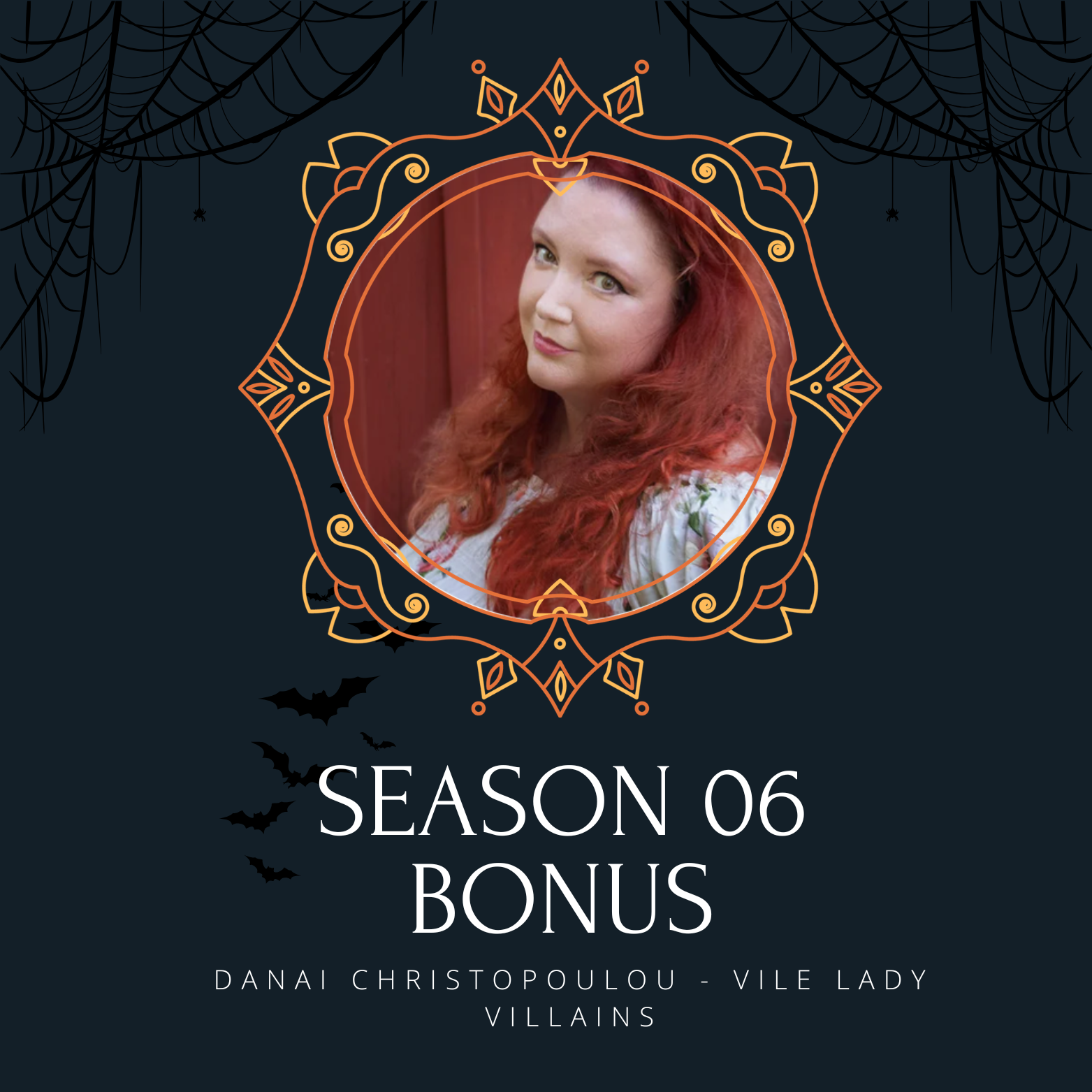

Danai Christopoulou (they/them) is a Pushcart Prize nominated SFF author and editor, and Associate Literary Agent at Tobias Literary Agency. A Greek author raised on a diet of myths and tragedies, Danai’s writing has appeared in Glamour, Marie Claire, khoréo, Fusion Fragment, Flame Tree Press, Writer’s Digest and more, and has featured on the Nebula and Stoker recommended reading lists. Vile Lady Villains is their debut novel. Growing up amid the ancient ruins of Athens, Greece, they currently haunt a forest in Sweden.
Introduction
CMR: Welcome back to Eldritch Girl, we have a very exciting bonus episode for this season. I have with me Danai Christopoulou, and I am going to introduce them to you and their book Vile Lady Villains, and we’ll also be chatting a little bit about Greek representation in mainstream media as well. So Danai, I’m going to hand over to you, would you like to introduce yourself?
DC: Hi Mel, thank you for having me. I’m excited to be here. Hi everyone, I’m Danai. I am a Greek author, editor, and associate literary agent. So basically my job is “Book” (pauses and grins) in the many different variations of that.
My debut novel, Vile Lady Villains, came out this year in the UK by Penguin Michael Joseph and in the US by Hachette by Union Square & Co. And it’s also coming out in Greece. In September, by Anubis Books, which is the publisher of G.R.R. Martin, so I’m super excited to be able to say that I’m sharing a publisher with G.R.R. Martin. But yeah, that was a sidebar because I’m geeking out.
CMR: (claps while muted)
DC: Thank you. I am really excited to be here and to talk about Vile Lady Villains, villains in general, Greek mythology, and shoot, I’m open to questions.
CMR: Fantastic. Can we start by you just giving us a little bit of the book and maybe reading the book description? So for people who haven’t heard about it yet, I don’t know where they’ve been living. Perhaps you haven’t seen it. But yeah, if you could just give us a little bit of a description and then we’ll go from there.
Vile Lady Villains Description

DC: Yes, perfect. OK, so imagine that you’re Lady Macbeth. You have plotted your king’s death and now you need to flee. You turn to the three witches for help, but their spell casts you out in an unrecognisable new realm.
You fall through a door, only to stumble upon another woman’s blood -soaked triumph. You meet Klytemnestra as she stands over her husband’s corpse.
But as this queen of Mycenae mistakes you for a spirit, she chases you through another mysterious door into the world of stories.
Hunted by wraiths in an unfamiliar land, determined to destroy you both, you are forced into an alliance. Castles crumble, myths collide. In the chaos, your dark rivalry gives way to a fiery attraction no one could have predicted. To survive, you must choose.
Return to the tragedies that define you, or burn those stories’ pages and rewrite your ending together.
This is more or less the long description of Vile Lady Villains, which in short I pitch as Klytemnestra meets Lady Macbeth, literally.
C.M. Rosens in Conversation with Danai Christopoulou
CMR: That is beautiful. I love that. Where did the idea come from for you to merge these two villains together or kind of, you know, get them on this collision course? And how did you come up with the idea to send them into these sort of layered fantasy worlds?
DC: So the first, I mean, the first draft of this story came around 2021. I saw something on Twitter about Lady Macbeth. Someone was saying something, I don’t remember. And I wrote a tweet. Like, what would happen if Klytemnestra and Lady Macbeth met like would they burn the world would they become enemies lovers and then that just wouldn’t let me go, this idea.
But on a deeper level, I think this obsession started in my childhood both of my parents were actors so I grew up like learning ancient monologues and Shakespeare monologues, and I really, really liked the monologues of both Klytemnestra and Lady Macbeth. They were some of my favourites. And of course, I was perhaps too young to understand the deeper themes. I just liked how the words sounded back then. But growing up, it became clear to me that there’s a lot of overlap in their journeys and their characters.
They could both… physically be described as archetypes for female power, female ambition, and they’re both villainized within their text more or less in different degrees by their authors. So it was very interesting to me what happens to characters. If you take them out of the confines of their narratives, if you put them in another world, perhaps I watched a lot of Isekai when I was growing up, but it’s this idea of a portal, like what happens to characters when they enter a different world? How much of their original selves do they retain and how much do they have to transform to survive and what do they become? So that has been the underlying question underneath all this.
CMR: That’s really interesting. I love the idea of turning it into a portal fantasy. I think that’s kind of a bit of a reductive marketing box. But like, yeah, I really like that concept of portal fantasy, creating this opportunity for these characters to meet. So have you always been interested in the villain as an archetypal character or as specific villains have always fascinated you? Where does that love come from?
DC: It’s not just villains that fascinate me, but there’s a lot of complexity usually in villain characters that maybe in some of the more heroic arcs tend to be flattened or used to be, not any more. But growing up, it was easier to think, oh, okay, so there’s like different shades of gray here. But there’s been a lot of characters and in Shakespeare’s plays that I have… always had a keen interest in. Ophelia is another one.
Ophelia also shows up briefly in the book so she’s not a villain at all but she’s also not a victim either any more, so I’m really interested in that dichotomy: villain or victim? And how do you like take charge of your narrative and like decide for yourself who you want to be? And of course, Greek mythology has always been part of who I am, as I grew up with these myths like my father used to tell me stories from Greek myths instead of fairy tales growing up. So it has been part of my upbringing in a very like inherent way, I guess.
CMR: I love that. And I also love the collision of Shakespeare as well for you. Yeah, because you mentioned there’s a lot of, I guess, universal themes that kind of cross over and you can see Greek myth tackling those themes.
And then Shakespeare also does it, but in a very different way and in a very sort of specifically English way or, you know, sort of Western kind of idea.
DC: But he was also obsessed with Greek mythology. Like he was obsessed with mythologies of all kinds. He was like dipping his toes into different pantheons, borrowing things. So I think, of course, some of the themes from the ancients come seep into his work. Like we see this in plays like A Midsummer Night’s Dream, things like that. There’s a lot of Greek myth there.
CMR: Yes. Everyone seems to be obsessed with Greek myth in Europe generally. It seems to be a very sort of, it’s treated as almost public domain.
Whereas, you know, if you’ve, I grew up in Greece when I was very small. I went to Greek kindergarten as well. I’m Welsh, but I lived there for some time, Welsh, Turkish. So I have a very strange upbringing. And my earliest memories are Greek myths, but also visiting Greece and visiting places from Greek myths and from ancient, you know, when we went on holiday. And that was normal you know, going to the modern cities where these stories are based and then going on, there are some ruins. My mum lived in Athens for 30 years. So the Parthenon and the Acropolis, that was all very second nature to me, I suppose. And I think that that is a very different experience than the distancing that you get when you grow up without being able to see those places and being part of that culture.
So do you see significant differences in the way that Greeks tell their own stories versus the way retellings are treated by people who are not Greek and have just kind of come to these stories from English-language retellings and from, you know, sort of the Ovid fan fiction versions of the myths as well. I was wondering if you had any kind of thoughts on that.
DC: Yeah, it’s markedly different. And I realized how different it is because I also grew up amid ruins, right? I grew up in Athens. I lived in Athens until I was 33 years old. Ruins is something that you pass by on your way to the supermarket. But also there is this complexity because Greece has this continuous story of struggle, of occupation.
You have 400 years under Ottoman rule that has really enmeshed with who we are and all these influences from the Levant, from North Africa, from the Middle East. We are kind of like a… a mix of so many different things, while at the same time having ancient Greeks as our ancestors, and having that through line more or less unbroken despite the changes.
So it’s fascinating that we learn ancient Greek in school, and although we can’t understand it fully of course – until we study it, [then] we can understand – we can read the alphabet. It’s almost more or less the same alphabet as it is now in modern Greek.
So even that difference that the ancient Greek alphabet is not something exotic or academic to us. It’s something like very normal that even a child would see. Oh, that’s an A. Oh, that’s a B. You know, it, of course, creates a different relationship to the material.
The other thing is that, especially in the Anglosphere, there is a certain entitlement that comes from while Greece was under Ottoman rule, there was this need in the West to reinvent the ancient ideal.
And so along with our marbles, they also took over believing that they’re the custodians of our myths and of our civilization, and so kind of like this reinvention of the ancient spirit as something they could mould and fit into the Western views and ideas and white supremacy, although white supremacy was not at all a thing in Greece because it was a very different world very much more pluralistic back then.
So now you have this sense that ancient Greeks belongs to the West. It’s part of the Western canon I have a lot of thoughts about. But I think it does inform how Anglophone writers come into these myths and how they enter into these myths. And then, of course, it can go into many different directions, right?
There are people like Madeleine Miller [author of Circe], who are classicists, [and] like Emily Wilson, who have done tremendous work with translations, who have a deep appreciation and love for the material.
There’s even people like Rick Riordan [author of the Percy Jackson series], for instance, who has been a teacher all his life and although it’s like a fantasy for kids it’s also great fun and you can see his love of the material shine through Percy Jackson.
But then you have a younger generation of authors who have learned Greek myths through Percy Jackson and through movies like Disney’s Hercules that have kind of – I don’t want to say “skewed” idea, but different idea about Greek mythology and a different kind of entitlement to it.
And then you get into the whole publishing of retellings industry, and then you get into situations where someone like me who is Greek who writes a Greek myth retelling is being told by agents and publishers that this is “too different from the other retellings that we have published”, and it’s “just too weird to become part of the canon”. This is a phrase that was uttered years ago, but I will never forget it. And by canon, do you mean stories about my culture told from people who are not of my culture? Is this the canon you refer to? So, yeah.
CMR: I think also now there’s a bit of a… an issue with prescriptivism as well, and this idea of myth literalism that’s coming out of certain area of the West and Anglophonic cultures, whereby the myth itself is treated as a static thing, a thing that is not a living, breathing… myth. It is a story that is told and the text that you have the version of the text that you read is almost like you know the Biblical truth if you like. This, I would say, US evangelical understanding of that text, and I think it’s mainly in the US that you see this.
For example, Medusa, Medusa being the the rape victim of Ovid, which is Latin [Roman] fan fiction of the Greek myth. It’s not the myth, but you see that repeated, “Oh, Medusa was a rape victim” all the time. And I’m like, when? I mean, you know, which version?
DC: Which version? Which version? In the versions we have, she was a Gorgon to begin with. She was like a primordial kind of being that was a protector, and her visage was used as a protector in temples, outside buildings, like this idea of the Gorgon as protective.
But then it is very interesting and I think it happens a lot to female characters of myths like they start off as… very badass and then slowly even throughout the antiquity itself they tend to lose either their powers, like take Hecate, for example.
At the beginning, she was this primordial goddess who controlled everything. But then as the Olympian pantheon became more like established in Greece, you couldn’t have a woman goddess more powerful than Zeus, right? So they had to diminish her powers to narrow them down and make her, you know. Not even an Olympian, the goddess of magic.
Same with Aphrodite. She was also the goddess of war to begin with. There’s a lot of different interpretations of Aphrodite. There’s statues of her where she also holds arms, like Athena.
And then she becomes flattened into this, oh, she was only the goddess of love. So I can’t blame just the current US sphere for that. I think this is something that happens throughout the ages.
Even as I was looking at Clytemnestra’s story, I am following Aeschylus’ interpretation here, where he has her killing Agamemnon as something she planned meticulously for 10 years while he was in Troy to avenge their daughter. And of course, it also suited her political aspirations. It suited what she wanted to do with her life. But it was an act of revenge, and it was cold-blooded, and it was very premeditated.
But even in later versions of this story from other ancient authors, you get Clytemnestra who kills out of jealousy for Cassandra. And then even later on, it’s not at all Clytemnestra who killed Agamemnon, it’s Aegistus, her boyfriend, who does the deed.
And this upset me so much that I completely wrote Aegistus out of the book. He does not exist. He’s not mentioned even once. And the funny thing is, is that I’ve seen people complain about that, that I am disregarding that Aegistus existed. But I just wanted to write a story that does not centre men.
CMR: I think that’s fair enough. Yeah, I think they get centred. They’ve been centred enough. But yeah, I mean, even in the text, they’re centred enough. Like, it’s time to reclaim a few things. Did you always know it was going to be a sapphic romance when you wrote it? Or like there was going to be this attraction between them? Or was that something that came out as you were writing and you went, actually?
DC: I think I kind of suspected. But it’s been interesting because it’s also been interesting. This is not the first novel I’ve written. This is the fourth novel I’ve written. It’s just the first one that managed to be published. I am seeing it turn the more I write. Suddenly characters start to become more sapphic. They start to become more neurodivergent. They start to become more non-binary. So I don’t know what’s happening there. I’m completely innocent, I swear. But yeah, it’s happening sometimes almost by itself.
And in this particular case, I was planning for this to be a short story. Mostly because I thought it was just too crazy of an idea to write a whole novel about it. But then as I kept writing, it kept growing. And at some point I gave up and I was like, you know what? Fine, I give up. This is a novel.
CMR: I’m glad it is a novel. I think a short story would be… yeah, not enough to
satisfy the full world building that you’ve got going on here and the relationship dynamics. I think that’s fantastic. So you mentioned this is your fourth book that you’ve written, your first book to be published. So of the other books that you’ve written or books that you plan to write, do you also use Greek mythology in those, or is there a myth that you haven’t used yet that you would really like the opportunity to explore in future work?
DC: Yes. Two out of the three currently unpublished books are based in Greek myth. The other one was a science fiction novel, like, very dystopian, very weird. I hope all of them see the light of day at one point.
My very first one was about Pasiphaë in Minoan Crete. And I’m starting to toy with the idea to maybe self-publish that one. I don’t know how, maybe in some kind of episodic form. I haven’t decided yet.
But in terms of my traditional publishing journey, I am currently writing something new that is unannounced as of yet, so I can’t get into detail about it. But it is, yes, very much Greek myth, but also has some Greek folklore, Balkan folklore in the mix. So it’s a different kind of thing, I guess, not a retelling.
CMR: I really like that actually because I think that Greek folklore is as very distinct to Greek myth. It has its own life. It has its own corpus of material, and it has its own living tradition as well, and I think that’s really interesting because I don’t see a lot of Greek folklore out there and again I think that’s possibly because it gets overshadowed by the myth retellings. You don’t see a lot of Greek folklore because that is specifically Greek. And it comes under that kind of folk tradition that I think people were not keen to appropriate back in the day because it didn’t fall under this banner of… you know, the origins of democracy and the things that they could take and weave into that Western White Supremacy narrative, and it didn’t offer as much because it’s classed as ‘lesser than’ myth in that hierarchy, so I find that really fascinating.
What is your favourite, if you have a favourite? If you could pick a favourite Greek folklore story?
DC: So it’s interesting because I think my favourite one goes back to Greek myth but it has become folklore throughout the years, and I wrote a short story about that actually. It’s about Thessaloniki, who was Alexander the Great’s sister, whom the lore goes that after his death she becomes immortal, because Alexander during his travels discovered the well of immortality, the waters of immortality, and for some reason instead of drinking it himself he gave it to his sister so his sister is now immortal. And she walked into the sea out of her sorrow when he died and became the first ever mermaid. And so she was also the person who created the city of Thessaloniki. It’s named after her.
Thessaloniki is the second largest city in Greece. It’s the co -capital. And there has been throughout the years this idea that the Greek sailors, if they encountered her at sea or any mermaid, she would ask, does Alexander the King live? And the right response to that, if you do not want your boat to be… you know, upended, and if you don’t want to drown, is: “He lives, and he’s king, and he rules the world: Ζει, και βασιλεύει, και τον κόσμο κυριεύει!”
And I thought that was a fascinating idea that she’s like this creature from ancient Greece that she still exists in this day and she still has to ask this question of sailors. And so I wrote a story. It’s called Bride of the Gulf.
It was published in khōréō magazine in 2022, about what happens to creatures from antiquity that still exist among us and honestly that short story has a lot of themes that I’m working on in my current novel about memory and immortality and how the myth entwines with later folkloric ideas and what do we become when the stories about us change, basically.
CMR: I’m just looking up a film that that made me think of, sorry. I think it is called Entwined. Άλυτη, perhaps? Yes. Yeah, the English title is Entwined. It’s 2019 by Minos Nikolakakis.
DC: Okay.
CMR: It seems to be quite low budget, I think. But it’s on Shudder and it’s basically, it is literally about Danai. Yeah, but as a woman who lives in the woods outside of a small rural village Greek village, and she appears to be living with an old man that she claims is her father and a doctor thinks that they are having an inappropriate incestuous relationship and what’s actually happening is that she takes virile young men and she shags them, and it’s kind of … they get possessed by love for her.
And then that solves her problem of… She has this weird skin condition, which is like bark fibres growing on her skin. So she’s almost like going back into a tree unless she becomes almost like a succubus, I guess, is a kind of. And she takes their essence as she has sex with them and they become older and older and older. And so this old man that she’s living with is one of her lovers, who is actually the son of one of the widows in the village. And she has a photo of him. So the doctor doesn’t recognize this guy because it’s the same guy, but like 70 years older or something.
DC: Oh, that is fascinating. That combines so many different things, like the myth of the night, whom I am named after, but also the idea of a dryad, who is this like tree nymph kind of spirit, and also the idea of Lamia, who is the first Greek vampire, who kind of sucks the essence of people during sex in one of the interpretations. which I think is very fascinating that you told me this because Lamia does play a part in the book I’m currently writing.
CMR: Oh, there we go! Fortuitous. Yeah, if you can get hold of that and have a look, obviously it’s in Greek and it has English subtitles for those who do not speak Greek. But yeah, it’s on Shudder at the moment. I think it’s on a few other streaming services.
DC: But it does point to something we were talking about earlier. Like how Greek people are a bit more fearless to mix and match different things because for us it’s like there’s this pluralism between myth and folklore and Byzantium in between all these years and the Baroque darkness of Byzantium. And then all this like under Ottoman occupation, all this darkness that manifests as supernatural creatures or cannibalism. You have so many very dark stories.
So I think we are all deep into these like sources in a way that people who only see the ancient Greek canon, whatever ‘canon’ means, [are] not.
So you tend to see Anglophone retellings be more… or used to be, because lately I’m seeing people take some more chances with that and I really like that, but it used to be a bit more narrow and sticking to the myth or like to the more broad knowledge of the myth.
CMR: Yes, yeah, I like that and I quite liked … There’s another film because we’re into 100 Horror Film in 92 days Challenge at the moment. I don’t know if you’re playing along. So the challenge is to watch 100 new to you horror films from the 1st of August to the 31st of October. That’s the rules and the films have to be 45 minutes long or feature length to count. But we were talking about Medusa earlier, and there is another film that reminds me of, which is directed by George Lazopoulos in 1998.
And that is just called Medusa, but it’s about this idea of a lineage of Gorgons. And it’s passed on by, so it’s sort of, if a man sees Medusa or that kind of archetypal figure, he will turn to stone. But if a woman sees her, she will become the next Gorgon. And it’s passed on by sight and Perseus is the leader of a gang of Athenian street thieves, and I was like yes, very accurate, and his mother accidentally… she disappeared, but she became a Medusa figure. And he doesn’t know that. And then he kind of finds out, he’s looking for what happened to his mother, why she disappeared and why the night she disappeared, all there was on the floor was a broken statue. And it was the same night that the person she was seeing and was going to marry also disappeared. And the broken statue appears to be a statue of him.
And, you know, you sort of unravel who this is, what happened, how she got the curse passed to her, and so on. And then you get the next one in line and the next one in line and sort of this idea of this unbroken line of women who become the next… vigilante, almost, and they either choose to lock themselves away so that they’re never seen, or they deliberately go out and look and sort of and take off their sunglasses or their mask or whatever it is they’re wearing and look at a man directly, and then he will become a statue, and so you have this kind of protectress vigilante element to it and then you have the men who want to destroy them and how futile that pursuit is ultimately because it will always find a way to to find another person to pass on this almost duty to, I guess, and I really like that. It’s a horror film I guess, but it’s it’s not really, I suppose it’s kind of you could call it Greek Gothic maybe.
DC: But it’s very interesting! Greek… so so many parts of Greece and our history are extremely gothic. But there’s this collection of folktales that were like poems, essentially, that are really hardcore gothic.
There’s like, there’s a ballad of the dead brother, where it’s like this woman had like seven children, I don’t remember how many, and they all died, apart from her daughter, who she kept under lock and key to keep her alive. And then the dead brother returns, she gets married and goes away, and then the dead brother rides to her to bring her home by the time before her mother dies and so she doesn’t understand why her brother looks so different and she basically rides back home with a revenant. So it’s there’s so many elements.
There’s another story about a mother accidentally eating her own children without realising [what] she was served. And all these themes kind of echo back from ancient Greek myths, but become something completely different, inspired by other Balkan countries, inspired by the Ottomans.
Like there’s so much like commingling in this that I find fascinating.
CMR: I love that. That’s, yeah, that’s a really interesting point. I think that kind of echoes one of the interviews I did that was with Jelena Donato, who is Croatian author of fantasy and publishes in English as well. And we were talking there about the richness of Croatia, Croatian myth, and the difficulties of publishing in English while being from a country that is kind of outside of the publishing, the Anglophonic publishing world in a way. But yeah, just talking about the richness and the layers of the history of Croatia, the folk tales of Croatia and like all of that rich, multi -layered stuff that you can dig down into. And I think Greece is… so fertile for so many different kinds of stories, and you do have the the occupation stories and the the themes that come out of there and the trauma, like the collective trauma of centuries of occupation, not just from the Ottomans but then also you have the Nazis obviously the most recent stories, and that that sort of echoing back through history of Greece as this place of contestation and yeah and the islands as sites of contestation and violence as well, as you say.
DC: Yeah, to this day.
CMR: Yes, yes. And there are so many, I think people look at Greece and they see this beautiful country and it is beautiful, but you also see it is ripe for Gothic horror specifically, I think, because you have so many isolated places that hold so many secrets and so many… uh difficult things that have happened in the past and so much collective trauma and things that have been hidden away and things that people don’t talk about.
And if you go into the Peloponnese, for example, you’re driving through all these villages and you know… Usually when I go there it’s usually with somebody who’s like, “ah this is my mother’s village, this is my father’s village”, you know, and we sort of go through the mountains, but there are all these different tiny places that are squirrelled away from the world. You get the sense sometimes … like my mother was very sensitive to places but she would get out and she would say, “oh this feels like it’s a really happy place” or she would get out and she would say, “oh my god we need to get back in the car and drive on because something terrible happened here”, and she would always be right.
DC: I mean there’s like specific villages that during the Nazi years like everyone was slaughtered, every single adult man or child were slaughtered, and only the women were left, so well sadly enough these people now vote for alt-right political parties who are Neo-Nazis so there’s this also this you know conundrum that’s happening with current Greek politics, but that’s a different discussion.
Honestly, I’m seeing something there, what your mother was saying. There are some places that hold on to their pain. I felt that in Berlin, actually. I felt that there was so much pain and darkness and collective trauma that I couldn’t breathe. I lived in a hotel. I stayed in a hotel close to the Checkpoint Charlie, and it was just impossible for me to breathe. So, yeah, I think some people can sense that.
CMR: Yeah, I just think it’s such a fascinating… It’s a fascinating thing, but I think also some of the islands as well. Obviously, there are some islands that you go to and you’re like, oh, my God, something. You just know you get off the ferry or the boat or something and you’re like, no, something happened here. But I grew up on Paros and for a little while and we lived in Parikia, Naousa. And that’s where I first I think I was about five, six. And that’s where I learned about the Ottoman occupation and I learned about Barbarossa, and all of that kind of stuff.
And it’s a really interesting dichotomy of modern day tourist trap kind of place not tourist trap places but you know places that attract a lot of tourists because they’re so beautiful and they’re so stereotypically white and blue and all the painters come and they love them and if you go maybe a mile around the corner of the beach or wherever you’ll find half-finished shells of cement houses that will never be finished and they’re sort of these ghost places almost, and parks that no children will ever play in, or you know these sorts of really strange eerie kind of places.
And as a child I used to discover them and have fun on my own there but I think the most gothic moment I ever had was on a beach like that with a cement shell of a house that I don’t think was finished within like the three years or something that we lived in that place. [I think it was more like 18mths we were in that area but I was very young, and it felt like 3 years!!] And there was a park that just had a roundabout and a swing in it and there were never any other children there at all. You might see one person walking their dog and that was it. And I was all on my own. My mother… sort of knew where I was but I’d kind of run off and done my own thing because you could do that, it was it was the 90s.
And I looked up and on the cliff top very far away from me there were four figures all in black and they were four Orthodox priests and they were just head you know head to toe in black and just standing in a line on the cliff looking out. And I was so scared and I ran back and I hid behind this shell of a cement house that wasn’t finished and only had like one set of stairs in it and stuff. And I waited and the men ended up walking down the cliff and going down. And I was like quite disappointed that, you know, you could see their trainers under their robes. Normal guys.
DC: This is a very healthy reaction to Greek Orthodoxy. Like one of my most vivid memories is being seven years old and we were forced to go to church like our school would force us, to take us to church trips, which I understand is not the thing in other countries so much. And I was like, no, I was nine. I was not seven. I was nine and I was just on my period for the first year. And I was forced to stay outside the church because I was dirty. I was tainted. And I couldn’t step inside the holy building because I was on my period. So I was waiting outside of the church for hours in the rain. I think it really formed some strong opinions against Greek Orthodoxy at that moment.
CMR: Yes, I never had that because I think we left the island before I turned nine or ten and came back to Britain. So I kind of missed out on all of that joy. But yeah, I just remember Papa Petros who was actually really nice and would lift me up to light candles and stuff because I was too small. That’s what I remember. So I have some good memories, but also the intimidation, I suppose, of it as well, like the awe. I suppose we’re into things like the Burkeian Sublime concept, the Greek Gothic with that. And I think that’s something you have to… grow up with and experience you have to be immersed in it to really understand the power of that because it’s very different to Roman Catholicism.
DC: And I think it also makes a difference like when we see Greek diaspora people who have grown up abroad, and for them Greece is like their ancestral story from their parents or their grandparents. They sometimes, not often of course, not always because we’re not like a monolith, but they sometimes tend to become more conservative in how they view the country because the country in their minds and in their psyche is something that is kind of like calcified in what it was like when their parents or grandparents left it, versus for us who are first generation. We had to leave our country for various different reasons.
I left because of the financial collapse. Everything was just difficult. I couldn’t find a job. I was working for a magazine and the industry just collapsed around from 2012. Afterward, I stayed for a few years and then it was just impossible.
So I carry a different image of Greece from someone being raised abroad. But also, I think I am… outside of Greece for about like nine years now, and it’s already becoming a fonder place in my mind. So it’s interesting how it happens. I don’t think I would have started writing books about Greek myth and folklore if I was currently living in Greece. I think I needed that kind of distance to be able to recover what I love about my country.
CMR: Yes, I get that. I find that when, because I grew up so much in Wales and I’ve lived in Wales most of my adult life, and I cannot write books set here. I have to write books about… I do write books about my home, but I write it from the distance of setting it in an English town, and I think it’s because it’s very hard to write a fantasy version of the place you live or a horror version of the place where you live when you have to go to the supermarket there and you have to pay bills there and you go for a walk and then you get annoyed with the kids and, you know, some old man shouts at you because you know everyone and everyone says hello. Everybody wants to know who your grandfather was and what he did for a living and work out how you know each other and whether or not you’re related, and I … you can’t, you can’t, I, I find it too hard to write or to fantasize about that place or to to make it a place of horror, because it’s not. It’s fundamentally just somewhere I, I am, you know.
DC: It’s too mundane.
CMR: Yeah, I find that really interesting. So just to wrap up then, would you like to just let us know about anything that you have coming out or anything that you already have out apart from Vile Lady Villains that you would like people to know about and maybe go and find?
DC: So I have several short stories published in various venues. I have a short story in the Medusa anthology that was published by Flame Tree Press last year, I think, where I wrote a story from the POV of Pegasus, who is the horse that was Medusa’s offspring, actually. And I got the chance to kill Perseus in that story.

And I think I really enjoy killing mythological men in my work, especially in Vile Lady Villains. I’m making a point that Agamemnon dies a lot, often, repeatedly.
Unfortunately, I cannot give a lot of information yet about my next book, but hopefully I will be able to share some exciting news about that soon. In between, if anyone is in Athens in September, I will be at the book fair there doing a presentation for the Greek edition (of Vile Lady Villains).

Otherwise, I’m doing my first physical… real life events but that is a big thing for me because I live in the middle of the forest so that’s very difficult. I’m doing an event in Gothenburg, Sweden, in October, and same week middle of October in Oslo, Norway, in a bookshop, so that’s exciting but yeah.
CMR: Oh, amazing. I hope some people will be able to go. Hopefully they will hear about it here and get their tickets. It’s been absolutely lovely talking to you. I hope the storms don’t disrupt things too much where you are right now.
DC: Thank you so much for having me. It’s been great to discuss like broadly about Greek folklore and myths and, you know, everything.
CMR: Yeah, it’s been an absolute pleasure to have you on. And that’s all we’ve got time for. So we’ll see you next time on Eldritch Girl for some more horror films. Bye for now.


Leave a Reply