
Introduction
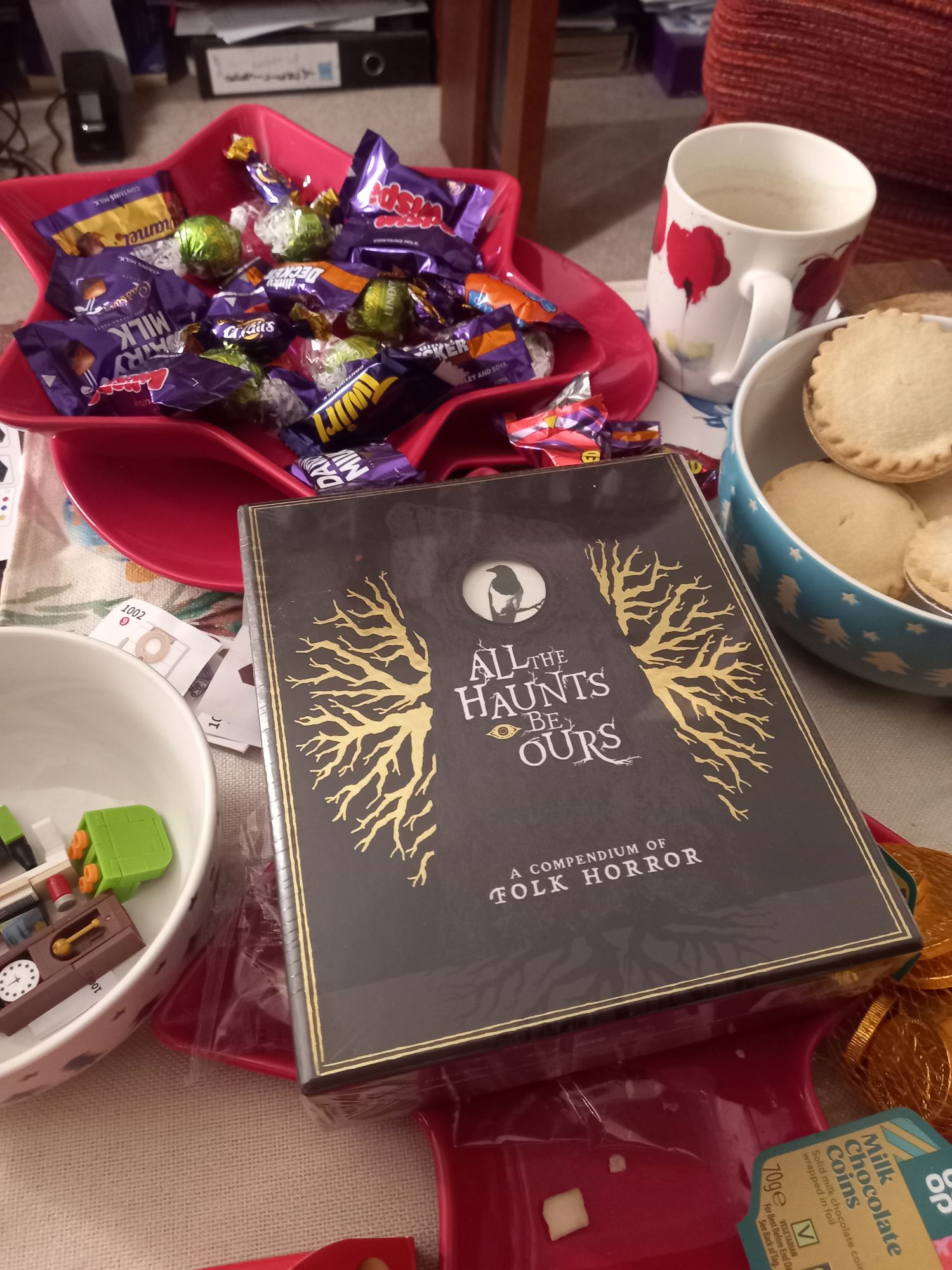
I was so spoiled this year. I got the 2 volume box set of All the Haunts Be Ours for Christmas. I had only tentatively asked for the 2nd volume, as it’s pretty expensive, to be a combined Christmas/birthday gift, but Himself got me both volumes and I got them on Christmas Day, along with a stuffed crocheted bee mascot, which is very soft and very cute.
Anyway, the compendium of folk horror… Let me take you through the films and extras on the discs of volume one to start off with, and the contents of the accompanying book. This is a massive post because there are so many things.
Not only does it look gorgeous, both the book and the set as a whole, it is definitely worth a read and a watch. I appreciate it is pricey, so I will break down what is in here and you can have a go at sourcing these films elsewhere.
I’m going to introduce you to Volume 1 first, then Volume 2 in another post. A lot of the first compendium are ones I’ve already seen, but all are ones I’ve enjoyed and want to rewatch.


Honestly, I can’t wait to watch them, but there’s a snag. I don’t own a Blu-ray player. I own a DVD player that only opens when there is already a disc inside. If not, you have to smack the top of it quite hard, and in the right place, for it to pop out. When you turn it on, it hisses. The hissing is just background noise, but constant.

I thought it’s probably time I got a new one, as mine is at least 15 years old. This is my sign. I’m waiting for the January Sales to get myself a Blu-ray/DVD player, and then I shall settle in to watch my new compendium…
… But in the meantime, I have the books of both volumes to go through. I will take you through the Vol 1 book of essays first and then the disc contents – and then when I watch the disc, I’ll probably do individual posts on the films then, either here, or for Divination Hollow, where I’m a contributor.
CONTENTS OF THE BOOK (Vol. 1)
Volume 1 contains a 156-page booklet, designed by Luke Insect, edited by Kier-La Janisse, director of the Woodlands Dark and Days Bewitched documentary.
The book is prefaced by an excerpt from Storyteller, by Leslie Marmon Silko, a Native American poet and novelist of the Laguna Pueblo tribe. This was a really moving preface that set the tone for the films and essays that follow, and the reasons for making folk horror, the clashing cultures of traditional life versus industrial capitalism, from the perspective of the practicing witches within these traditional indigenous cultures. Note that this was originally published in 1981, and a slur for Inuits appears in it.
Essays by film scholars, authors, and historians:
- “Wouldst Thou Like To See The World?” An Introduction by Andy Paciorek.
- The Nature of Folk Horror by Dawn Keetley
- Strange Colonies by Mitch Horowitz
- We Aren’t Superstition by Stephen Vincent Benét
- Wrestling with Witches: Sticking Pins in Movie Malevolence by Stephen Volk
- The Cult of Death is a Way of Life: Folk Horror and the Feminine in Mexican Identity by Sarah Chavez
- Tilbury by Þórarinn Eldjárn – his original short story translated into English, reproduced here in full. Its adaptation is included in the compendium.
- The Serbian Roots of the Vampire Family Tree by Dejan Ognjanović
- Genealogy of a Legend: Tracking the Fool-Killer by Stephen R. Bissette
- LAMKIN: The Motivation of Horror by John DeWitt Niles
- The Hobyahs – a fairy tale reprinted from More English Fairy Tales (1894) collected by Joseph Jacobs. This story is very short, and very grim (dog abuse).
- Appendix: The Films
- Credits and Thanks
CONTENT SUMMARY
Volume 1: 12 Blu-rays, 3 CDs, 20 feature films, plus 15+ hours of special features and more.
Special features include short films, audio commentaries, and exclusive features, including Kier-La Janisse’s award-winning documentary, Woodlands Dark and Days Bewitched.
There is a 2-disc reading of Arthur Machen’s story, The White People, the bulk of which is reproduced verbatim in T. Kingfisher’s novel The Twisted Ones, which I found deeply irritating for its lazy, repeated potshots at the Welsh language for cheap laughs. Anyway, if you have read this novel, you will be familiar with the majority of Machen story. It comes with a score composed by Timothy Fife, and is read by actress Linda Hayden.
CONTENT DETAILS
Disc One:
Woodlands Dark and Days Bewitched: A History of Folk Horror (2021) dir. Kier-La Janisse.
An exploration of the cinematic history of the folk horror, from its beginnings in the UK in the late sixties; through its proliferation on British television in the seventies and its many manifestations, culturally specific, in other countries; to its resurgence in the last decade.
I’ve seen this documentary before, and it’s excellent. It’s produced by Severin Films. USA.
Extras:
Video Introduction by Writer/Director/Producer Kier-La Janisse (8mins)
Animating Folk Horror – A Conversation with Ashley Thorpe (12mins)
Outtake: What is Folk Horror? (2mins)
Outtake: Harvest Hymns – The Sounds and Signals of Folk Horror (22mins)
Outtake: Terra Assombrada – Expressions of Folk Horror in Brazil (7mins)
Folk Poetry (5mins): Ian Ogilvy recites H.P. Lovecraft’s poem “A Garden”, and W.B. Yeats’ poem “The Stolen Child”. Linda Hayden recites Grey Malkin’s “Doonie Woods” set to Super 8 footage shot by David Gregory and Neil Edwards.
Disc Two:
Eyes of Fire (1983) dir. Avery Crounse.
The secret is sleeping in the trees.
In 1750, an adulterous preacher is ejected from a small British colony with his motley crew of followers, who make their way downriver to establish a new settlement of their own beyond the western frontier.
Another rewatch for me, and this is one I really like. Another USA-made film.
Extras:
Audio Commentary with Colin Dickey, Author of Ghostland: An American History In Haunted Places
Author Stephen Thrower Interviews Writer/Director Avery Crounse
CRYING BLUE SKY (alt title for Eyes of Fire) – Alternate, Longer Cut, restored in 2k from the director’s personal 35mm answer print.
Bonus Short Films
The Legend of Sleepy Hollow (1972) dir. Sam Weiss (13mins)
Synopsis
John Carradine narrates the Washington Irving story of Ichabod Crane and the Headless Horseman.
Transformations (1972) dir. Barbara Hirschfeld (8.5mins)
A tribal film.
A coven of witches gather in Vermont in a feminist collective’s transporting short that shakes off patriarchal scrutiny during the women’s ceremony, where they’re free to remake reality before our eyes. TRANSFORMATIONS creates an intoxicating alchemy from the witches’ interactions with nature: an attempt, as Hirschfeld remembers, to “use the act of filmmaking to heighten experience.”
Backwoods (2018) dir. Ryan Mackfall (15mins)
1907, Massachusetts. A scholar drifts from his path and finds himself in a house he assumed to be deserted – apart from a beguiling book containing dark secrets that exerts a powerful hold over those who come into contact with it.
Based on H.P. Lovecraft’s “The Picture In The House”.
Disc Three:
Лептирица/Leptirica (1973) dir. Đorđe Kadijević.
If fear has its name, then it is LEPTIRICA!
A young man wants to marry the beautiful daughter of a landowner who refuses to allow the marriage. To prove his worth, the young man becomes a miller in a vampire-infested local mill.
Based on the Serbian classic vampire story, After Ninety Years by Milovan Glišić (1880). You can listen to a translated version here. This is another rewatch, and I’m really pleased to own a copy of this film now! The depiction of the boredom and day-to-day grind of village life punctuated by superstition and erotic, horrific moments, really speaks to me.
Extras:
Radical Fairy Tales – Interview with Director Đorđe Kadijević (31mins)
Diary of an Inmate – Interview with Štićenik actor, Milan Mihailovic (10mins)
Prisoner of Song – Interview with Devičanska svirka actor, Goran Sultanovic (10mins)
Short Films:
Štićenik/Ward (1973) dir. Đorđe Kadijević (45mins)
A terrified young man is being pursued by a mysterious man in black. He hides out in a nearby mental hospital, but can he escape his fate?
Devičanska svirka/The Maiden’s Tune (1973) dir. Đorđe Kadijević (60mins)
A man heading through the countryside is drawn to a strange castle, which is reputed by the locals to be haunted. There he meets a beguiling young woman who ensnares him in her world of secrets.
Disc Four:
Kladivo na čarodějnice/Witchhammer (1970) dir. Otakar Vávra.
Anyone who stands up for heretics is considered a hectic himself!
In the 1600s, an overzealous clergy hauls innocent women in front of tribunals, forces them to confess to imaginary witchery, and engages in brutal torture and persecution of their subjects.
Another rewatch, and another film I’m glad to actually own. Czech New Wave.
Вий/Viy (1967) dirs. Georgi Kropachyov, Konstantin Ershov.
The Soviet Union’s first horror film!
A seminary student on monastery holiday kills an old witch in a remote village. The hag then transforms into a beautiful young woman whose dying wish is for him to watch over her wake for three nights. With terrors occurring and his faith waning, he reads prayers on the overnight watch and tries to survive the supernatural encounters.
I love this film! It’s really fun, and I’m very excited to hear the commentary and interviews. This will be another rewatch.
Extras:
Witchhamer Audio Commentary with Czech Film Historian and Curator, Irena Kovarova
From the Woods to the Cosmos – John Leman Riley on the History of Soviet Fantasy and Sci-Fi Film (34mins)
Viy Trailer
The Womb of Woman is the Gateway to Hell – Appreciation by Essayist and Critic Kat Ellinger and Film Historian Michael Brooke (22.5mins)
The Projection Booth Podcast – Witchhammer Episode with host Mike White, and guest critics Samm Deighan and Rahne Alexander. (62mins)
Silent Short Films:
Сатана ликующий/Satan Exultant (1917) dir. Yakov Protazanov. (20mins)
Pastor Talnoх furiously urges the flock to fight temptations, but he himself becomes a victim of temptation. In his house appears Satan, pushing the hero to theft and spiritual fall.
Пиковая дама/The Queen of Spades (1916) dir. Yakov Protazanov. (16mins)
While hosting a game of cards one night, Narumov tells his friends a story about his grandmother, a Countess. As a young woman, she had once incurred an enormous gambling debt, which she was able to erase by learning a secret that guaranteed that she could win by playing her cards in a certain order. One of Narumov’s friends, German, has never gambled, but he is intrigued by the story about the Countess and her secret. He soon becomes obsessed with learning this secret from her, and he starts by courting her young ward Lizaveta, hoping to use her to gain access to the Countess.
Портрет/The Portrait (1915) dir. Władysław Starewicz. (8mins)
A man is increasingly unnerved by a mysterious portrait. Based on a story by Nikolai Gogol, the film is thought to have run about 45 minutes long, but only an 8 minute fragment is known to have survived.
These are the fragments surviving from the above 3 films, all of which were originally much longer.
Disc Five:
De dødes tjern/Lake of the Dead (1958) dir. Kåre Bergstrøm.
A group of friends travel to a cabin in the Norwegian forest to join Bjorn, brother to Liljan, in his remote cabin. When they arrive to find his dog dead and Bjorn missing, Liljan is convinced her brother is in danger – compounded by the legend she learns of the cabin’s previous occupant, who killed his sister and his lover there, then drowned himself in the lake. Now, whoever stays there is doomed to repeat this pattern…
Norwegian classic, remade in 2019, and an adaptation of Andre Bjerke’s 1942 novel.
Tilbury (1987) dir. Viðar Víkingsson
In 1940, when there are British forces in Iceland, a country boy goes to Reykjavik to work for the army and to find what became of his childhood sweetheart. He soon discovers that she’s having an affair with a British soldier. Moreover, he starts to suspect that the soldier, instead of being an officer and a gentleman, is in fact a very peculiar kind of monster.
I haven’t seen this one! I really want to watch more Icelandic horror – I loved the modern Icelandic Weird Gothic horror film Rökkur/Rift (2017) dir. Erlingur Thoroddsen, the breakdown of a gay relationship and lots of timey-wimey weirdness. The mini-series Katla is equally weird and a good watch, created by Sigurjón Kjartansson and Baltasar Kormákur. Also, The Damned (2024) dir. Thordur Palsson was great Arctic Gothic Folk Horror, with folklore blending with psychological horror.
This made-for-TV film is based on the short story by Þórarinn Eldjárn, Tilbury, based on the folklore of the tilberi, a beast that can be summoned by women in times of financial hardship or starvation; but their gifts come with their own brand of destruction. Eldjárn’s original short story is reproduced in the booklet, translated into English.
Extras:
Audio Commentary with Film Historians Jonathan Rigby and Kevin Lyons
Audio Commentary with director Viðar Víkingsson and screenwriter Þórarinn Eldjárn, moderated by film scholar Gudrun D. Whitehead.
With Enough Tilbury Butter, Anything is Good – Interview with Karl Ágúst Úlfsson (6mins)
A Boy From The Country – Interview with Kristján Franklin Magnúss (3mins)
The Moon Fades, Death Rides – Viðar Víkingsson discusses the folkloric origins of White Spot in the Back of the Head. (5mins)
Short Films:
White Spot in the Back of the Head (1979) dir. Viðar Víkingsson (33mins)
An adaptation of the Icelandic ghost story of “The Deacon of Dark River”, set in 1970s France.
We went on the Folklore Tour of Reykjavik when we went there in June 2025, and this tale, the Deacon of the Dark River, was told to us in the cemetary.
[Big shout out to Einar the guide, and Your Friend in Reykjavik, who faciliate the tours! As well as the Folklore tour, we also did the Food Tour, and had a wonderful time on both. We will absolutely be doing this again when we come back to Iceland, we had an unforgettable few days.]
Disc Six:
The Dreaming (1988) dir. Mario Andreacchio.
Are they dreams or nightmares…Nightmares or premonitions?
When a group of Indigenous activists attempt to repatriate ancestral artifacts found in a cave on Australia’s Kangaroo Island, one of them is shot, evading police and taken to a local hospital, where the doctor attending to her experiences strange visions relating to violent events from the past.
I’ve been watching more Australian horror and I’ve wanted to see more Aboriginal horror by indigenous directors and writers. I’ve recently seen feature film The Moogai (2024) dir. Jon Bell, and I’ve enjoyed other Australian films like Talk to Me (2022) and Relic (2020), Run Rabbit Run (2023), You’ll Never Find Me (2023), Violett (2023), and The Babadook (2014). A lot of these are by women directors, but I’d like to expand my horizons further.
This one is new-to-me, both the director and the film.
Kadaicha (1988) dir. James Bogle
Who says you can’t get blood out of a stone…
Teens of Kangaloola High are visited by a skull-faced Aboriginal apparition in their nightmares, and one by one they meet a violent end.
Another new-to-me director and film, which I’m very excited to watch.
Extras:
The Dreaming Audio Commentary with director Mario Andreacchio, moderated by film historian Jarret Gahan
The Dreaming Trailer
Kadaicha Audio Commentary with director James Bogle, moderated by veteran film journalist Michael Helms
The Final Girl of KADAICHA – Audio Interview with actress Zoe Carides, conducted by film historian Jarret Gahan (13mins)
Composing KADAICHA – Audio Interview with composer Peter Westheimer, conducted by film historian Jarret Gahan (17.5mins)
Behind the Scenes of KADAICHA – recently unearthed footage of director James Bogle and the cast and crew during a typical day on set (7mins).
Kadaicha Trailer
Disc Seven:
Celia (1989) dir. Ann Turner.
A tale of innocence corrupted.
In 1950s Australia, young Celia is growing up with a sense of isolation and mistrust of the world that surrounds her. Her mother and father won’t let her play with the kids next door because their parents are communists. Then her pet bunny is taken away because of rabbit overpopulation. And, more traumatizing yet, when her grandmother dies, she’s the one to discover the corpse. To cope, she retreats into elaborate fantasies.
More Australian folk horror, and by another new-to-me director, as well as being a new-to-me film.
Alison’s Birthday (1981) dir. Ian Coughlan.
She’ll never forget her party… and neither will you!
During a Ouija board session with her teenaged friends, 16-year-old Alison gets a message from beyond the grave not to go home for her birthday three years later.
Another new-to-me director and film. I’m very excited for this one.
Extras:
CELIA and me – A New Interview with director Ann Turner (40mins)
From Crawfords to CELIA – Interview with veteran editor Ken Sallows (17mins)
The Rabbit in Australia – short documentary produced by Australia’s national science agency CSIRO (24mins)
ALISON’S BIRTHDAY – Extended Interviews from NOT QUITE HOLLYWOOD with producer David Hannay and cast members Joanne Samuel and Belinda Giblin (12mins)
The Devil Down Under – Satanic Panic in Australia from Rosaleen Norton to ALISON’S BIRTHDAY (15mins)
Disc Eight:
Wilczyca/She-Wolf (1983) dir. Marek Piestrak.
In 1848 Poland, Kacper Wosinski is cursed by his wife Maryna on her deathbed. Her evil spirit then haunts him in the form of a she-wolf.
I find Polish films a bit hit and miss for me, but I’m always interested in finding more I like. Will this disc deliver? Let’s see!
Lokis: Rękopis profesora Wittembacha/Lokis: A Manuscript of Professor Wittembach (1970) dir. Janusz Majewski.
A pastor and ethnographer visits a remote corner of 19th-century Lithuania where folk customs associated with the area’s pagan past still have a hold on the population.
Another Polish film, set in Lithuania, and another new-to-me film and director.
Extras:
Unleashing the She-Wolf – Interview with director Marek Piestrak
Wild Country of the Were-Bear – Interview with director Janusz Majewski
Disc Nine:
Clearcut (1991) dir. Ryszard Bugajski.
The violence has begun.
A white lawyer finds his values shaken when he is paired with an angry Indigenous activist who insists on kidnapping the head of a logging company to teach him the price of his destruction.
Canadian First Nations folk horror, restored in 4k from 35mm answer print. I’m excited for this disc, as it’s full of North American First Nations films. I want to watch more horror like this, as I remember liking Slash/Back (2022) and Don’t Say Its Name (2021).
Extras:
Archival Video Introduction by director Ryszard Bugajski (7.5mins)
Audio Commentary with scholar and anthropologist Shaawano Chad Uran (White Earth Anishinaabe)
Archival Audio Interview with director Ryszard Bugajski and journalist Allan MacInnis (98mins)
A Dream Like Arthur’s – Audio Interview with actor Graham Greene (16mins)
Composing CLEARCUT – Interview with composer Shane Harvey (17mins)
Audio Commentary for THE BALLAD OF CROWFOOT with Kevin Howes and Lawrence Dunn.
Short Films:
The Ballad of Crowfoot (1968) dir. Willie Dunn (10mins)
Often referred to as Canada’s first music video, Mi’kmaq/Scottish folk singer and activist Willie Dunn’s The Ballad of Crowfoot is a powerful look at colonial betrayals, told through a striking montage of archival images and a ballad composed by Dunn himself about the legendary 19th-century Siksika (Blackfoot) chief who negotiated Treaty 7 on behalf of the Blackfoot Confederacy.
You Are on Indian Land (1969) dir. Michael Kanentakeron Mitchell (37mins)
A landmark film that documents a 1969 protest by the Kanien’kéhaka (Mohawk) of Akwesasne, a territory that straddles the Canada-US border, which occurred when Canadian authorities prohibited the duty-free cross-border passage of personal purchases – a right established by the Jay Treaty of 1794 – causing Kanien’kéhaka protesters to block the international bridge between Ontario and New York State. YOU ARE ON INDIAN LAND screened extensively across the continent, helping to mobilize a new wave of Indiginous activism. Notably, it was shown at the 1970 occupation of Alcatraz.
Consume (2017) dir. Michael Peterson. (20mins)
Residential school survivor Jacob struggles to hang onto his family and identity as his demons threaten to manifest.
Disc Ten:
Il Demonio/The Demon (1963) dir. Brunello Rondi.
A night she wakes up bound to the bed and with the bleeding body. The revenge of the devil will not delay!
Purif is distraught when her lover is betrothed to another. When she summons the old ways to curse him, her erratic behavior is interpreted as demonic possession, and the villagers turn against her with physical and sexual violence.
Here we go with Southern Italian folk horror, and this is one I haven’t seen! This is a predecessor to Lucio Fulci’s acclaimed giallo, Don’t Torture a Duckling (1972). I’m not keen on sexual violence and assault in films, but I am braced for it. [Stuff I won’t watch and find too visceral include really graphic rape scenes, stuff like Satan’s Slave (1976) and its opening assault sequence with scissors.]
Dark Waters (1993) dir. Mariano Baino.
A New Wave of Horror
After the death of her father, a young woman travels to a remote convent on an island in the Black Sea to find out why her father funded it for years.
This has been on my watchlist for ages but I’ve never been able to find it on my streaming platforms. I am so excited to watch it!
Extras:
IL DEMONIO Audio Commentary with film historian Kat Ellinger
DARK WATERS Audio Commentary with writer/director Mariano Baino
“The Kid from a Kibbutz” – Daliah Lavi and the Road to IL DEMONIO (27.5mins)
Once Upon a Time in Basilicata (23mins) – Alberto Pezzotta, Rondi’s biographer, looks at the themes that dominated Brunello Rondi’s career.
Deep into the Dark Waters (50mins) – the cast and crew recall the making of DARK WATERS in this archival documentary featurette.
Disc Eleven:
A Field in England (2013) dir. Ben Wheatley.
Open Up And Let The Devil In
During the Civil War in 17th-Century England, a small group of deserters flee from a raging battle through an overgrown field. They are captured by an alchemist, who forces the group to aid him in his search to find a hidden treasure that he believes is buried in the field. Crossing a vast mushroom circle, which provides their first meal, the group quickly descend into a chaos of arguments, fighting and paranoia, and, as it becomes clear that the treasure might be something other than gold, they slowly become victim to the terrifying energies trapped inside the field.
I’ve avoided watching this one until now, as I really don’t like mushroom trips and things like that. However, for completeness, I will give this a go.
Anchoress (1993) dir. Chris Newby.
Ecstasy and orthodoxy in the 14th century!
A 14th-century peasant becomes transfixed by a statue of the Virgin Mary, and petitions to be walled into a cell attached to the church as a religious hermit.
Based partly on the true story of Christine Carpenter, anchoress of Shere, this is full of visions and sensual and spiritual awakening.
Extras:
A FIELD IN ENGLAND Audio Commentary with director Ben Wheatley, producer Andy Starke and sound editor Martin Pavey
Letterboxd Magic Hour Episode One: Kier-La Janisse X Ben Wheatley (45mins) – Wheatley talks folk horror with Kier-La Janisse in this special online interview conducted for the release of Wheatley’s IN THE EARTH.
Please Hear Me – The Music of A FIELD IN ENGLAND (6mins)
Ben Wheatley in Conversation with Pete Tombs (23mins)
A Field In England Camera Tests (10.5mins)
A Field In England UK Trailer
A Field In England US Trailer
Lockdown 1329 (13.5mins) – a video essay by Chris Newby that explores parallels between COVID lockdowns in the UK and Christine Carpenter’s experience as an anchoress, featuring outtakes from the film.
A Short Trip to Shere (2.5mins) – Chris Newby documents the location of the real Christine Carpenter’s anchoress cell at St James’s church in Shere, England.
Disc Twelve:
Penda’s Fen (1974) dir. Alan Clarke.
I’m Nothing Pure
Through a series of real and imagined encounters with angels, demons, and England’s pagan past, a pastor’s son begins to question his religion and politics, and comes to terms with his sexuality.
I’ve wanted to see this for ages! It’s about a gay man (in 1974) coming to terms with his sexuality and who he is, told in a folk horror way. This is the one where our protagonist is visited by the ghost of Edward Elgar, among other things.
Robin Redbreast (1970) dir. James MacTaggart.
After the break-up of a long-term relationship, urban sophisticate Norah seeks refuge in a remote house in the country.
I’ve been so close to renting this a few times, but now I don’t need to! This was written by John Bowen, who also wrote two of the Ghost Story for Christmas episodes; the adaptation of The Treasure of Abbot Thomas, and an original story, The Ice House. I’m not sure how I will get on with this film, as Abbot Thomas isn’t my favourite adaptation, and The Ice House was chilling in more ways than one but not my favourite original. But let’s see.
Extras:
PENDA’S FEN Audio Commentary with James Machin and Matthew Harle
The Landscape of Feelings – The Road to PENDA’S FEN (16mins)
ROBIN REDBREAST Audio Commentary with William Fowler and Vic Pratt
Interview with John Bowen, writer of ROBIN REDBREAST (12mins)
Short Films:
The Pledge (1981) dir. Digby Rumsey (22mins)
Three criminals pledge to free the soul of their friend from his gibbeted corpse in this short film based on ‘The Highwayman’ by Lord Dunsany. A dark, luscious film co-edited by an uncredited Peter Greenaway and featuring music by Michael Nyman.
More people need to be aware of Lord Dunsany’s work, honestly. There is a gorgeous box set of his work that has been given the go-ahead by the estate, illustrated by Thomas S. Brown, and I can’t wait for that to come out.
The Sermon (2018) dir. Dean Puckett (12mins)
They have witnessed…an abomination!
A young woman’s secret rocks an isolated church community.
Disc Thirteen:
CD: The original soundtrack of Woodlands Dark and Days Bewitched, composed and performed by Jim Williams.
- Wounds That Were So Red
- Hell Is Deeper Than The Sea
- The Stalk Is Withered Dry
- A Grave Long, Wide and Deep
- He Shall Sing Us a Mass
- Mantle of Red Scarlet
- Order the Coffin Opened Wide
- The Darkling Thrush – lyrics by Thomas Hardy, sung by Jim Williams
- Livelong Winter’s Night
- The Nine Witch Knots
- The Mirk and Midnight Hour
- High Hanged Should He Be
- An Ill Death May She Die
- Penance I Will Give Thee None
- If the Devil Won’t Be Damned
- I Saw Him Laid in Clay
- She Wept Most Bitterly
- This Cursed Hand of Mine
- Heart’s Blood…
- A Fire of Coals to Burn Her
- …On the Ground
- She the Fiend Did Name
- Gone in the Devil’s Name
- The Stair It Was Full Fifteen Steps
- A Great and Gruesome Beast
- Lambkin – traditional, sung by Lisa Abbott
- By Oak and Ash and Bitter Thorn
- She Saw the Flames Ascending High
- Your Eyes They Look So Dim
- Eyes as Black as Sloe
- The Hour of Gloaming Gray
- Many a Widow Poor
- Drinking of the Blood-Red Wine
- The New Moon Clear
- Pay for Fouling the Well
- Witch of the Vilest Kind
- I Have Come for to See You Hang
- Vanished in a Cloud of Mist
- There Is a Place Prepared in Hell
Disc Fourteen:
CD: The White People (Part 1) written by Arthur Machen, read by Linda Hayden
Disc Fifteen:
CD: The White People (Part 2) written by Arthur Machen, read by Linda Hayden
Read this story free on Project Gutenberg. There are a couple of free audio versions on YouTube: Tony Walker’s version, and Gates of Imagination’s version narrated by Arthur Lane.
I’ve also been gifted Volume 2, and I will share the contents of that compendium next. I’m so excited to get into them.






Leave a Reply