
Check out what’s included in Volume 1 in my first appreciation post of this compendium! This is the volume I have really wanted for ages, and I’m so happy to get both.
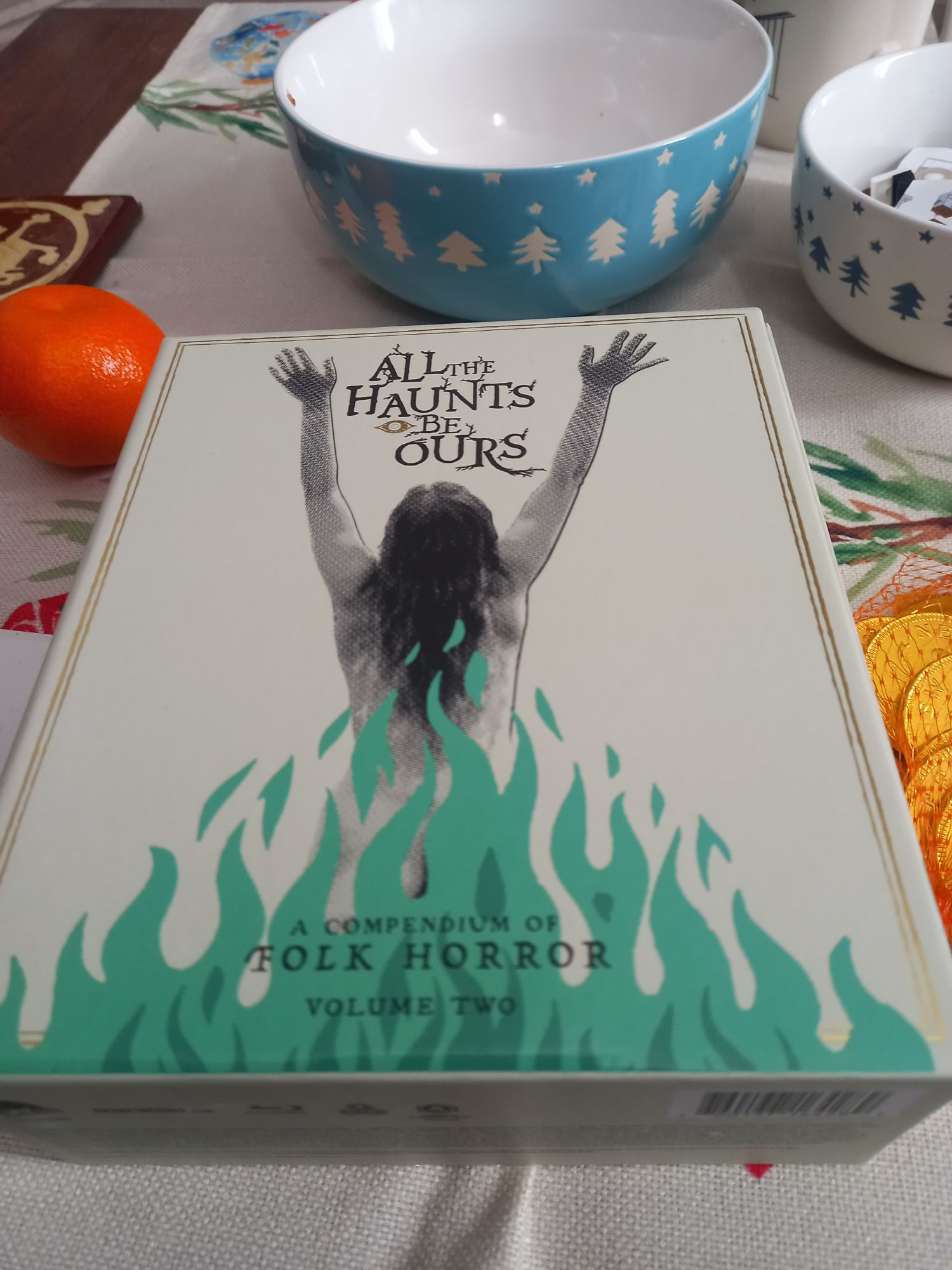
Here is the gorgeous Volume Two with its hardback storybook and film guide!


I’m really excited to get into the storybook, and once I get my new Blu-ray/DVD combi player I will start doing reviews of the films! I’ll probably do individual posts on the films then, either here, or for Divination Hollow, where I’m a contributor.
CONTENTS OF THE STORYBOOK & FILM GUIDE

I’m really excited for the Cynthia Pelayo, Cassandra Khaw, Kim Newman, and Ramsey Campbell stories in particular, and to read the others from authors I don’t know as well. Drazen Kozjan’s illustrations are gorgeous and peppered throughout. Each story gets a full page illustration and a title illustration.
The book was copy edited by Amanda Reyes and Amy Voorhees Searles, with the layout by David Levine. It is a Severin Films compilation.
We have:
Introduction by Kier-La Janisse (compiler of the book, and director of the award-winning folk horror documentary Woodlands Dark and Days Bewitched.)
Every Second Saturday, Sea Island Silencers Meet In Secret by Eden Royce
Apple Annie’s Fancy by Kim Newman
I Can Hear You by Cynthia Pelayo
We Are Phil by Sarah Gailey
Mortar Pestle Comfort Crumble by Chandra Mayor
The Bricky Pond by Steve Duffy
Matters of the Heart by Eric Schaller
Top Hat Man by Erika T. Wurth
Bati by Yvette Tan
Stick In The Mud by Ramsey Campbell
Kindling by Cassandra Khaw
The Ferryman by Lynda E. Rucker
What a line up! They are very short stories, and I’m going to try and dip in and out of these even when I find reading and concentrating on written words difficult.
The film guide goes through the films in alphabetical order, with the summary and credits for each, and has the credits and thanks at the end. Where films have associated special features, these are included on that film’s page.
The film guide is also very attractive, with each page coloured and patterned, with film posters and stills on each page. I am really excited to dive into these discs!
CONTENT SUMMARY
Volume 2: 13 Blu-ray discs, including 24 international folk horror films and 55+ hours of special features, 1 illustrated hardcover storybook collection of folk horror tales by various authors, 1 film guide.
Special features include audio commentaries, short films, interviews, video essays, and more.
The storybook is a star by itself, honestly, and I can’t wait to dig into it.
CONTENT DETAILS
Disc One:
To Fire You Come At Last (2023) dir. Sean Hogan.
In rural 17th-century England, a group of men gather to carry a coffin on the long walk to the local graveyard for burial. Much ancient folklore and superstition surround the pathway to the church, and several of the party are afraid to walk it after dark. Squire Marlow, the grieving father of the dead man, promises to double their wages if they agree to make the mysterious journey full of unexpected revelations.
My first thought reading this summary was Robert Aickman’s short story, “The Real Road to the Church”, and the folklore surrounding coffin roads. I’d be interested to see where Hogan takes this; this one is new to me, so I’ll be getting something fresh straight out of the gate!
Psychomania (1973) dir. Don Sharp.
The Dead Still Ride… the Living Howl in Terror!
A gang of young people call themselves the Living Dead. They terrorize the population from their small town. After an agreement with the devil, if they kill themselves firmly believing in it, they will survive and gain eternal life. Following their leader, they commit suicide one after the other, but things don’t necessarily turn out as expected…
This is a genuinely hilarious mess of a film, I’ve watched it so many times, and it’s hilarious every time. Bikers! Frog God! Really Long Sandwich! I can’t tell you how happy I am to own a copy of this now: I rely on YouTube for my Psychomania fix usually. If you want a folk horror that literally tricked its actors into starring in it, and you don’t take too seriously, this is Peak. God tier. Frog god tier. I think what I’m looking forward to the most is the commentary for this one, I’m so curious to see if they take it seriously or not.
Extras:
TO FIRE YOU COME AT LAST Audio Commentary with director Sean Hogan and co-producers Paul Goodwin and Nicholas Harwood
On the Lych Way – Corpse Road chronicler Dr Stuart Dunn discusses the pathways of the dead (16mins)
TO FIRE YOU COME AT LAST Trailer
PSYCHOMANIA Audio Commentary with Maria J. Pérez Cuervo
PSYCHOMANIA Introduction by film historian Chris Alexander (5.5mins)
Stone Warnings – Dr Diane A. Rodgers on Stone Circles and Standing Stones in Film and Television (28.5 mins)
Return of the Living Dead – Interviews with actors Nicky Henson, Mary Larkin, Denis Gilmore, Roy Holder, and Rocky Taylor (25mins)
The Sound of PSYCHOMANIA – Interview with soundtrack composer John Cameron (9mins)
Riding Free – Interview with ‘Riding Free’ singer Harvey Andrews (6.5mins)
PSYCHOMANIA Theatrical Trailer
WE ALWAYS FIND OURSELVES IN THE SEA Audio Commentary with director Sean Hogan and co-producers Paul Goodwin and Nicholas Harwood
EPK for WE ALWAYS FIND OURSELVES IN THE SEA (9.5mins)
Short Films:
We Always Find Ourselves In The Sea (2017) dir. Sean Hogan (22.5mins)
A windswept ghost story set on England’s southeastern coast. A lonely old man living in a desolate town receives an unexpected visitor from his past.
Our Selves Unknown (2014) dir. Edwin Rostron (3mins)
Exploring ideas of landscape and dislocation, OUR SELVES UNKNOWN takes architect Lionel Brett’s 1965 book ‘Landscape in Distress’ as its sole raw material, isolating and reconfiguring its photographic illustrations, text and cover design as pencil and ink drawings, using a working process of self-enforced rules and restrictions, obstacles and chance.
Disc Two:
The Enchanted (1984) dir. Carter Lord.
A Strange and Beautiful Place – A Door Between Two Worlds
Royce Hagan returns from the sea to claim and inhabit a 2000 acre ranch in one of the last wild places left in central Florida. Old family friend Booker T Robertson (Julius Harris) is welcoming but warns him not to get “too close” to a strange family living in the woods nearby. Royce falls in love with Twyla, the oldest daughter, and discovers the bizarre secret of the Hole in the Wall and the enchanted people who live there.
This is a new-to-me film based on Elizabeth Coatsworth’s 1951 fantasy story The Enchanted, an Incredible Tale.
Who Fears the Devil / The Legend of Hillbilly John (1973) dir. John Newland
From ghostly hark mountain this eerie story of witches … voodoo … devils … monsters… mountain folk swear it’s true!
A roaming hillbilly, on a quest to defy the Devil, encounters several supernatural characters and does battle with his silver-stringed guitar. Based on Manly Wade Wellman’s beloved literary character, John the Balladeer, WHO FEARS THE DEVIL was re-released as ‘The Legend of Hillbilly John’ with an alternate opening.
This one sounds fascinating. It’s a loose adaptation of two of Portuguese West Africa-born author Manly Wade Wellman‘s stories, ‘The Desrick on Yandro‘ and ‘O Ugly Bird!‘. Wellman (1903-1986) moved to the US at age 6, and grew up to be a pulp speculative fiction author, but he’s new to me, so I’m excited to discover him and this film version of his work. It features the debut performance of Hedges Capers as John, who composed and performed several songs in the film.
Extras:
THE ENCHANTED Audio Commentary with director Carter Lord and camera assistant Richard Grange, moderated by filmmaker/author Kier-La Janisse
THE ENCHANTED Audio Commentary with award-winning authors Chesya Burke and Sheree Renée Thomas
A Magical Place – an interview with THE ENCHANTED composer Phil Sawyer (11.5mins)
Hole in the Wall – THE ENCHANTED Character Notes by screenwriter Charné Porter (5mins)
WHO FEARS THE DEVIL Audio Commentary with Television Historian Amanda Reyes
THE LEGEND OF HILLBILLY JOHN Alternate Opening Introduced by actor Severn Darden (4mins)
Crumble Will the Feet of Clay – Interview with producer Barney Rosenzweig (35mins)
Silver Strings – Interview with actor/musician Hedges Capers (21mins)
Manly of the Mountains – Author David Drake remembers Manly Wade Williams (16.5mins)
Occult Appalachia – Occult historian Mitch Horowitz on the arcane texts of Wellman’s John the Balladeer Stories (22.5mins)
WHO FEARS THE DEVIL Theatrical Trailer
Short Films:
Swimmer (1973) dir. Carter Lord (24mins)
A Remarkable Work by Don Seiler
A glimpse into the life of sculptor Don Seiler – who would go on to create the painted murals of THE ENCHANTED – during the creation of a ten-ton concrete commission, in honor of Olympic swimmer Mark Spitz, for the International Swimming Hall of Fame in Ft. Lauderdale, Florida, in the early 1970s.
Disc Three:
Valkoinen peura/The White Reindeer (1952) dir. Erik Blomberg
Finland’s greatest horror film!
A newly-married woman becomes frustrated as her husband, a reindeer herder for an Arctic village, spends much of his time away. Desperate for affection, she visits a shaman who offers a potion that makes her irresistibly desirable, with unexpected and deadly results.
I love this film, it’s a rewatch for me, but I’m really glad I get to own it. It is based on Sámi folklore, and attempts a for-the-time respectful portrayal of the Sámi, but this portrayal and representation is considered problematic today.
SG̲aawaay Ḵ’uuna/Edge of the Knife (2018) dirs. Helen Haig-Brown, Gwaai Edenshaw
Island of Haida Gwaii, northern Canada, 19th century. During a fishing gathering, Adiits’ii commits an unfortunate act. Tormented, he runs away to the wilderness as his mind embraces madness.
This is the first Haida language film, and I’ve wanted to get hold of this one for a while now. It was the film that drew my attention to this folk horror compendium in the first place! I’m really excited to watch this one, and hear the Haida language for the first time. Himself loves langauges and linguistics, and did his PhD on case theory and its relationship to computer langauges for mobile interfaces, or something like that (don’t ask me, I did mine in a very niche area of British Medieval History). Anyway, I think this will be one he’s also interested in, or if not the film, the special features!
Extras:
The Projection Booth episode on THE WHITE REINDEER hosted by Mike White and feat. Kat Ellinger (68mins)
EDGE OF THE KNIFE Audio Commentary with directors Helen Haig-Brown and Gwaai Edenshaw.
RETAKE – Making the World’s First Haida-Language Feature Film (2018) dir. Kristi Lane Sinclair (24.5mins) – This documentary by Kristi Lane Sinclair (Haida/Cree) offers an intimate behind-the-scenes look at the filming of EDGE OF THE KNIFE, including the challenges of working in a remote, formidable location and in a critically endangered Indigenous language.
Short Films:
Noitarumpu/A Witch Drum (1982) dir. Kari Kekkonen (10mins)
In a barren, snowy Lapland landscape a man in a reindeer sled escorts a shaman’s corpse to its final resting place. In the pale moonlight the fear is starting to take over, since something has awakened the shaman.
The Nightside of the Sky (2023) dir. Rhayne Vermette (4.5mins)
In this experimental short film specially commissioned from celebrated Métis filmmaker Rhayne Vernette for Severin’s All the Haunts Be Ours vol. 2, images from The White Reindeer are reanimated through contact printing and optical printing.
Porojen parissa/With the Reindeer (1947) dirs. Erik Blomberg, Eino Mäkinen (8mins)
A short documentary about reindeer herding in Lapland.
Haida Carver (1964) dir. Richard Gilbert (12mins)
On Canada’s Pacific coast this film finds a young Haida artist, Robert Davidson, shaping miniature totems from argillite, a jet-like stone. The film follows the artist to the island where he finds the stone, and then shows how he carves it in the manner of his grandfather, who taught him the craft.
Nalujak Night (2021) dir. Jennie Williams (13mins)
Nalujuk Night is an up close look at an exhilarating, and sometimes terrifying, Labrador Inuit tradition. Every January 6th from the dark of the Nunatsiavut night, the Nalujuit appear on the sea ice. They walk on two legs, yet their faces are animalistic, skeletal, and otherworldly. Snow crunches underfoot as they approach their destination: the Inuit community of Nain. Despite the frights, Nalujuk Night is a beloved annual event, showing that sometimes it can be fun to be scared. Rarely witnessed outside of Nunatsiavut, this annual event is an exciting chance for Inuit, young and old, to prove their courage and come together as a community to celebrate culture and tradition. Inuk filmmaker Jennie Williams brings audiences directly into the action in this bone-chilling black and white short documentary about a winter night like no other.
Disc Four:
Born of Fire (1987) dir. Jamil Dehlavi
Evil never dies, It just takes on a new soul…
For reasons unknown, a flautist and an astronomer find themselves drawn to one another. But, when the flautist stumbles upon a secret regarding his late father, the two wind up in a celestial duel against the ancient Master Flautist for earth’s future.
I love this film, so I’m glad I now own a copy! A lot of it was filmed in Cappadocia, in the caves and travertines, and it’s such a gorgeous setting. I love the djinn as Master Flautist, the ancient idea of music and sound influencing creation (ancient poems of the spheres singing in the heavens, the catalyst for creation being a sound, a word, spoken aloud by God, the idea that there is a background sound to the universe, and so on). In pre-Islamic times, they were said to influence poets and soothsayers, so I love the concept of making one a powerful, cosmic musician. More info on jinni here.
Extras:
Igniting the Fire – Interview with director Jamil Dehlavi (19.5mins)
The Silent One Speaks – Archival Interview with actor Nabil Shaban (34.5mins)
Between the Sacred and Profane – Archival Lecture on the Cinematic World of Jamil Dehlavi by Dr Ali Nobil Ahmad (65.5mins)
The Djinn Revisited – Director Dalia Al Kury examines the role of djinn in contemporary Arab culture, including imagery from her 2015 feature film Possessed by Djinn. (24.5mins)
BORN OF FIRE and the Roots of Pakistani Horror – Interview with scholar Syeda Momina Masood (11mins)
BORN OF FIRE Trailer
Short Films:
Towers of Silence (1975) dir. Jamil Dehlavi (57mins)
A Pakistani boy develops into a young revolutionary and confronts love, religious conflict, and his own death through Zoroastrian rituals of purification.
Qâf (1985) dir. Jamil Dehlavi (27mins)
Footage of a volcano eruption set to music. A homage to a volcano, photographed at close range of a volcanic eruption at Le Piton de la Fournaise on Réunion Island. Music by Tangerine Dream, Klaus Schulze, and Popol Vuh.
Disc Five:
이어도/Io Island (1977) dir. Kim Ki-young.
A company hopes to open a spa hotel named after Ieodo, a mythical island inhabited by the souls of drowned sailors. During a study trip to the proposed location of the hotel, a journalist disappears under mysterious circumstances. One of the contractors goes to Ieodo’s neighboring island, populated by widows of the dead sailors, to unravel the mystery.
This is a South Korean film I haven’t seen, and by a new-to-me director, so I’m really excited to try this. The description is giving me Aurora vibes (Filipino film in which drowned people start appearing at a hotel after a shipping disaster).
سيدة البحر/Scales (2019) dir. Shahad Ameen
Bound by tradition. Controlled by no one.
Hayat, a 12-year-old strong-willed girl, lives in a poor fishing village governed by dark tradition, in which every family must give away a daughter to the sea creatures who inhabit the waters near by. In turn, the sea creatures are hunted by the men of the village. Saved from this ordeal by her father, Hayat is outcasted by her village and considered a curse. But Hayat never surrenders. When Hayat’s mother gives birth to her new-born brother, Hayat must accept the brutal custom by sacrificing herself to these creatures or find a way to escape.
A Saudi film, with funding/support from the Iraqi Film Council, Qatar, and the UAE. I haven’t seen any Saudi horror, and this is classed as drama/fantasy on Letterboxd, so it won’t count on there. Nevertheless – I’m curious about Arab merfolk concepts and this take on femicide.
Extras:
IO ISLAND Audio Commentary with archivist and Korean film historian Ariel Schudson
Shaman’s Eyes – Dr. Hyunseon Lee on Shamanism in Korean Visual Culture (26.5mins)
Telling Our Stories – A Conversation with SCALES director Shahad Ameen and producer Rula Nasser, moderated by filmmaker/author Kier-La Janisse (35mins)
SCALES Trailer
Short Films:
禮物/The Present (2013) dir. Joe Hsieh (15mins)
A married man on a business trip checks into a hotel. The hotel manager’s daughter falls for him at first sight. Rejected by the man, she embarks on a journey of revenge… Taiwanese animator Joe Hsieh taps into regional folklore about female shapeshifters for this award-winning short film.
I love a lot of the Taiwanese films I’ve seen so far, and I have family in Taipei, so I’m slightly biased, but this short is one I haven’t seen and I’m looking forward to it.
قنديل البحر/Kindil (2016) dir. Damien Ounouri (40mins)
During a beach excursion, Nfissa, a young mother, is violently sexually harassed and drowned by a group of young men after she absent-mindedly swims into their midst. Nobody seems to witness her disappearance. Anxiety and fear grow among her family, especially as, on the same beach, bathers suddenly start dying en masse.
A look at Algerian rape culture and victim blaming. Bracing for this one.
Disc Six:
怪猫 呪いの沼 / Bakeneko: A Vengeful Spirit (1968) dir. Yoshihiro Ishikawa.
Nabeshima Naoshige murders his lord, Ryuzoji Takafusa, seeking to gain power and steal his Lord’s wife. To avoid her fate, Lady Takafusa drowns herself along with her cat in a nearby marsh. A decade later, Naoshige’s efforts to steal another woman trigger a curse on him when she also commits suicide at the same marsh — forcing him to suffer the consequences of his past actions.
Also known as Ghost Cat of the Cursed Pond, this one explores the ghost cat mythology of Japan, and it’s a new one to me! I have mostly liked the 1960s Japanese films I’ve seen so far, so I’m curious about this one.
นางนาก / Nang Nak (1999) dir. Nonzee Nimibutr
Death never do us part.
In a rural village in Thailand, Mak is sent to fight in a war and leaves his pregnant wife, Nak. Mak is injured and barely survives. He returns home to his doting wife and child, or so he thinks.
Based on the Thai legend Mae Nak Phra Khanong, this is a new-to-me Thai film, which is generally regarded as the leader of the Thai New Wave film movement of the 1990s.
Extras:
BAKENEKO Audio Commentary with Japanese film historian/author Jasper Sharp
Scratched – A History of the Japanese Ghost Cat – Experts Miyoko Shimura, Zack Davisson, and Michael Crandol discuss fearsome felines in this new featurette produced by Jasper Sharp (23mins)
The Vampire Cat – Tomoko Komura reads the classic folk tale from F. Hadland Davis’ 1914 anthology Myths and Legends of Japan, with an original score by Timothy Fife (9mins)
BAKENEKO Trailer
NANG NAK Audio Commentary with director Mattie Do and Asian Gothic scholar Katarzyna Ancuta.
Love and Impermenance: NANG NAK and the Rebirth of Thai Cinema – Interview with director Nonzee Nimibutr (22.5mins)
NANG NAK Trailer
Short Films:
灰土警部の事件簿 人喰山 / Man-Eater Mountain (2010) dir. Naoyuki Niiya.
Naoyuki Niiya throws in every influence ranging from pre-war kamishibai to Edogawa Rampo and creates a hilariously horrible and exciting tale. Captain Haido takes an insane serial killer on a fact-finding expedition up the ominous ‘Man-Eater Mountain’. But the higher they climb, the more they descend into hallucinatory visions of grotesque murders.
Disc Seven:
Sundelbolong (1981) dir. Sisworo Gautama Putra.
A newly-married woman and former prostitute whose husband, a ship’s captain, has gone to sea, is pressured into returning to her old profession. When she refuses, she is violently gang-raped and left pregnant and despondent. She kills herself while attempting to abort the fetus but returns as a vengeful Sundelbolong (which roughly translates to Prostitute with a Hole), a ghost with a putrid, rotting hole in her back. When the rapists and conspirers start turning up dead, her husband and the police try to put a stop to the violence, once and for all.
I’m going to have to brace for this one, and possibly fast forward bits, but we’ll see. This is both a rape-revenge story, and abortion horror. It stars Indonesia horror superstar, Suzzanna, who plays sisters, Alisa and Shinta.
Suzzanna: The Queen of Black Magic (2024) dir. David Gregory
The mysterious true story of Indonesia’s iconic horror star.
A documentary about Suzzanna Martha Frederika van Osch (1942–2008), better known as ‘Suzzanna’, “the Queen of Indonesian horror” and crowned ‘Asia’s most popular actress’. She starred in 42 classic movies, and was best-known for portraying vengeful spirits from Indonesian folklore, demons whose supernatural retribution is widely believed to have influenced her controversial life and mysterious death. Through exlcusive interviews with family, colleagues, filmmakers and historians, Gregory unearths the legacy of the Indonesian Scream Queen who has begun to emerge as one of the most compelling female genre icons in cinema history.
Extras:
Hantu Retribution – Female Ghosts of the Malay Archipelago – a video essay/interview with filmmaker Katrina Irawati Graham and Dr Rosalind Galt. (28.5mins)
A Conversation with SUZZANNA direcotr/co-producer David Gregory and co-producer Ekky Imanjaya (19mins)
SUZZANNA Documentary Trailer
Short Films:
White Song (2006) dir. Katrina Irawati Graham (11.5mins)
An Indonesian ghost story told from the ghost’s perspective.
The most famous of Indonesian ghosts, the Kuntil Anak, tells the story of Raesita, the batik artist, whose heavy grief after the death of her husband draws the ghost to her. They seduce each other into a deadly dream world. Raesita’s own desire for oblivion moulds perfectly to the Kuntil Anak’s desire to save her from the pain of life. But it is Raesita’s unborn child, and its desire to live, that the Kuntil Anak has not counted upon.
Disc Eight:
Panna a Netvor/Beauty and the Beast (1978) dir. Juraj Herz
Julie, the youngest daughter of a bankrupt merchant, sacrifices her life in order to save her father. She goes to an enchanted castle in the woods and meets Netvor, a bird-like monster. As Netvor begins to fall in love with Julie, he must suppress his beastly urge to kill her.
This is my favourite Beauty and the Beast film, and I am so happy to finally own a decent copy of it. I can’t wait to watch this version, which has been restored and colour corrected, and I’m especially excited for the extra features on this disc so I can learn more about it.
Deváté srdce / The Ninth Heart (1979) dir. Juraj Herz
Martin, a poor student, volunteers to go on a quest to find a cure for the princess Adriana, who is stricken with a strange illness. Unknown to Martin or anyone else, the princess is actually under the spell of the powerful magician Andlobrandini, who is preparing a rejuvenating elixir made from the blood of nine men’s hearts.
I haven’t seen this one, so I’m looking forward to it!
Extras:
PANNA A NETVOR Audio Commentary with film historian Michael Brooke
PANNA A NETVOR Archival Interviews with director Juraj Herz and actors Vlastimil Harapes and Zdena Studenkóva. (16.5mins)
THE NINTH HEART Audio Commentary with Kat Ellinger
The Uncanny Valley of the Dolls: The History and Liminality of Dolls, Puppets, and Mannequins – featuring Dr Emily LeQuesne and titles by animator Jennifer Linton (13mins)
The Curious Case of Juraj Herz and the Švankmajers – Czech film programmer Cerise Howard explores the intersection of these masters of the macabre (25mins)
Short Films:
František Hrubín (1964) dir. Tomáš Škrdlant (9mins)
A short film on Czech writer and poet František Hrubín, co-screenwriter of PANNA A NETVOR.
Disc Nine:
Demon (2015) dir. Marcin Wrona
A bridegroom is possessed by an unquiet spirit in the midst of his own wedding celebration, in this clever take on the Jewish legend of the dybbuk.
Another Polish film I haven’t seen yet, which is described by Amanda Reyes as ‘an unsettling chiller’, an ‘ambitious and thoughtful film’, and ‘a haunting allegory for social amnesia’. It’s adapted from Piotr Rowicki’s 2008 play, Przylgnięcie / Adherence, and focuses on Poland’s tragic history with its Jewish population during the Holocaust.
November (2017) dir. Rainer Sarnet
In a poor Estonian village, a group of peasants use magic and folk remedies to survive the winter, and a young woman tries to get a young man to love her.
This is a rewatch for me, and another film I’m very glad to own. It’s based on Andrus Kivirähk’s novel, Rehepapp ehk November (translated into English with the title The Man Who Spoke Snakish), and it’s a gorgeous, black and white, Estonian Gothic fairytale about unrequited love and domestic treachery.
Extras:
DEMON Introduction by Slavic Horror Scholar, Agnieszka Jeżyk (10.5mins)
DEMON Audio Commentary with film historian Danie l Bird and film critic/actress Manuela Lazić
DEMON Trailer
In the Shadow of the Dybbuk – video essay by author Peter Bebergal and filmmaker Stephen Broomer (18mins)
The Supernatural Lore of NOVEMBER – Archival video essay with film critic John DeFore (11.5mins)
Kratt Test Footage for NOVEMBER (4mins)
NOVEMBER Theatrical Trailer
Short Films:
Dibbuk (2019) dir. Dayan D. Oualid (35.5mins)
Dan, a pious man who lives on the margins of the Orthodox Jewish community in Paris, is tasked by Sarah to examine her husband Eli, who is no longer in his usual state. Dan thus brings together a minyan, a quorum of ten Jewish adults, in order to perform an exorcism according to a precise and exhausting ritual.
French film with French and modern Hebrew spoken.
Boundary (2009) dir. Devin Horan (17mins)
Set among an isolated community in a remote landscape near the Latvia-Russia border. BOUNDARY evokes a space of ambiguity, a psychogeography, an absence of personal histories.
Retk läbi Setumaa/Journey Through Setomaa (1913) dir. Johannes Pääsuke (7.5mins)
Estonia’s first ethnographic film. Made by Johannes Pääsuke in 1913 on his expedition to Setomaa, the South-Eastern region in Estonia.
Midvinterblot/Midwinter Sacrifice (1946) dir. Gösta Werner (12.5mins)
A mythic depiction of a pagan sacrifice in prehistoric Sweden. A shadowy avante garde ode to a pagan rite.
Disc Ten:
Litan (1982) dir. Jean-Pierre Mocky
Married couple Jock & Nora are visiting the town of Litan during Litan’s Day, with its carnivalesque atmosphere. When Nora wakes that morning from dreaming the bizarre death of her husband, she sets out across town to find him and warn him. But as she does, she encounters stranger and stranger people and events erupting into a frenzy in front of her. Now, she and Jock must elude all of the impediments in their way of reaching safety on the outskirts of town.
This is a French film I haven’t seen before, and I’m not familiar with the director either, so another new-to-me one. This one sounds like the kind of trip I don’t enjoy, from bizarre medical experiments (no, thank you) to watery catacombs and foggy labyrinths from which the couple must try to escape. Let’s see how I get on with it.
Blood Tea and Red String (2006) dir. Christiane Cegavske
The aristocratic White Mice and the rustic Creatures Who Dwell Under the Oak battle over the doll of their hearts’ desire.
This one is meant to be pretty harrowing, and I’m going to watch it but prepare for some sort of mental unravelling in the process. It took 13 years to make! It’s described as a ‘David Lynchean fever dream on Beatrix Potter terrain’ by Dennis Harvey, with the doll, commissioned by the white mice but desired by the Creatures who made it, becoming both revered and an object to possess, an expression of love, desire, and obsession, according to Amanda Reyes. Cegavske describes the doll as signifying the public self, the construction that hides the inner self, ‘the mask that is mistaken for the real face.’ Bracing for this one.
Extras:
LITAN Audio Commentary with film historian Frank Lafond
Un Tournage LITAN – Archival making-of footage made for Antenne 2 (27.5mins)
Jean-Pierre Mocky, Un Drôle D’Oiseau – 1982 episode of Temps X (13mins)
BLOOD TEA AND RED STRING Introduction by director Christiane Cegavske (1.5mins)
2021 Indie Scream Online Film Festival Q&A with Christiane Cegavske (27mins)
BLOOD TEA AND RED STRING Production Stills and Concept Illustrations (4.5mins)
BLOOD TEA AND RED STRING Trailer
Trailer for SEED IN THE SAND, Cegavske’s Work-in-Progress
Disc Eleven:
Nazareno Cruz y el lobo/Nazareno Cruz and the Wolf (1975) dir. Leonardo Favio
The Mighty One offers Nazareno Cruz all the wealth in the world if he agrees to abandon his beloved; otherwise, the curse that supposedly weighs on him will be fulfilled.
Originally produced as a radio play in 1951, this Argentinian adaptation recounts the Paraguayan Guarani legend of the Luisõ/Lobizón/Luisón, which roughly translates to man-wolf in English. I really liked the modern Argentinian horror I’ve seen so far, so I’m looking forward to watching a classic film.
Akelarre (1984) dir. Pedro Olea
A small village in Navarre, Spain, 17th century. Garazi’s grandmother is burned at the stake when accussed of being a witch and convicted by an inquisitor, something that brings Garazi under suspicion and eventually into prison, where she is atrociously tortured and humiliated. Shot in Navarre where it is set, and even inside the infamous Zugarramundi caves, Pedro Olea applies an authentic lens to the witch hunts in the Basque Country during the Spanish Inquisition, exposing class system disparities and the deadly culture clash that led to the trials. Released in 1984, almost a decade after the death of Spain’s dictator Francisco Franco, AKELARRE is both a disturbing historical overview of the Inquisition as well as a political critique on the more recent anguish caused by Franco’s tight-fisted rule.
Extras:
NAZARENO CRUZ Audio Commentary with directors Adrian Garcia Bogliano and Nicanor Loreti
LOVE FROM MOTHER ONLY Audio Commentary with director Dennison Ramalho
The Realistic Inquisition – Interview with AKELARRE director Pedro Olea (14mins)
Empowered Women – Interview with AKELARRE actress Silvia Munt (22mins)
Playing the Villain – Interview with AKELARRE actor Iñaki Miramón (31mins)
Invoking the Akelarre – Dr Antonio Lázaro-Reboll, on the Basque Witch Trials (25.5mins)
Short Films:
Amor Só de Mãe/Love from Mother Only (2003) dir. Dennison Ramalho (21mins)
In this masterpiece of Brazilian folk horror, directed by future ‘Coffin Joe’ collaborator Dennison Ramalho (EMBODIMENT OF EVIL) and based on a traditional song, a lonely fisherman lives in the woods with his aging mother while being tormented with lust for a local witch who wants him to prove his devotion through a gruesome and evil act. Newly restored in 4K for this box set.
Disc Twelve:
O’r Ddaear Hen/From the Old Earth (1981) dir. Wil Aaron
As William Jones digs in the garden of his council house he finds a strange looking stone head. During the night his wife has horrible dreams, forcing William to move the head out of the house. In turn, he takes the head to an archaeologist at Bangor University who is an expert on Celtic artefacts and trying to dig up the remains of the Celts elsewhere. In order to try and understand the head, he goes home with her but things start to go wrong at night there as well, bringing the horrors of a half-human half-animal creature to the housewives. One by one the archaeologist’s family is horrified leading to death and another sacrifice to the ancient gods of the Celts.
This is the disc I was most excited about, as we never got to watch either of these features in Welsh class, and I haven’t been able to find a disc copy of them. O’r Ddaear Hen is a film I’ve wanted to see for years now, as I’ve only seen bits of it, not the full feature. Also, as I was born in 1987, I missed out on being one of the primary school children to be traumatised by its screening.
Gwaed ar y Sêr/Blood on the Stars (1975) dir. Wil Aaron
Shadrach Smith and his school choir do their best to ensure that the local celebrities hired to appear at a concert in a village hall don’t make it to the stage and steal the choir’s limelight, and slaughter anyone they believe is getting in their way.
This is a rewatch for me, but it’s an enjoyable horror-comedy!
Extras:
Introduction to FROM THE OLD EARTH by musician Gruff Rhys (2.5mins)
Getting a Head in North Wales – Director Wil Aaron revisits the head that launched a thousand primary school nightmares (17mins)
FROM THE OLD EARTH by the Book – Welsh folklore and O’R DDAEAR HEN (17.5mins)
A Sword in the Battle of Langauge – Dr Kate Woodward on the short life of the Bwrdd Ffilmiau Cymraeg/Welsh Film Board
Introduction to BLOOD ON THE STARS by Gruff Rhys (1.5mins)
Gwesty Aduniad/Reunion Hotel – a segment from the popular Welsh TV show, Gwesty Aduniad, that reunites the young cast members of BLOOD ON THE STARS (10mins)
Short Films:
The Wyrm of Bwlch Pen Barras (2023) dir. Craig Williams (18mins)
Fate Will Unwind As It Must
Early one winter morning in the town of Ruthin in North Wales, three men are called upon once again to carry out a terrible assignment on the Bwlch Pen Barras mountain pass.
I held off watching this one for a while, as I wanted to do a sort of Welsh film marathon one day, watching as many short and feature films in Welsh over a week or something. I still haven’t done that, but I think treating myself to the three films on this disc will be well worth it.
I might throw in Gwledd/The Feast and Gwen as rewatches, but both of these get really rough for me in places. I would also consider Darklands and also Apostle as doing things with Welsh Gothic tropes and themes, Dark Signal too, but also films like The Silent Twins which would be new to me. I wish we had a lot more films that look at the experiences of minorities in Wales, and reflected a more modern Welsh demographic.
Anyway! I’ll see, and maybe make this disc part of a wider Welsh exploration.
Disc Thirteen:
The City of the Dead (1960) dir. John Llewellyn Moxey
300 years old! Human blood keeps them alive forever!
In Whitewood, Massachusetts, a presumed witch places a curse on the town before she is burned at the stake. 300 years later, a college student arrives and checks into the mysterious Raven’s Inn to research the town’s history with witchcraft.
UK film, set in the US, and a rewatch for me of a Christopher Lee film. I’ve seen both the colourised and the original black and white versions, and now I own a copy!
Itim/The Rites of May (1976) dir. Mike de Leon
During a return to his provincial home, a young man gets involved with a woman who is ultimately possessed by her sister’s spirit, paving the way to revealing the painful truth about her unsolved disappearance.
I quite liked this one, this is another rewatch for me, but I’m glad I’ve got it! I guess these two are connected by witchcraft concepts, but I’m not sure why they are on the same disc really. I’ll watch both to find out if they’re thematically linked or something.
Extras:
THE CITY OF THE DEAD Introduction by director Kay Lynch (6mins)
THE CITY OF THE DEAD Audio Commentary with film historians Kim Newman and Barry Forshaw
THE CITY OF THE DEAD Archival Audio Commentary with film historian Jonathan Rigby
THE CITY OF THE DEAD Archival Audio Commentary with actor Christopher Lee
THE CITY OF THE DEAD Archival Audio Commentary with director John Llewellyn Moxey
Christopher Lee remembers THE CITY OF THE DEAD (8mins)
Archival Interview with John Llewellyn Moxey (26.5mins)
Archival Interview with actress Venetia Stevenson (19.5mins)
Burn Witch, Burn! A Tribute to John Llewellyn Moxey – a video essay by TV Historian Amanda Reyes and filmmaker Chris O’Neill (20.5mins)
ITIM/THE RITES OF MAY Audio Commentary with Filipino film historian Andrew Leavold
Portrayal of Guilt – Filipino film scholar Anne Francis N. Sangil on the darkness of ITIM/THE RITES OF MAY
Short Films:
ITIM Isang Eksplorasyon sa Pelikula/Itim: An Exploration in Cinema (1976) dir. Clodualdo del Mundo Jr. (20mins)
Doy del Muno’s documentary about the making of Mike De Leon’s Itim also features the only scenes to survive from De Leon’s now-lost debut film, the 16mm short Monologo (Monologue) (1975). De Leon recalls, “Itim was filmed in my grandmother’s hometown of San Miguel, in her family’s ancestral house where more than two decades later I would also shoot Bayaning 3rd World. Doy and his brother-in-law Gil Quito wrote the screenplay. It was Gil who suggested the use of spiritualism and spirit possession during the holy week.”
And that’s the final disc in Volume Two of All the Haunts Be Ours, and I’m really looking forward to getting started on the hardcover storybook, and the films themselves.
I think I’m most interested in a few of the audio commentaries and video essay bonus features here.
Watch this space for my thoughts on some of these.


Leave a Reply