
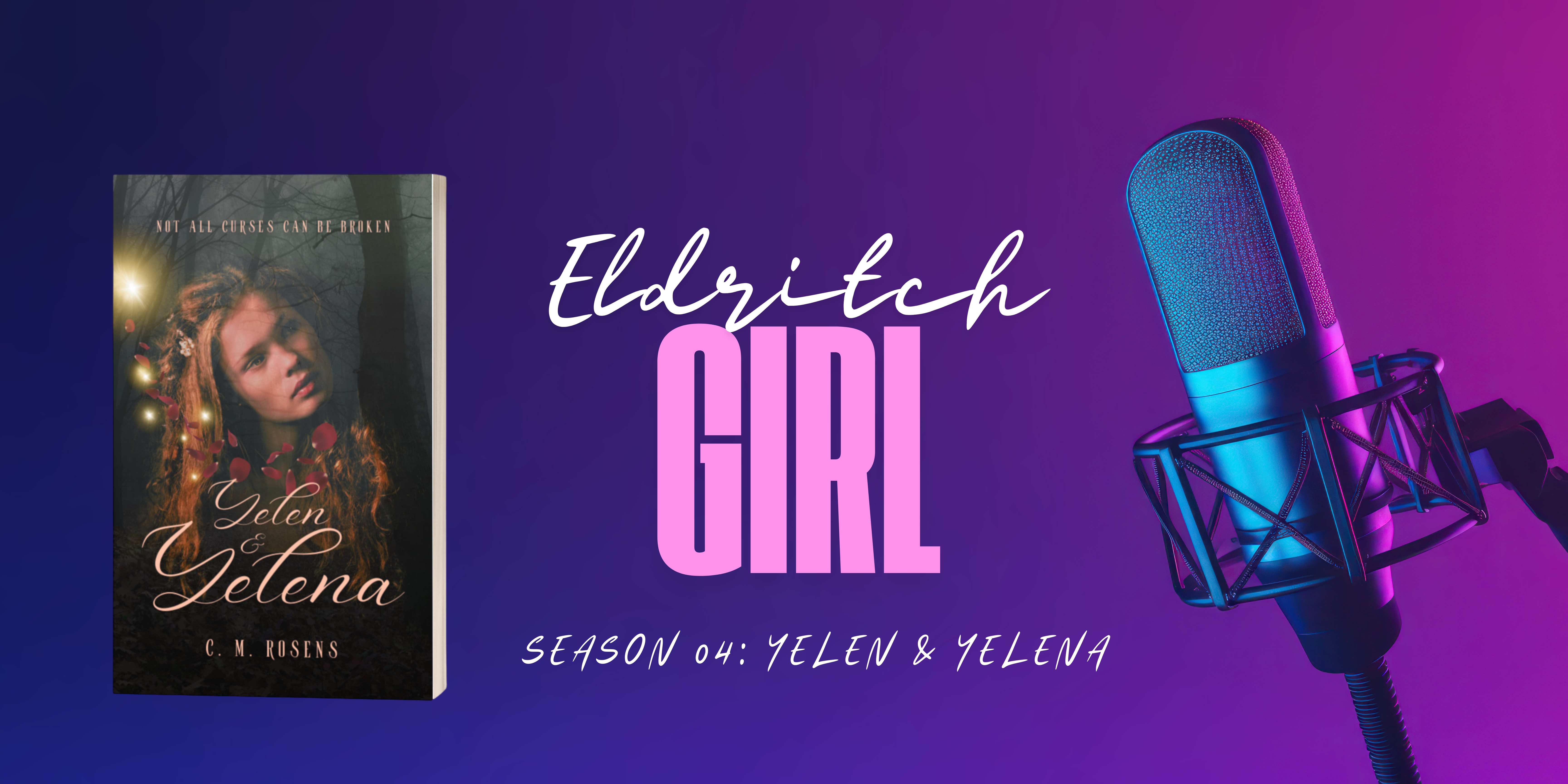
Today we’ve got two chapters for the price of one, and it’s an hour long.
You can download this episode as an mp3 file, and get early access to Chapters 5, 6 and 7 here: ko-fi.com/cmrosens/shop/audiobookfiles
Chapter 03: Last Orders and Chapter 04: Winds of Change complete Part 1 of the novel, and next time we’re into Part 2: The Castle, which is the majority of the book. My parts are not sectioned evenly by Acts, but separated by location or major theme.
In these two chapters, we get more of Yelena’s personal history, with a bit more of village life, and the folk religion in that region. If you want to just enjoy the novel, please do grab a copy and read along with the podcast. If you want to learn more about my worldbuilding and religion in Yelen & Yelena, you can nerd out with me below.
Religion in Yelen & Yelena
There are mainstream religions, and there are fringe cults, and there are various loose iterations of folk beliefs across the country (Ebronia, from Tére Epuroni, the land of the Epuron [people], which meant ‘free/not servile’ people in that tongue > Trepuronia > Treburonia > ‘Eburonia > Ebronia).
The main one that we’re concerned with is Decadianism, which is based around the Sacred Ten [the Decad, which means ‘ten’], who are less gods and more demigods, and formed from leftover magic as an unintended consequence of the dead gods’ atrocities.
The Sacred Ten/Decad act more like patron saints of various things, but don’t interfere in normal life very much – they are guardians of the ten afterlives, and how you die, not how you lived, determines which one you end up in.
There is no concept of “sin” in this religion, which theologically is the abstract concept of what separates you from the perfect Divine, and onto which is ascribed various actions and thoughts that constitute it in actuality.
In this worldview, there is no concept of sin.
Sin is a concept of separation from the Divine due to a perfect God being unable to look upon imperfection, but in this case, the Divine are apathetic to mortality and not that interested in the mortal, living realms. The dead gods, similar to the Sumerian gods in the Epic of Gilgamesh, were so annoyed at the prayers of the living that they sealed themselves away, making it harder and harder for prayers to reach them.
More on that later.
The Decad might listen to prayers, but it depends if someone else is present to carry that prayer to them on your behalf. If not, you’ll have to rely on the dead voices carried by the wind, and if nobody is present at your death to open the pathway to your afterlife by their prayers, you’ll join the wind forever.
There are spirits, of course, who do not feature in the Decad. They could be any number of things, and nobody is absolutely certain. Some say that the spirits simply aren’t real. Some say they are the ghosts of the dead gods. Some say they were always spirits, and always present in the world, and others are agnostic and just don’t think about it too much.
Erish is a spirit that is only recognised in the Provinces, and is… possibly a spirit, possibly the ghost of a dead god of pleasure, possibly a superstitious figment of people’s imaginations, but Yelena believes she might have seen Erish at the moment of sexual climax on a couple of occasions.
Erish worship is the giving and receiving of mutual pleasure, but this doesn’t mean mutual orgasm, as long as both parties are enjoying themselves throughout. Orgasms are encouraged during Erish worship, though, if that’s what one or both parties want, and these are thought of as ‘deaths’, because the aim is to reach a moment of oblivion through pleasure. Therefore, to be ‘slain by Erish’ is a euphemism for orgasm.
However, Erish has nothing to do with life after death, as the dead cannot typically feel pleasure anymore, as they are generally incorporeal. So for the purposes of the afterlife, Yelena is a Decadian.
Even so – I wouldn’t describe her as a mainstream Decadian, because of the Provincial belief in listening to the wind. This isn’t discussed in the book, but I think in other stories I’ll bring this in more – but listening to the dead on the wind is a rural practice and older survival, and not something that people do in urban spaces (it’s too loud, especially in industrial towns and cities). So urbanites have lost that part of their heritage, and many have lost the art and ability to understand what the wind is saying through lack of practice. They tend to look down on people who still do it.
Where Decadianism manifests in urban spaces, therefore, there is a different emphasis on prayer and communal practice than in the rural areas and places like the Provinces, which exist in the periphery and occupy a very unstable place in the understanding of the borders and national identity at this time. I think about the Provinces as being what the Scottish Borders were to Southern England throughout the medieval and early modern period, and also what Brittany or Picardy was to Parisian France, as dialects were being stamped out in favour of a unified, Parisian French.
The Provinces were royalist, so come under intense suspicion from the Oligarchy.
Due to the Counter-Revolution and other, smaller, pockets of unrest and protest starting in the Provinces, there is a lot of suspicion around Provincial folk religion and belief, and discourse around the “corruptive influences” of the spirits still worshipped there.
Urban Decadianism in this country has almost entirely stripped out spirits from its unofficial pantheons, unlike other countries that also practice forms of this religion and have retained their spirit-worship alongside the Sacred Ten, or exalt spirits to the same level. Rural Decadianism is almost considered a separate sect, and looked down on by the urbanites as ‘lesser’ or even subversive and concerning, or a sign that someone cannot be trusted.
These attitudes often prejudice employers and curb advancement of rural people – especially Provincials – in trade guilds and trading guilds. Rural migration to urban areas often simply increases the slum populations rather than works to the advancement of the rural people themselves – this is loosely modelled on experiences of the rural vs urban poor during the English Industrial Revolution, specifically.
I’m also drawing a lot on the distrust of Anglicans [in 17thC-19thC England, taking a big-picture view and zooming in on bits of English ecclesiastical and theological history I think would be most helpful to my world building] towards other Protestant sects, the attitudes around the Toleration Act (1689) and discourse of Dissenters vs Church of England, and those sorts of arguments, to create the conflict within Decadiansim and its fringe beliefs.
There is also the Fraternity – who are basically the Freemasons, but the symbology and cosmology and so on are geared towards mercantile interests rather than stonemason interests, and lean more into astrology and esoteric alchemy – and they’ve got a very strong foothold in the country too.
The Fraternity think of Decadianism through the lens of intense metaphor, and have exported some of their beliefs – like the belief in an additional afterlife of punishment for executed criminals – into mainstream Ebronian Decadianism. This is not a mainstream Decadian belief in other countries, or even in places within Epronia where the Fraternity is not as big of an influence (like the Provinces), even though it’s a belief they will have heard of.
I think I might explore the Fraternity and their relationship with Decadianism in my next story in this universe – AS BELOW, SO ABOVE, the alchemist novel/la. It won’t have much of a bearing on the actual plot, but it might come up in the world building and character interactions.
In future books, you might also see religious rites and rituals being performed. I’m not sure yet, as I have the basis for thousands of years of Decadianism, diverging and evolving as all religions do, incorporating folk beliefs and practices across the world for various reasons and spreading all over the place, but I only need to know the details of a few bits and pieces of it, and how it is practiced in the certain traditions and specific areas I’m writing about.
I think in some areas it may even have developed into monotheism, with the Sacred Ten representing ten aspects of the same deity. Some of the Decad could even double up as both a sacred aspect and a person who represented that sacred aspect, or who was thought to be an incarnation of the deity in one of their ten forms. They could also be demoted into saint-equivalents or servants or prophets around one of the Decad, and form a pyramid of ten figures with the main deity at the top, representing the journey to divinity and purification, or something. Spirit-belief could be continuing in some form alongside this. Even within a monotheistic interpretation of Decadianism, there are a multitude of interesting variants I can play with.
If I ever write a story with a character who is from a monotheist Decadian background, we’ll find out more then!
Music Credits:
Kevin MacLeod (incompetech.com) Licensed under Creative Commons: By Attribution 4.0 License creativecommons.org/licenses/by/4.0
Intro/Outro:
Quinn’s Dream: The Dance Begins
Kevin MacLeod pieces used in Ch 3 and 4:
Folk Round
Achaidh Cheide
Brandenburg Concerto
Leaving Home
Stages of Grief
Blue Feather
Sound Effects:
BBC Sound Effects Library
Floraphonic – Pixabay (monster roar)




Leave a Reply